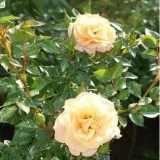
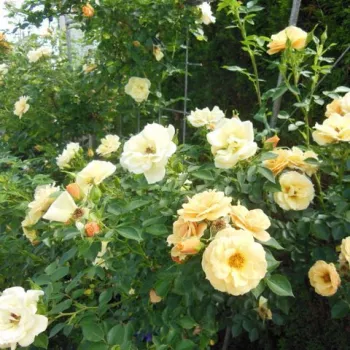
ZORBA™ – yellow climbing rose – Olesen & Olesen
Step out after the rain and let ZORBA™ frame your entrance with colour, grace and balance, its golden-yellow clusters softening to a creamy ombre that flatters brick, stone and painted façades alike. Bred for reliable structure on trellises and arches, this Courtyard® climber keeps its neat outline with good self-cleaning blooms, so there is little for you to do beyond occasional tying-in. Own-root plants establish steadily, building a long-lived framework that regenerates well and supports sustainable, rain-aware city gardens where heavy showers test planting and drainage. Over the first three seasons roots settle, then shoots extend, and by the third year you enjoy full ornamental impact from a rose that suits busy, design-conscious households.
Usage options
| Target area | Reasoning |
|---|
| London front-garden trellis beside the door |
Trained on a slim trellis, this medium-height climber frames a doorway without overwhelming a compact terrace frontage, its self-cleaning flowers keeping the approach smart with minimal deadheading for busy beginners. |
| Curtain of colour along a shared front boundary |
Planted at hedging distances, ZORBA™ forms a dense, glossy screen that softens fences and railings, giving a long flowering season of warm yellow clusters while remaining manageable to prune for family gardeners. |
| Rain-aware courtyard or side return planting |
The strong root system of own-root plants copes well where downpipes, paving and compacted soil focus moisture, partnering with improved drainage to create a resilient vertical accent for urban homeowners. |
| Statement pillar rose in a mixed front bed |
Used as a pillar, its 150–240 cm height draws the eye above perennials and herbs, adding long-season vertical interest while the medium maintenance level stays realistic for time-poor gardeners. |
| Large container by steps or balcony rail |
In a 40–50 litre peat-free container with regular watering, ZORBA™ gives structured greenery and repeat flowers where borders are impossible, ideal for paved approaches and compact balconies enjoyed by flat dwellers. |
| Soft backdrop for children’s play areas |
Moderate prickles and a trained, upright habit allow you to keep stems tied back on supports, providing colour and seasonal interest behind seating or play zones with sensible access management for young families. |
| Pollinator-supportive mixed planting strip |
Although only moderately attractive to insects, its open double blooms still offer some interest when combined with pollinator favourites such as lavender, sage or nepeta, creating a balanced wildlife corridor for eco-conscious gardeners. |
| Coastal-facing or wind-exposed front garden |
The dense foliage and climbing framework can be trained along stout supports to ride out blustery weather in exposed streets, helping structure city plots where wind and driving rain are regular features for sustainability-minded owners. |
Styling ideas
- Courtyard-Arch – Train ZORBA™ over a slim metal arch with underplanting of lavender and low nepeta to echo its soft yellow tones – ideal for small front gardens needing a gentle, fragrant gateway.
- Urban-Pillar – Use a single plant on a sturdy obelisk among grasses and salvias to create a vertical focal point that stays elegant without daily attention – perfect for style-led city homeowners.
- Rain-Garden-Frame – Position it by a downpipe rill with moisture-tolerant perennials, letting the climber add height while planting below slows and soaks rainwater – suited to sustainability-focused renovators.
- Brick-Softer – Soften bare brick or painted walls by fan-training ZORBA™ and edging the base with thyme and dwarf sage for texture and scent – a good choice for terrace fronts with hard surfaces.
- Balcony-Screen – In a 50 litre trough, combine this rose with trailing herbs and compact catmint to create a floral privacy screen – appealing to flat dwellers wanting calm greenery without complex care.
Technical cultivar profile
| Parameter | Data |
|---|
| Name and registration |
Climbing rose from the Courtyard® collection; registered as POULyc008, marketed as Zorba™ Courtyard®. Listed by the American Rose Society for exhibition under the name ‘Zorba’. |
| Origin and breeding |
Bred in Denmark in 1992 by L. Pernille and Mogens Nyegaard Olesen for Poulsen Roser A/S, from an unnamed seedling crossed with ‘Aspen’; commercial introduction followed after 2004. |
| Awards and recognition |
Awarded a Certificat de Mérite at Bagatelle, Paris in 2005, Honourable Approval at Hradec Králové in 2006, and a Recommendation Certificate at The Hague rose trials in 2007. |
| Growth and structural characteristics |
Medium climber reaching about 150–240 cm high and 70–120 cm wide, with a tidy climbing habit, dense dark green glossy foliage and moderate prickles; spent blooms fall cleanly without manual removal. |
| Flower morphology |
Freely produced double, cupped clusters with around 25–30 petals per bloom, small flower size yet generous trusses, repeating well with a notably strong second flush after the main flowering period. |
| Colour data and phenology |
Golden-yellow with peach tones, ARS YB; RHS 14B and 22B. Buds open vivid yellow, then soften through creamy yellow to near cream-white edges, giving a subtle ombré effect that changes attractively as blooms age. |
| Fragrance and aroma |
Mild, soft and elegant fragrance that suggests classic rose notes without being overpowering, making it suitable near doors or paths where a discreet scent is preferred over strong perfume. |
| Hip characteristics |
Produces orange ellipsoidal hips 10–15 mm across, appearing moderately where flowers are not deadheaded, adding late-season interest and a naturalistic touch in less formally maintained plantings. |
| Resistance and winter hardiness |
Rated RHS H7, hardy to around −21 to −18 °C and USDA zone 6b, with medium resistance to black spot, powdery mildew and rust; may occasionally require preventive care in humid, high-disease-pressure areas. |
| Horticultural recommendations |
Best in full sun with improved drainage and fertile soil; plant 140–150 cm apart in groups or 250 cm as a specimen, tying new shoots to supports and pruning lightly to maintain a balanced climbing framework. |
ZORBA™ Courtyard® offers long-season golden blooms, a compact, easy-to-manage climbing framework and the resilience of an own-root rose, making it a thoughtful choice for enduring structure in a family garden.