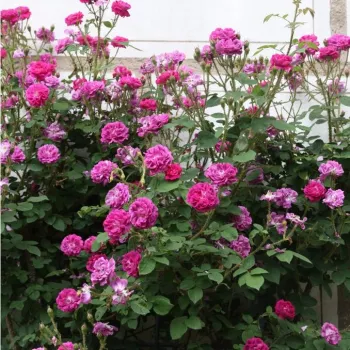
WILLIAM LOBB – deep purple historic moss rose - Laffay
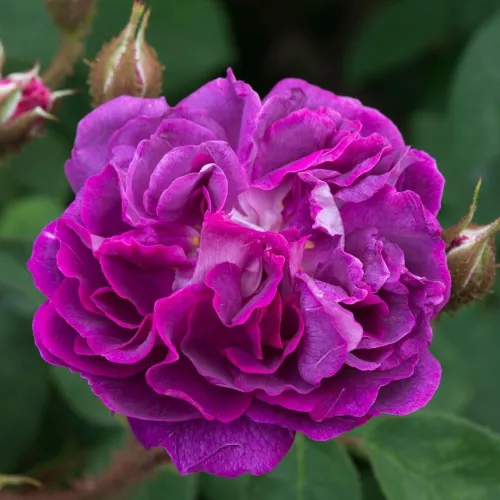
Step into the scented past with William Lobb, a richly perfumed historic moss rose that brings a sense of character and time-worn romance to even the smallest London front garden. Its arching, shrub-like presence and dramatic crimson-purple blooms create an instant focal point, while the mossy, aromatic buds offer tactile detail that rewards close-up viewing from a pavement or front step. Once established, this own-root shrub has a reassuringly long lifespan, building a deep root system that supports a generous early-summer flowering in typical UK conditions of changeable rainfall and cool breezes. In its first year it concentrates on roots, the second on framework, and by the third year it reaches full ornamental impact, settling naturally into a sustainable, rainwater-conscious planting for low-input garden owners.
Usage options
| Target area | Reasoning |
|---|
| Front garden focal shrub |
The tall, upright yet slightly arching habit and deep purple, rosette blooms give instant street-side presence, ideal beside a front gate or path where you can appreciate the fragrance on everyday comings and goings – a classic choice for the homeowner. |
| Heritage rose collection or specimen |
As an 1855 moss rose with Royal Horticultural Society Award of Garden Merit, this cultivar lends authenticity to period schemes, cottage-style borders and heritage collections, offering living history in a manageable shrub for the thoughtful collector. |
| Rainwater-aware, low-lawn front garden |
The deep root system on an own-root shrub helps anchor the plant in heavier soils where you direct roof run-off into planting beds instead of paving, supporting a more absorbent, climate-conscious front garden for the urban gardener. |
| Screening and informal hedge line |
Plant at 110 cm intervals to form a tall, flowering boundary; the dense prickliness and moderately full foliage provide gentle screening and a textured backdrop that softens fences while deterring access, suiting the privacy-minded family. |
| Mixed shrub and perennial border |
Use its once-a-year, dramatic early-summer display as a seasonal highlight among long-flowering perennials; the smoky colour transitions combine well with silvers and soft pastels, fitting the planner who enjoys layered succession planting. |
| Larger container on terrace or balcony |
In a minimum 40–50 litre container with free-draining, peat-free compost, it becomes a vertical accent for compact spaces, giving fragrance at nose height for seating areas and balcony railings, ideal for the space-conscious city dweller. |
| Partial-shade side return or alley |
Suitable for partial shade, it copes with those side-of-house positions that receive only part-day sun, still producing a satisfying flush of bloom where many roses struggle, reassuring for cautious, newer gardeners. |
| Long-term, own-root legacy planting |
As an own-root shrub it matures steadily, with year one focused on roots, year two on framework, and year three on full ornamental effect, giving a stable, regenerating feature for decades, appealing to sustainably minded rose enthusiasts. |
Styling ideas
- Victorian – Pair with lavender and sage along a front path, echoing nineteenth-century gardens while providing gentle scent layers – for lovers of period detail.
- Romantic – Underplant with nepeta and soft pink anemones to blur the shrub’s base and emphasise its arching form – for those seeking a dreamy, “girly” frontage.
- Coastal – Combine with hardy ornamental grasses in a free-draining bed that can handle wind and showers – for gardeners near breezy, exposed streets.
- Rainwise – Sink a gravelled swale in front and plant this rose on a slight mound to receive overflow from downpipes – for homeowners redesigning water-smart entrances.
- Cottage – Mix with coneflowers and airy annuals such as hare’s-ear to extend interest after the rose’s main flush – for relaxed, wildlife-aware family plots.
Technical cultivar profile
| Parameter | Data |
|---|
| Name and registration |
Historic moss shrub rose from the Heritage rose collection, traded as William Lobb and Laffay; unregistered variety with American Rose Society exhibition name listed as William Lobb. |
| Origin and breeding |
Bred by Jean Laffay in France and introduced in 1855, probably a seedling moss rose descendant of ‘Gloire des Mousseux’, with historical distribution through European rose nurseries. |
| Awards and recognition |
Holds the Royal Horticultural Society Award of Garden Merit, first granted in 1993, indicating proven garden performance, stable characteristics and value under average UK growing conditions. |
| Growth and structural characteristics |
Vigorous, upright to slightly arching shrub, 150–230 cm tall and 100–160 cm wide, with moderately dense, dark green foliage and heavy prickliness that provides textural stems and some deterrent effect. |
| Flower morphology |
Large, double rosette flowers, 26–39 petals, borne in clusters with a single, non-remontant main flush; spent blooms are slow to fall and benefit from deadheading to maintain a tidy appearance. |
| Colour data and phenology |
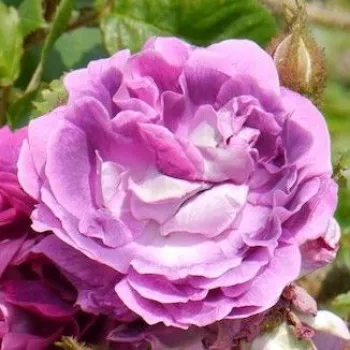
Closed buds are dark violet-purple; newly opened blooms are deep crimson-purple, then fade to smoky, greyish-lilac with silvery centres, especially in strong sun, giving complex colour shifts through the flowering period. |
| Fragrance and aroma |
Strong, rich, full-bodied fragrance that lingers well in still air, best appreciated at close range along paths or seating; classic old-rose scent characteristics suited to traditional garden atmospheres. |
| Hip characteristics |
Occasionally develops egg-shaped, red-orange hips, 14–22 mm in diameter, which add modest late-season interest and may be left for wildlife or removed during pruning, according to garden style. |
| Resistance and winter hardiness |
Fully hardy to about −32 to −29 °C (RHS H7, USDA 4b, Swedish zone 5); disease resistance moderate to weak, with susceptibility to rust and some powdery mildew and black spot in damp or crowded conditions. |
| Horticultural recommendations |
Best in open, well-drained soil with full sun to partial shade; allow space for mature height, use preventive care against fungal diseases, and plant 110–180 cm apart depending on hedge or specimen use. |
William Lobb offers atmospheric historic blooms, a rich long-lasting fragrance and enduring own-root structure; consider it if you wish to anchor a small garden with living heritage.