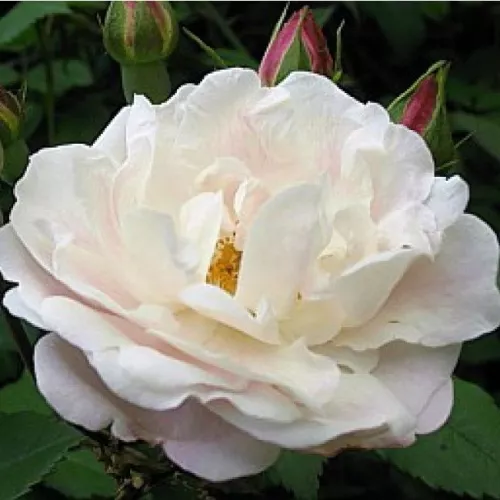
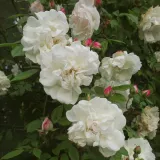
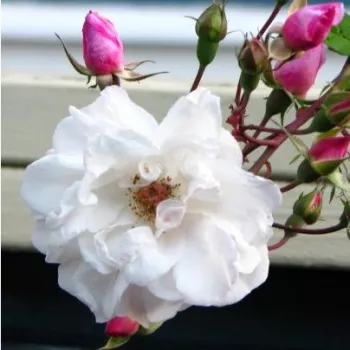
VENUSTA PENDULA – white historic rambling-climbing rambler rose
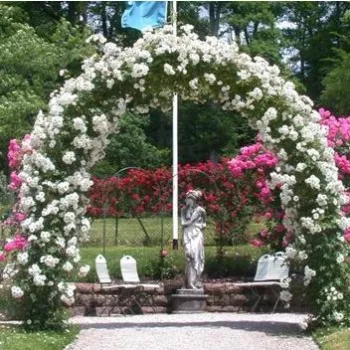
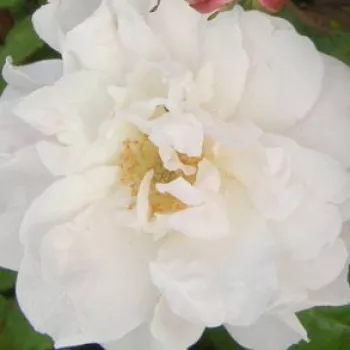
With its long, graceful canes and clouds of soft white blossom, VENUSTA PENDULA brings a sense of balance and timeless charm to compact London front gardens and family plots alike. This historic rambler flowers once, but in a breathtaking summer flush, its semi-double blooms opening from pastel buds into lightly scented, cup-shaped clusters that invite a slow walk along a narrow path in post-rain fragrance. Trained on an arch, fence or small tree, its pendulous shoots form romantic curtains of blossom while the own-root habit supports a long-lived, regenerating framework that settles in steadily over three seasons – roots in year one, structure in year two, full ornamental presence in year three. Moderately thorny yet manageable, and suited to partial shade, it works especially well where damp, heavier soils meet good drainage, coping reliably with breezy, rain-washed conditions near the coast. Once established, its self-cleaning flowers, moderate disease tolerance and modest pollinator interest make it an easy-going choice for a girly yet sustainable façade, particularly when you water with collected rain as part of a low-input, urban routine. Use it to soften railings, clothe a pergola or green an overlooked wall, and you gain a resilient living screen that matures year by year, anchoring a small-space planting in quietly romantic harmony with its surroundings.
Usage options
| Target area | Reasoning |
|---|
| Terraced-house front fence or railings |
The very long, flexible canes create a romantic veil of blossom over metal railings or low fencing, giving privacy without feeling heavy, and the self-cleaning flowers keep the pavement tidy with little intervention for the busy urban gardener |
| Rose arch over a narrow path |
Once established, VENUSTA PENDULA clothes an arch with pendulous clusters in a single, spectacular summer display, while its own-root vigour ensures the woody framework endures for many years with only light pruning needed for the low-maintenance homeowner |
| Pergola or walkway in a family garden |
Its long, climbing growth easily spans pergola beams, forming a dappled tunnel of white flowers that drops spent petals cleanly, so children can play underneath without snagging on dense thorns, suiting the family-focused gardener |
| Climbing into a small garden tree |
Traditional Ayrshire rambler character lets this rose scramble through a light-canopy tree, adding a floating layer of blossom without smothering the host, ideal for softening views in mature plots for the romantic traditionalist |
| Shadier side wall or north-east aspect |
This cultivar tolerates partial shade, still producing a generous once-a-year flush, so you can green up cooler, less-loved walls where other climbers struggle, bringing life and softness for the space-maximising city dweller |
| Rainwater-conscious front garden scheme |
Suited to rain-washed, breezier conditions, it partners well with permeable surfaces and rainwater butts, using collected water during dry spells while its moderate disease tolerance reduces chemical inputs for the sustainability-minded beginner |
| Historic cottage or period property façade |
The heritage character and softly tinted white flowers echo traditional cottage gardens, working beautifully against brick or stone while the once-flowering habit feels authentic to older styles, pleasing the heritage-leaning gardener |
| Long-term boundary or screen planting |
Given space and a sturdy support, the tall, spreading habit forms a long-lived living screen; being on its own roots, it can regenerate from the base if cut back, offering stable structure for the forward-planning garden owner |
Styling ideas
- Soft-arch romance – Train VENUSTA PENDULA over a narrow arch, underplant with lavender and nepeta to echo the pastel tones and fragrance – ideal for front-garden owners seeking a welcoming entrance.
- Tree-draped charm – Let the rambler weave through a small ornamental tree, with Knautia and Lychnis in the understorey for a meadowy, “girly” feel – suited to wildlife-aware family gardeners.
- Historic frontage – Pair against brick with blue globe thistles and sage for contrast between airy white blossom and architectural perennials – perfect for period-terrace residents.
- Rainwise pergola – Combine on a pergola with permeable gravel and rainwater-fed pots of nepeta beneath, keeping surfaces dry underfoot and inputs low – good for sustainability-focused urban planners.
- Shaded side escape – Use along a part-shaded side path, adding ferns and pale foxgloves to extend the cool, romantic mood – appealing to beginners who want atmosphere with little upkeep.
Technical cultivar profile
| Property | Data |
|---|
| Name and registration |
VENUSTA PENDULA is a historic Ayrshire rambler rose grown as a climbing rambler; it is unregistered, traded under the heritage name Venusta Pendula and supplied here as an own-root plant. |
| Origin and breeding |
Believed to derive from Rosa arvensis crossed with an unknown parent, introduced in 1928 via W. Kordes’ Söhne in Germany; an older selection, often dated to the late nineteenth century. |
| Growth and structural characteristics |
Very vigorous rambler with climbing, pendulous canes reaching about 4.7–6.9 m high and 2.1–3.3 m spread; moderately thorny, with medium-dense, matt, bluish-green foliage forming a graceful arching framework. |
| Flower morphology |
Semi-double, cup-shaped, medium-sized flowers in sizeable clusters, bearing around 13–25 petals; blooms once per season in a profuse flush, with good natural self-cleaning as petals fall away after flowering. |
| Colour data and phenology |
Soft pastel pink buds open to very pale, silky pink with creamy white edges, quickly appearing bone-white with a faint blush; colour fades faster in strong sun, creating a gentle, light-reflecting effect in the garden. |
| Fragrance and aroma |
Lightly and pleasantly scented with a mild, subtly musky character; not overpowering but noticeable at close range around arches, pergolas or paths during the main flowering period. |
| Hip characteristics |
Rose hips are usually sparse, but when formed they are spherical, red, about 15–22 mm across; they add a discreet seasonal accent without dominating the plant’s overall appearance. |
| Resistance and winter hardiness |
Moderate tolerance of heat and drought, needing watering in extended dry spells; disease resistance to mildew, black spot and rust is moderate, with good hardiness to around −21 to −18 °C (RHS H7 rating). |
| Horticultural recommendations |
Best on strong supports such as arches, fences or pergolas, or trained into trees; plant about 2.3 m apart for mass, 2.15 m for hedging, 3.5 m as specimens, in well-drained soil with regular watering in dry periods. |
VENUSTA PENDULA offers romantic once-a-year blossom, impressive height for arches and pergolas, and long-term regenerating strength from its own-root form, making it a considered choice for gardeners planning structure and charm over time.