SUPER EXCELSA – crimson-red climbing rambler rose - Hetzel
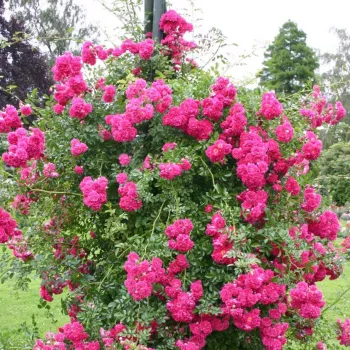
On a compact London front garden wall or balcony arch, Super Excelsa creates a curtain of small, crimson-red blooms, ideal where rain-laden winds and heavier soils demand resilient planting that copes gracefully with wet weather. This once-flowering rambler turns early summer into a single, spectacular display, with dense, glossy foliage and natural clusters that minimise fiddly shaping. Trained along a fence, pergola or rainwater-fed arch, it offers stable, long-term structure, while own-root plants quietly regenerate from below, supporting a long garden lifespan with minimal intervention. In an average family garden you simply plant, guide the main shoots, then watch roots settle in the first year, framework build in the second, and full ornamental value arrive by the third.
Usage options
| Target area |
Reasoning |
| Front-garden house wall or terrace façade |
Use as a vertical accent that leaves precious ground space free in a small urban front garden. Once-flowering clusters create a concentrated early-summer show, then the dark leaves give quiet structure for the rest of the year, ideal for beginners. |
| Pergola or arch over a narrow path |
Train the long, flexible canes over an arch to form an immersive tunnel of colour for a few weeks each summer. The semi-double flowers appear in abundant clusters, then self-clean moderately, so you only tidy when convenient, suiting busy-owners. |
| Rainwater-friendly, low-lawn front garden |
Plant into a mulched, free-draining bed fed by a downpipe, where its vigorous climbing habit turns vertical surfaces into sponges of green and flower while the soil below handles heavy rainfall and patchy drainage, well matched to city-gardeners. |
| Family seating area backdrop |
Use as a flowering screen behind a bench or patio set, where the dense foliage gives privacy and the flowers offer gentle, barely-there fragrance that will not dominate eating areas. Once flowering means little deadheading, easy for families. |
| Partially shaded side return or alley |
Suitable for positions with a few hours of sun or dappled light, where many roses struggle. Super Excelsa tolerates partial shade, still giving strong colour on fences or walls along side paths, rewarding less-than-ideal spots for town-dwellers. |
| Large container on balcony or roof terrace |
In a minimum 40–50 litre container with sturdy support, this climber brings cottage-garden charm to hard surfaces. Own-root vigour and medium maintenance needs mean an occasional feed, water and tie-in routine that fits time-poor. |
| Pollinator-supporting vertical accent |
The semi-double blooms provide accessible centres that moderately attract bees and other beneficial insects during the main flush, extending ecological value upwards where ground space is tight, an appealing choice for wildlife-lovers. |
| Durable coastal or exposed garden feature |
With hardy, flexible canes and medium disease resistance, this climber copes with blustery, rain-driven conditions and variable summer warmth, performing reliably where more delicate varieties fail, reassuring for practical-gardeners. |
Styling ideas
- Romantic-arch – Drape Super Excelsa over a slim metal arch, underplant with lavender and nepeta for soft lilac froth and bees, perfect for couples turning a small front path into a gentle, scented threshold – ideal for urban nesters.
- Colour-contrast – Train along a fence behind pale pink shrub roses and silvery sage, so the crimson-red clusters pop without overwhelming the space – suited to design-conscious homeowners who like bold yet balanced planting.
- Cottage-ribbon – Pair with catmint and low geraniums at the base of a house wall, allowing the climber to rise in a loose column of colour above a hazy blue carpet – attractive to beginners wanting an easy cottage feel.
- Evening-backdrop – Use as a dark-leaved screen behind a small terrace, with pots of white gaura and soft grasses in front, so the crimson flowers glow at dusk – good for busy professionals enjoying the garden after work.
- Wild-edge – Let Super Excelsa ramble over an obelisk near lilac and dogwood, where hips and seasonal colour shifts blend into a more naturalistic corner – appealing to wildlife-friendly gardeners seeking a semi-informal look.
Technical cultivar profile
| Property |
Data |
| Name and registration |
Climbing rambler rose, registered as HELexa, marketed as Super Excelsa climbing rose HELexa; ARS exhibition name Super Excelsa; part of the climbing rose collection for walls and supports. |
| Origin and breeding |
Bred by Karl Hetzel, Germany, from ‘Excelsa’ × unknown pollen; introduced in 1986 as a higher-performing evolution of Excelsa, combining traditional rambler charm with improved garden reliability. |
| Awards and recognition |
Holds the Royal Horticultural Society Award of Garden Merit, indicating dependable garden performance, consistent flowering and sound health under typical UK conditions when grown with reasonable care. |
| Growth and structural characteristics |
Climbing rambler with 220–340 cm height and 190–310 cm spread, dense dark green glossy foliage and moderately thorny canes; best trained and tied to walls, fences, arches, pergolas or tall obelisks. |
| Flower morphology |
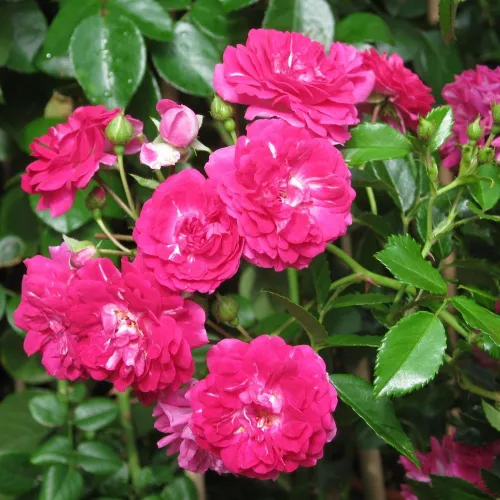
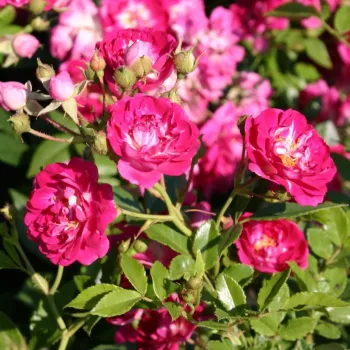
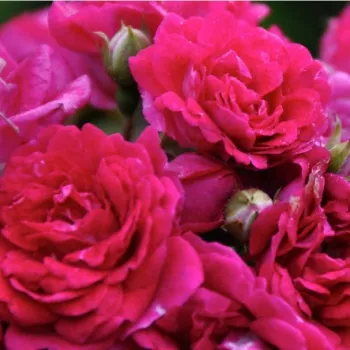
Semi-double, cup-shaped, cluster-flowering blooms, 0.5–1.5 inches across, with 13–25 petals; non-remontant, giving one main, dramatic flowering period per season, followed by gradual self-cleaning of spent blooms. |
| Colour data and phenology |
Crimson-red flowers with a narrow white centre; buds dark crimson-red, opening vivid, then lightening towards magenta-red tones in strong sun, with a creamy centre as they age, creating lively, multi-tonal clusters. |
| Fragrance and aroma |
Delicate, very weak fragrance with a soft, unobtrusive character; chosen more for visual impact and structural presence than scent, suiting seating and dining areas where strong rose perfume is not desired. |
| Hip characteristics |
Occasional spherical orange-red hips, about 6–10 mm diameter, following flowering; add small-scale seasonal interest and gentle wildlife value without becoming dominant or messy on well-sited plants. |
| Resistance and winter hardiness |
Rated RHS H7, hardy to approximately –29 to –32 °C; medium resistance to powdery mildew, black spot and rust, and moderate heat and drought tolerance with watering needed during extended dry periods. |
| Horticultural recommendations |
Use for walls, fences, pergolas, arches and obelisks; plant 230–240 cm apart in hedges or groups, 400 cm as a specimen; grows in full sun or partial shade, in fertile, well-drained soil with support. |
SUPER EXCELSA offers a concentrated summer curtain of crimson-red flower clusters, reliable hardiness and long-term own-root resilience for walls and arches, making it a thoughtful choice if you prefer strong impact with modest ongoing care.