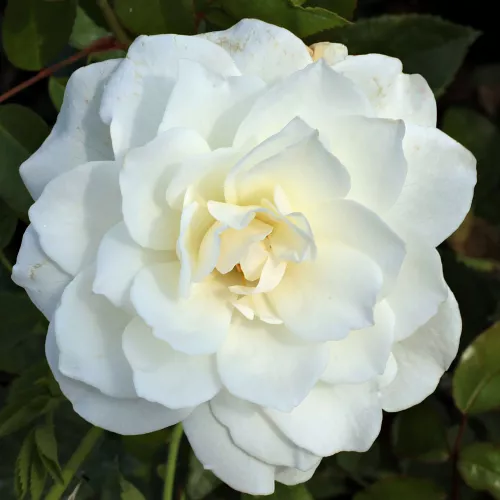
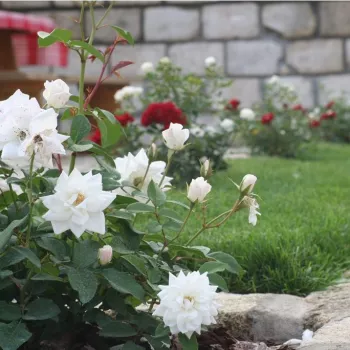
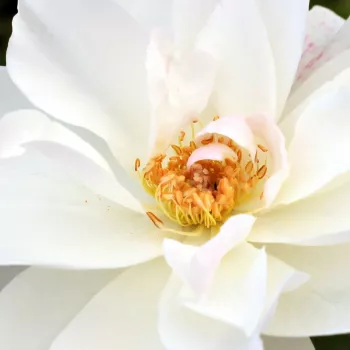
Radiant, uniform shade of white. - park rose - mild, restrained-scented rose - sweet-scented
– Iconic snowy-white blooms in large clusters.
– Long flowering season with strong repeat flush.
– Reliable garden performance with medium disease resistance.
– Hardy shrub rose tolerating cold to RHS H7.
– Versatile for beds, hedges and urban planting.
– Special feature: Decorated with top awards including World Favourite Rose and RHS Award of Garden Merit.
Tranquil garden experience – Season‑spanning
eleanorROSE® ORIGINAL 2-litre own-root potted rose
21,00 £
Unfortunately, we are currently unable to ship to the United Kingdom; we only deliver to countries within the European Union. For more information, please contact us!
5(9125)
SCHNEEWITTCHEN® – white park rose - Kordes
Step out after rain and this classic white rose brings a sense of balance and calm to even the smallest front garden, its bushy, upright habit forming a gently shimmering backdrop that copes well with blustery, rain‑laden British weather in exposed, coastal streets. SCHNEEWITTCHEN® settles in steadily as an own-root shrub, building a long‑lived framework that you simply prune and enjoy, rather than replace. Clusters of immaculate, cup‑shaped blooms keep returning from early summer to autumn, creating a season‑spanning show with minimal deadheading thanks to good self‑cleaning. Its sparse thorns make trimming and tying in easier for busy urban gardeners, while moderate size suits narrow beds, town frontages and larger containers. Over time, roots establish in year one, shoots fill out in year two, and by year three you enjoy its full ornamental lifespan with reliably floribunda displays. Combine with silver grasses and dusky perennials for a softly textural, “girly” London terrace look that still feels quietly sustainable.
Schneewittchen® park rose in full bloom
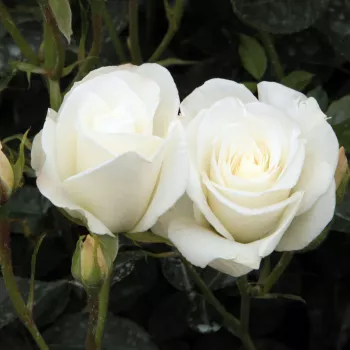
Schneewittchen® in closed bud, showing the pale greenish-white base and creamy-white tip.
Usage options
Target area
Reasoning
Small London front garden bed
The compact, bushy habit (around 100–150 cm tall) fits narrow street‑side borders, giving a long white flowering season that brightens brick and paving with little pruning beyond an annual tidy, ideal for a time‑poor beginner.
Low, airy flowering hedge
Planted at about 90–100 cm spacing, its upright, well‑branched framework knits into a semi‑transparent hedge, and own‑root plants recover well from harder pruning, suiting the needs of a family‑home gardener.
Rain‑aware front garden design
The fibrous own‑root system gradually builds depth in heavier soils, working well with permeable gravel or planting pockets so surface water drains more gently, reassuring the urban, sustainability‑minded homeowner.
Mixed white and pastel flower bed
Its self‑cleaning clusters keep borders looking fresh without constant deadheading, while the restrained fragrance adds subtle charm close to paths, reducing routine tasks for a busy city‑living couple.
Large container on balcony or patio
In a 40–50 litre peat‑free container, its moderate height and dense foliage create structure without overwhelming the space, and own‑root resilience helps it cope with pot life, reassuring the space‑conscious balcony‑owner.
Clay or chalky family garden borders
Once established, its strong shrub framework and medium disease resistance give reliable flowering even where soils are heavier or more alkaline, fitting the needs of a typical UK family‑garden owner.
Part‑shade side return or north‑east aspect
Tolerance of partial shade allows planting where sun is limited, still producing repeat clusters of white bloom to lift side paths and gateways, useful for a terrace‑house resident.
Wind‑exposed coastal plot
The sturdy, upright growth and dense foliage hold their form in blustery weather, supporting flower clusters without excessive staking even in damper, wind‑prone districts near the sea, encouraging the practical planner.
Styling ideas
Soft-hedge elegance – Run SCHNEEWITTCHEN® along a low front boundary with Stipa tenuissima ‘Pony Tails’ and clipped box balls for movement and structure – ideal for townhouse owners seeking calm formality.
Snowy-cottage mix – Blend with pale pink Monarda and lavender in a loose cottage‑style bed so the white clusters glow at dusk – perfect for romantic gardeners wanting a “girly” yet easy border.
Rainwise-gravel strip – Set in a gravelly, free‑draining strip with nepeta and thyme, letting rain soak away between plants while the white blooms add order – suited to sustainability‑focused front‑garden renovators.
Container-parlour rose – Grow one shrub in a 50 litre pot with trailing ivy and dwarf sage to frame a doorstep with long‑season bloom – appealing to balcony and doorstep gardeners with limited soil.
White-moon border – Combine with Liatris ‘Kobold’, silver foliage artemisia and soft grasses for a night‑light border that shimmers after rain – for design‑minded homeowners who favour restrained palettes.
Technical cultivar profile
Characteristic
Data
Name and registration
SCHNEEWITTCHEN® – white park rose - Kordes, shrub rose (park rose group); floribunda shrub type for beds and cutting; registered cultivar name KORbin; also known as ‘Iceberg’ in exhibition use.
Origin and breeding
Bred by Reimer Kordes, W. Kordes’ Söhne, Germany; cross of ‘Robin Hood’ × ‘Virgo’; introduced in 1958 and widely distributed as a reliable white shrub and landscape rose internationally.
Awards and recognition
Highly decorated classic: Baden-Baden Gold Medal and RNRS Gold Medal (1958); ADR rose (1960, later withdrawn); RHS Award of Garden Merit; World Federation “World Favourite Rose” and Hall of Fame inductee.
Growth and structural characteristics
Bushy, upright shrub to around 100–150 cm tall and 80–120 cm wide, with dense mid‑green glossy foliage and relatively sparse prickles; good framework for hedging, beds and specimen planting in small gardens.
Flower morphology
Double, cup‑shaped blooms with roughly 26–39 petals, carried in clusters on branching stems; large‑flowered floribunda character with remontant habit and abundant repeat flushes from early summer into autumn.
Colour data and phenology
Radiant, pure white flowers, sometimes faintly creamy at the centre and lightly pink‑tinted in cool weather; colour holds reasonably well, though hot spells may brown petal edges; blooms open continuously in warm seasons.
Fragrance and aroma
Mild, sweet classic rose scent, noticeable at close range without overwhelming nearby seating; best appreciated on still, humid evenings when clusters are fully open along paths and in enclosed garden spaces.
Hip characteristics
Hip set is generally sparse due to double flowers; where formed, hips are small, 7–10 mm, spherical and orange‑red, adding a discreet late‑season accent without significantly affecting flowering performance.
Resistance and winter hardiness
Hardy to about −29 to −26 °C (RHS H7; USDA 5a; Swedish zone 4); average disease resistance overall, with good black spot resistance but medium susceptibility to mildew and rust, sometimes needing preventive care.
Horticultural recommendations
Best in fertile, well‑drained soil with regular watering during dry spells; suitable for full sun or partial shade; protect new growth from late spring frosts and prune moderately to renew flowering wood each year.
SCHNEEWITTCHEN® – white park rose - Kordes offers long-season white floribunda bloom, a manageable shrub form and resilient own-root longevity; a thoughtful choice for those planning a relaxed, enduring garden feature.
Detailed product attributes
Product Identification Data
Product Name:
SCHNEEWITTCHEN® – white park rose - Kordes
Product Type:
eleanorROSE® ORIGINAL - 2-litre own-root potted rose
Competition and Show Awards:
Baden-Baden – Gold Medal (1958); RHS Award of Garden Merit (1993, confirmed 2012); RNRS – Gold Medal (1958); World Federation of Rose Societies – "World Favourite Rose" (1983), Hall of Fame
Hip Comment:
Hip formation is expected to be limited due to the double flowers; occasionally formed, 7–10 mm in diameter, globular, orange-red (RHS N34A) hips.
Our product is a rose grown with pharmaROSA®’s unique cultivation technology!
2-litre, own-root, potted rose.
With a shoot system appropriate to the season.
With a root system that thoroughly permeates the growing medium.
Quality compliant with the requirements of the E.N.A. (European Nurserystock Association).
Supplied in unique packaging that prevents damage.
Can be planted during frost-free periods.
True-to-variety rose bush with a unique identifier.
The pharmaROSA® own-root potted rose is a well-rooted plant that supports reliable establishment when planted and cared for properly, so it can be planted whenever the soil is not frozen.
Crop overview: several varieties and growth stages in a short crop section.Shoot system: intensive growth of fresh basal shoots on a young plant.Root system: demonstration of a vigorous root system permeating the growing medium, by removing the pot.Balance: mature plant with root system and shoots in harmony with each other.
Information about the videos
The video series is not a “seasonal showcase”; it illustrates the essence of pharmaROSA® own-root cultivation in a tangible way: how the plant is built up, what the root system is like and how the shoot system regenerates. The recordings were therefore made at different times and with plants at various stages of development, so mixed foliage levels and differing stages of growth may appear in the videos. They are not a ‘sample’ of the batch dispatched, but a visual explanation of how the technology works. The current condition of the rose available to order — typical for the given period and similar to what you can expect to receive in the parcel — is shown in the upper part of the product page.
Pages for private customers Garden roses for the family garden, with minimal care → ORIGINAL® Premium garden roses – instant impact, a truly showpiece garden → EXTRA® Pages for professionals and private customers Roses for public spaces – large areas, sustainable maintenance → NATURAL® Roses for projects – hedge and row planting, fast implementation → RAPID® For professional partners only Production – propagation material for garden roses, wholesale → NEONATAL®
Company details
PharmaRosa Ltd. Company registration number: 01-09-717479 VAT number: 13075314-2-43 Plant health registration no.: HU130721 Bank account (IBAN): HU85117631891388688400000000 BIC (SWIFT): OTPVHUHB Bank name: OTP Bank Nyrt.