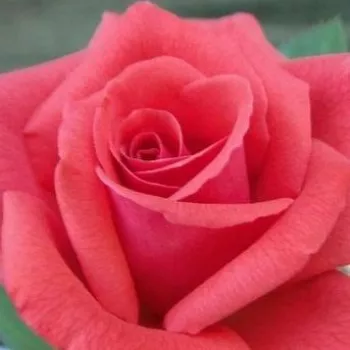
ROSALYNN CARTER™ – coral-red bedding grandiflora rose – de Ruiter
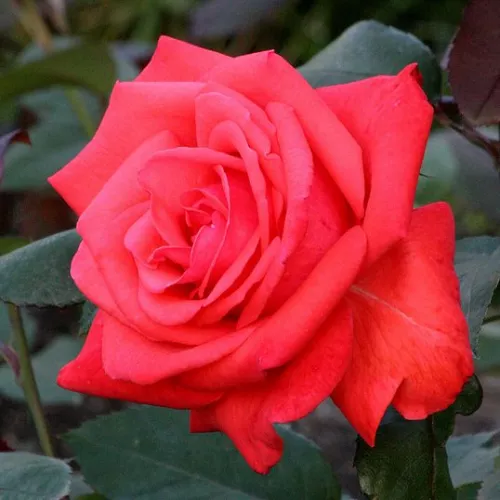
Step out after rain into a front garden that feels quietly composed, as coral blooms rise above neat foliage and reflect a sense of steady balance. This grandiflora bedding rose is bred for longevity, forming a sturdy own-root shrub that matures reliably in typical British family gardens, even where wind and showers are frequent in the growing season. Large, goblet-shaped flowers repeat generously from early summer onwards, bringing strong, warm fragrance that suits narrow London front gardens or compact beds. The own-root form offers dependable regrowth after pruning or weather damage, helping the plant settle in for the long term with minimal intervention as it follows a natural rhythm of root-building, then shoot expansion, before reaching full ornamental impact by the third summer.
Usage options
| Target area | Reasoning |
|---|
| Front garden bedding strip |
The upright, bushy habit and medium height make an ordered, easy-to-manage line along a front path or boundary, while strong colour reads clearly from the pavement for everyday kerb appeal – ideal for the busy homeowner. |
| Feature rose in a small mixed border |
Its extra-large, double goblet blooms stand out against perennials and grasses without overwhelming a modest space, giving a single focal point that looks deliberate rather than fussy – reassuring for the first-time gardener. |
| Repeat-flowering backbone in family beds |
Reliable remontant flowering delivers an early flush and a generous second wave, so beds never look bare after June and there is less pressure to keep replanting gaps – appealing to the time-poor family. |
| Cutting patch near the house |
Strong stems and large, elegantly formed blooms suit informal home-arranged vases, with the warm spicy scent noticeable indoors without needing expert conditioning – attractive for the home bouquet lover. |
| Urban rain-friendly front garden |
Works well combined with permeable gravel, low perennials and a simple planting grid, helping create structure while soil left open between plants can manage rainfall better in exposed, showery streets – useful for the sustainability-minded resident. |
| Low informal hedge or path edging |
Planted in a row at the recommended spacing, it forms a loosely continuous band of colour that guides movement without the clipping demands of traditional hedging, supporting relaxed spaces for the low-maintenance gardener. |
| Coastal or wind-exposed beds |
Medium height and sturdy, upright growth mean less flopping in blustery conditions and the shrub keeps its shape, so planting stays neat even where frequent showers and breezes are part of the growing season – helpful for the coastal household. |
| Large container on patio or balcony |
In a 40–50 litre peat-free container, roots have space to stabilise and support repeat flowering, providing a long-lived, movable feature that suits paved frontages and small patios with limited planting pockets – ideal for the urban balcony owner. |
Styling ideas
- Soft-edge border – Combine with Alchemilla mollis and low ornamental grasses to soften a front path while the rose provides height and long-season colour – suited to relaxed family gardens.
- Coral-focus scheme – Pair with Physostegia virginiana ‘Rosea’ and pale pink perennials so the warm coral-red flowers act as the central accent – ideal for romantically inclined city gardeners.
- Structured modern – Plant in a simple grid with gravel mulch and clipped evergreen shapes, letting the upright rose add colour and scent without complicating maintenance – good for design-conscious homeowners.
- Cutting corner – Group three plants with verbena and airy seed heads close to the back door to create a convenient source of scented stems – perfect for those who enjoy arranging homegrown flowers.
- Balcony statement – One plant in a generous container with trailing nepeta or thyme at the base gives vertical interest and fragrance in very limited space – aimed at compact urban balcony spaces.
Technical cultivar profile
| Trait | Data |
|---|
| Name and registration |
Grandiflora bedding rose registered as ‘Prins Claus, Ruprins’, marketed as ROSALYNN CARTER™; ARS exhibition name ‘Rosalynn Carter’; part of the bedding rose collection for garden and cutting use. |
| Origin and breeding |
Bred by Gerrit de Ruiter before 1972 in the Netherlands from complex ‘Queen Elizabeth’, ‘Scania’ and ‘Mischief’ parentage; introduced 1978 by De Ruiter Innovations with early distribution via Conard-Pyle and Star Roses. |
| Growth and structural characteristics |
Upright, bushy shrub to around 85–115 cm high and 70–95 cm wide with moderately thorny stems and medium-density, mid-green, slightly glossy foliage providing a tidy, structural presence in beds. |
| Flower morphology |
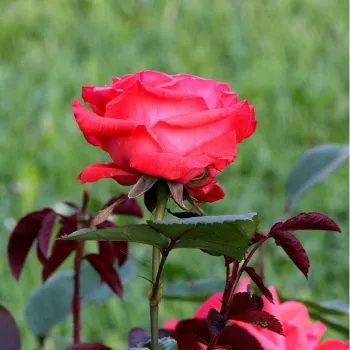
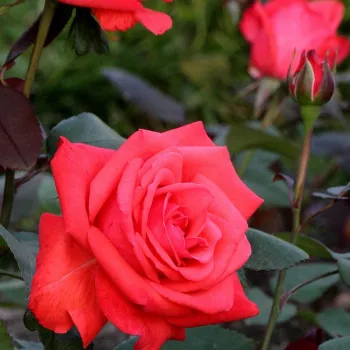
Extra-large, double, goblet to chalice-shaped blooms with 26–39 petals, typically borne singly on stems; remontant habit with a generous second flush, suitable both for bedding display and for cutting. |
| Colour data and phenology |
Bright coral-red with subtle orange undertones; deep coral-red on opening, then maturing towards a brick-coral shade with streaked, paler outer petals, giving a nuanced colour range over the life of each bloom. |
| Fragrance and aroma |
Strong, distinctly fragrant rose with a warm, spicy character noticeable outdoors and indoors; suitable for those seeking a scented feature rose rather than a purely visual bedding or landscape variety. |
| Hip characteristics |
Hip set generally low because of the double blooms; when present, produces small spherical orange-red hips about 10–14 mm across, adding occasional late-season interest without significant self-seeding. |
| Resistance and winter hardiness |
Classified to about -21 to -18 °C (RHS H7, USDA 6b, Swedish Zone 3) with medium overall disease resistance, showing good tolerance to powdery mildew and black spot, and moderate vulnerability to rust. |
| Horticultural recommendations |
Best in sunny positions with reasonably drained soil; spacing from 50–90 cm depending on use, at densities around 3.2–3.7 plants/m², with medium maintenance needs and occasional plant protection as required. |
ROSALYNN CARTER™ offers large, scented coral-red flowers on a reliable, repeat-flowering shrub whose own-root form supports long-term structure and steady regrowth, making it a thoughtful choice for enduring, low-fuss planting.