REINE DES VIOLETTES – purple historic perpetual-flowering hybrid rose - Mallet
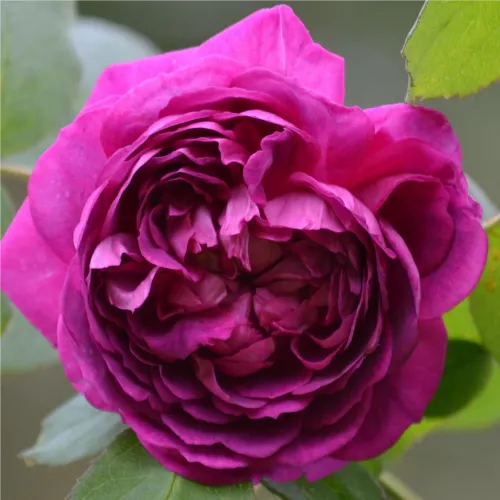
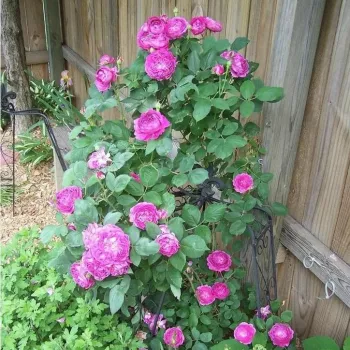
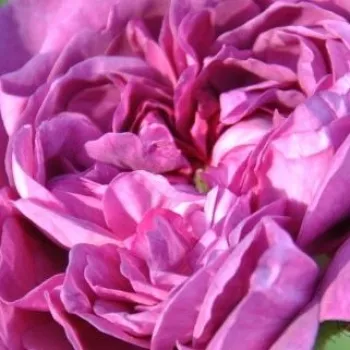
Step through your front gate and into a garden of heritage charm with REINE DES VIOLETTES, a nearly thornless hybrid perpetual that suits compact London terraces and relaxed family plots alike, even where heavy rain and wind regularly sweep through. Its velvety, purple rosette blooms and romantic, violet-sweet fragrance appear in generous flushes from early summer with an abundant repeat, so you enjoy that “after-the-rain” mood again and again with only moderate care. Own-root growth offers reassuring longevity, quietly rebuilding after pruning or weather damage to keep the shrub balanced and graceful over many years, while the upright, arching habit makes it ideal as a scented screen or specimen by the front door. Partial-shade tolerance lets you plant confidently against a north- or east-facing wall, and the almost thornless stems are kinder to children’s shortcuts and quick cut-flower snips. In its first year it focuses on roots, the second brings strong new shoots, and by the third year you see its full ornamental presence as a deep, romantic anchor in a sustainable, rainwater-friendly garden scene.
Usage options
| Target area |
Reasoning |
| Small front garden feature shrub |
The tall, upright yet arching habit and velvety purple rosettes give immediate character to modest front gardens without demanding complex pruning, making it ideal beside a path or doorway for beginners. |
| Low-maintenance heritage statement |
As an own-root historical rose with the RHS Award of Garden Merit, it combines time-tested reliability with steady regrowth after pruning or winter damage, supporting a long-lived planting plan for urbanites. |
| Partial-shade side return or north-east wall |
Good performance in partial shade and moderate heat tolerance mean it holds colour and form where many modern roses sulk, brightening narrow, overlooked side passages for busy homeowners. |
| Informal, almost thornless family walkway |
The almost thornless canes and moderate foliage density reduce snagging and scratches along narrow paths, offering a safer, softer option where children brush past plants for safety-conscious families. |
| Romantic cut-flower supply |
Large, very double, strongly scented blooms on long stems lend themselves to cutting for the house, giving a repeat supply of nostalgic, violet-rose fragrance with minimal specialist technique for relaxed hobbyists. |
| Rainwater-conscious clay or coastal garden |
Once established, its robust shrub structure and moderate disease resistance cope well with cool, breezy plots, provided drainage is improved on clay, fitting weather-exposed gardens for practical gardeners. |
| Own-root long-term hedge or screen |
Planted at hedge spacing, it builds a tall, scented screen that slowly thickens over the years; own-root resilience helps it recover evenly from harder trims, appealing to forward-planning planners. |
| Large container on balcony or paved front |
In a 40–50 litre peat-free container with regular watering, its upright habit and repeat flowering bring historic charm to paved or balcony spaces, offering character without ground digging for space-limited renters. |
Styling ideas
- Victorian-porch – Train REINE DES VIOLETTES loosely around a porch or rail with terracotta pots of lavender beneath, creating an easy-care, heritage welcome – ideal for period-terrace admirers.
- Gentle-screen – Plant as a scented hedge along a front boundary, underplanted with airy Coreopsis for a soft, semi-formal screen – suited to privacy-seeking families.
- Twilight-nook – Use in a part-shaded corner with silvery sage and nepeta, where the violet blooms and strong perfume stand out in evening light – perfect for after-work relaxers.
- Clay-courtyard – In improved clay beds beside a paved seating area, combine with ornamental grasses for movement and colour that copes with wind and showers – good for low-fuss homeowners.
- Balcony-bouquet – Grow one plant in a 50-litre container with chives and trailing thyme for scented, cuttable stems close to the kitchen – appealing to compact-living gardeners.
Technical cultivar profile
| Parameter |
Data |
| Name and registration |
Hybrid Perpetual, historical rose; trade name REINE DES VIOLETTES Heritage rose Mallet, ARS exhibition name Reine des Violettes; unregistered cultivar in formal registers. |
| Origin and breeding |
Originated in France around 1860, breeder Mille-Mallet; parentage recorded as ‘Pope Pius IX’ own-root, reflecting nineteenth-century hybrid perpetual selection practices. |
| Awards and recognition |
Holds the Royal Horticultural Society Award of Garden Merit, indicating dependable garden performance, robust constitution and ornamental value under typical UK growing conditions. |
| Growth and structural characteristics |
Strong upright shrub 150–220 cm tall, 120–200 cm wide, with arching, downward-bending shoots; foliage moderately dense, grey-green and slightly glaucous; produces many new upright stems. |
| Flower morphology |
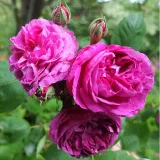
Large blooms (about 7–10 cm), very double with 40+ petals, rosette-shaped and often borne in clusters; remontant with a generous second flush, but spent flowers benefit from manual deadheading. |
| Colour data and phenology |
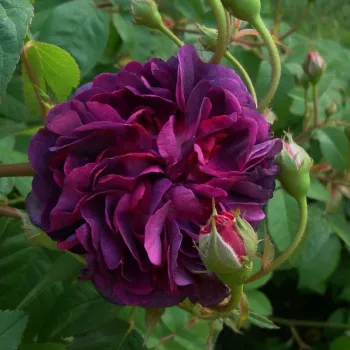
Deep velvety violet-purple with rosy highlights; RHS N78A outer, N78C inner; buds dark violet-purple, colour lightening to mauve-grey edges in strong sun, richer in cooler semi-shade. |
| Fragrance and aroma |
Very strong, sweet old-rose fragrance with distinct violet notes, noticeable from a distance in still air; suited to positions near windows, paths or seating to enjoy its scented presence. |
| Hip characteristics |
Due to the very double flowers, rose-hip set is generally scant; where formed, hips are small, around 0–6 mm diameter, contributing little to ornamental effect or wildlife value. |
| Resistance and winter hardiness |
Hardy to approximately −32 to −29 °C (RHS H7, USDA 4b, Swedish zone 5); resistant to black spot and powdery mildew, moderate susceptibility to rust, benefits from regular watering in dry spells. |
| Horticultural recommendations |
Best in fertile, well-drained soil; plant 90–165 cm apart depending on hedge or specimen use; tolerates partial shade; moderate maintenance with occasional rust control and deadheading advised. |
REINE DES VIOLETTES offers heritage charm, powerful fragrance and a long-lived own-root shrub that slowly builds an elegant presence, making it a thoughtful choice for those planning a lasting, characterful garden.