RED BERLIN – dark red hybrid tea rose - Olij
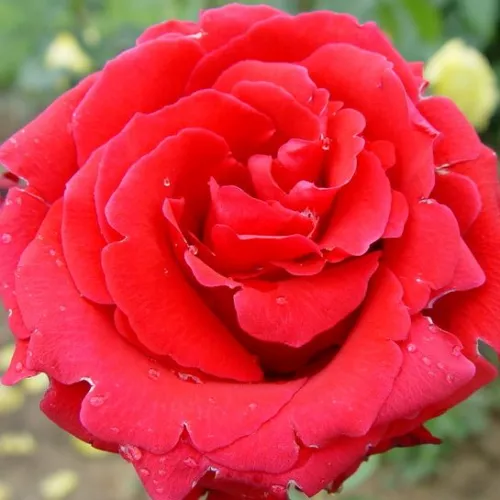
Imagine returning home along a narrow front path edged with velvet blooms, where deep, rain-fresh petals glow against dark foliage and the soil quietly handles showers with ease in a drainage-friendly planting. RED BERLIN is an upright, compact hybrid tea that offers classic, high-centred buds and long-stemmed flowers for cutting, yet remains surprisingly simple to look after in a busy urban setting. Its naturally strong disease resistance keeps maintenance low, and the colour’s superb stability means each flower holds its rich tone from bud to fall. As an own-root rose it develops steadily, with roots establishing, then top growth building, and by the third year delivering full garden presence and reliable flowering. In small front gardens, pots or narrow beds its manageable height and neat spread avoid crowding, while self-cleaning flowers reduce deadheading. Planted once and cared for with simple, peat-free soil preparation, RED BERLIN becomes a long-lived, calm centrepiece for those who want lasting beauty rather than constant gardening chores.
Usage options
| Target area | Reasoning |
|---|
| London-style terraced front garden border |
The upright, compact habit (around 80–110 cm) suits narrow front beds, giving structure without overpowering the space, while long-stemmed, high-centred flowers provide classic street-facing impact and an easy daily view for the busy homeowner. |
| Rainwater-conscious clay or chalky soil planting |
Once planted into improved, free-draining soil, the strong root system copes well with typical British downpours, helping the bed manage heavy rain rather than paving everything over, ideal for the environmentally minded urban gardener. |
| Low-maintenance family flower bed |
Good resistance to powdery mildew, black spot and rust reduces spraying and remedial work, while the bush stays tidy with self-cleaning blooms, keeping weekends free for relaxation rather than constant pruning for the time-poor parent. |
| Long-season focal point by the front path |
Remontant flowering with a generous second flush keeps rich, dark red blooms returning through the season, providing continuity and colour stability that supports a calm, welcoming entrance for the colour-loving beginner. |
| Cutting patch or single-specimen feature |
High-centred, pointed buds and long, straight stems make this variety excellent for vases, while a single well-grown plant can anchor a small border as a sculptural, repeat-flowering highlight for the home flower arranger. |
| Pollinator-aware mixed perennial border |
Although only modestly attractive to insects, it can be placed alongside nectar-rich partners such as rudbeckia or hemp agrimony, so you gain classic rose form within a more wildlife-supporting scheme as a thoughtful city pollinator-carer. |
| Large container on balcony or paved front area |
Its balanced height and spread work well in a 40–50 litre or larger pot, where good own-root vigour sustains long-term growth, offering a durable alternative to short-lived seasonal bedding for the balcony gardener. |
| Long-lived, sustainable family garden planting |
The own-root form supports gradual regeneration and a long lifespan, so the shrub can recover better from minor damage or hard pruning, maturing into a stable feature that earns its space over many years for the sustainability-minded owner. |
Styling ideas
- Terrace-Theatre – Line a narrow path with RED BERLIN and low nepeta, letting the dark red blooms rise over a soft blue carpet – ideal for front-garden owners seeking classic drama on a small footprint.
- Rain-Garden-Ribbon – Combine with hemp agrimony and ornamental grasses in a free-draining strip, guiding rain off paving into planting – perfect for urban gardeners designing permeable, climate-conscious entrances.
- Crimson-Showpiece – Plant a single shrub in a circular bed edged with lavender for scent and pollinators – suited to homeowners wanting an easy-kept, long-season focal point near the door.
- Balcony-Couture – Grow in a 50–60 litre container with trailing aubrieta and sage, giving vertical flower interest where borders are impossible – attractive to flat-dwellers upgrading pots from annuals to perennials.
- Family-Cutting-Corner – Group several plants with rudbeckia for cheerful contrast and plentiful stems to pick – great for hobby gardeners who like to fill vases without sacrificing garden display.
Technical cultivar profile
| Parameter | Data |
|---|
| Name and registration |
Hybrid tea group rose, registered as OLIjplam, marketed as Red Berlin hybrid tea rose; ARS exhibition name Red Berlin, protected in the EU under CPVO registration 2280. |
| Origin and breeding |
Bred by Olij Rozen BV in the Netherlands, around 1996; introduced commercially in 1997 as a dark red hybrid tea rose selected primarily for cut flower and garden display use. |
| Growth and structural characteristics |
Upright, medium-sized bush reaching about 80–110 cm high and 55–85 cm wide, with medium-density, dark green foliage and dense prickles; maintains a tidy, vertical outline in beds or containers. |
| Flower morphology |
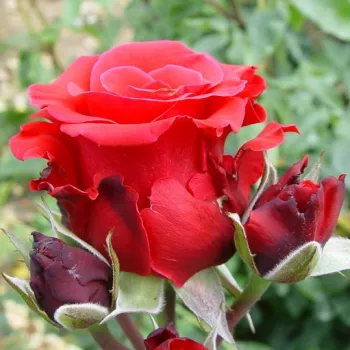
Classic hybrid tea form with high-centred, pointed buds on largely solitary stems; large, double blooms with 26–39 petals and remontant flowering, including an abundant second flush in suitable conditions. |
| Colour data and phenology |
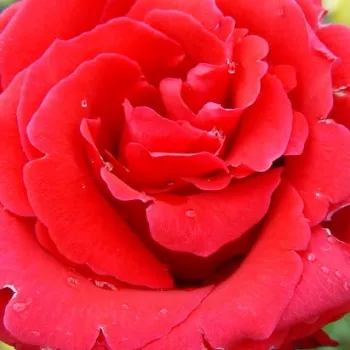
Deep, uniform, velvety dark red (RHS 53A–53B, ARS dr); colour holds exceptionally well, scarcely fading and often deepening slightly to a matt finish towards petal fall, maintaining richness throughout opening. |
| Fragrance and aroma |
Tea-scented character with very weak intensity; fragrance is barely perceptible in outdoor conditions, so the variety is chosen mainly for its visual effect and classic flower form rather than scent. |
| Hip characteristics |
Produces occasional ovoid, orange-red hips about 12–18 mm in diameter; hips can add a discreet late-season accent but are generally a minor ornamental feature on this variety. |
| Resistance and winter hardiness |
Classed as resistant to powdery mildew, black spot and rust under garden conditions; hardy to approximately −21 to −18 °C (RHS H7, Swedish zone 3, USDA zone 6b) with normal winter protection. |
| Horticultural recommendations |
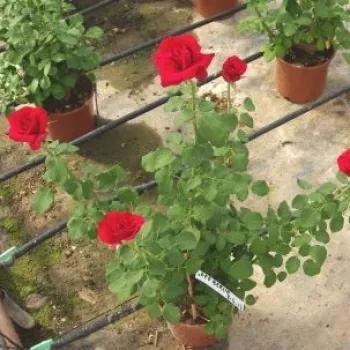
Best in full sun with improved, free-draining soil; spacing 40–75 cm depending on use. Suitable for cut flowers, specimen planting and beds; own-root 2-litre stock keeps maintenance low once established. |
RED BERLIN combines rich, colourfast dark red flowers, strong disease resistance and steady own-root longevity, making it a dependable choice for those planning a lasting, easy-care feature in a small to medium garden.