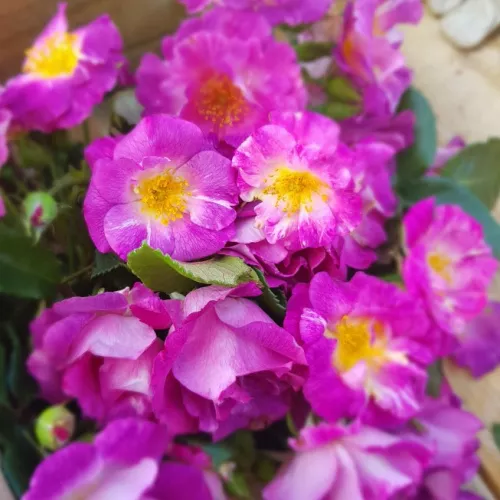
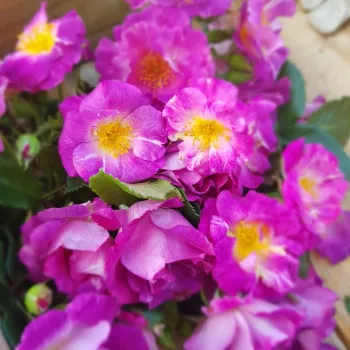
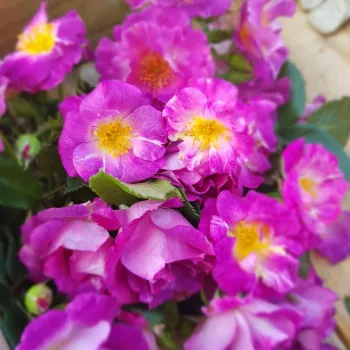
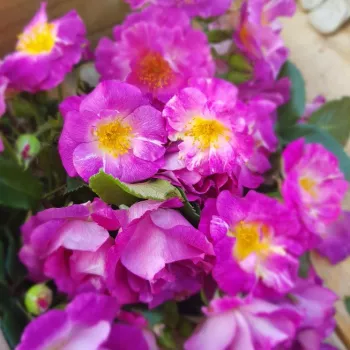
PURPLE KID – purple bedding shrub rose – Ducher
Step through your front gate after rain and PURPLE KID greets you with a low, bushy haze of colour, its rich purple blooms glowing against fresh mid‑green foliage while the air carries a fragrance reminiscent of classic roses. This compact shrub settles well into smaller London front gardens, coping reliably with cool, damp spells and the kind of humidity-laden weather that often follows steady rain and sea breezes. Semi‑double flowers with a golden eye offer a welcoming focal point near the doorstep, and in a large 40–50 litre container or narrow bed you can enjoy repeat flowering from early summer onwards with only straightforward care. Own‑root planting supports long, steady renewal and a naturally balanced shape, so if a stem is damaged it simply reshoots from the base rather than failing, helping this premium shrub to develop from a quietly rooting first season through a bolder second year to a full, mature garden presence by the third.
Usage options
| Target area |
Reasoning |
| Terraced-house front garden focal shrub |
The bushy, upright habit to about 120–160 cm creates an immediate vertical accent beside a path or gate without overwhelming a narrow frontage. Repeating purple flushes and a strong, classic rose scent give daily pleasure with simple seasonal care for the busy city homeowner front-garden owner |
| Sustainable bed with rainwater-fed planting |
Planted in improved clay or chalk with good drainage, this own-root shrub forms a stable, wide root system that copes well with typical British wet spells followed by fresh winds and lingering coastal-type humidity, making it a sound choice for rainwater-conscious schemes sustainability-focused gardener |
| Low, fragrant boundary hedge |
At 110 cm spacing PURPLE KID creates an informal, flowering hedge with scented summer air along paths and driveways. Semi‑double clusters flower repeatedly, while own-root vigour allows sections to regenerate after pruning, keeping the hedge attractive over many years time-poor homeowner |
| Large container on balcony or paved front |
In a 40–50 litre peat-free container with rainwater where possible, its compact spread and dense foliage give generous colour even where soil is limited. The steady own-root framework means you simply refresh the top compost and prune lightly each spring to maintain form urban balcony resident |
| Mixed pollinator-friendly border |
Although semi‑double blooms only partially expose stamens, the golden centres still add some nectar interest between companion perennials like salvia and nepeta. The repeated purple waves provide a linking colour note through the season with straightforward deadheading wildlife-aware beginner |
| Small family lawn-side specimen |
Used on its own at around 200 cm spacing, this shrub becomes a relaxed focal point off the patio, with richly coloured flowers and a strong scent children and guests notice as they pass. Own-root growth supports gradual thickening from the base, giving a long-lived feature family-garden owner |
| Rose and perennial flowerbed combination |
The vivid cyclamen-to-mauve tones sit beautifully with silver foliage and soft purples, creating a coordinated yet low-effort scheme. Once established, the shrub holds its colour well in semi‑shade, so there is less worry about bleaching on sunnier, exposed UK sites style-conscious planter |
| Urban parklet or community bed |
In public or shared spaces the dense, mid-green foliage and repeated clusters of purple blooms give reliable seasonal impact with simple annual pruning. Being on its own roots allows damaged or aged stems to be renewed, extending planting life and reducing replacement frequency community-space organiser |
Styling ideas
- Doorstep welcome – Underplant PURPLE KID with low lavender or dwarf nepeta in a small front bed for a gently scented, bee-friendly entrance – ideal for terraced-house owners wanting maximum charm in minimal space
- Colour corridor – Line a short path with two or three shrubs interplanted with Salvia nemorosa to echo the purple tones and lead the eye to the front door – suited to homeowners seeking simple, coordinated structure
- Rainwise container – Place a single shrub in a 50 litre pot with gravel mulch and trailing thyme, using stored rainwater for irrigation – perfect for sustainability-focused gardeners working with paved front gardens
- Family picnic edge – Position PURPLE KID by a seating area with airy grasses and white Liatris spicata for movement, scent and soft contrast – for families wanting a relaxed, ornamental backdrop to play and outdoor meals
- Twilight contrast – Combine its deep purple blooms with pale Crocosmia and silver foliage plants in a narrow border so the flowers glow at dusk – attractive for urban gardeners who mainly enjoy the garden in the evenings
Technical cultivar profile
| Characteristic |
Data |
| Name and registration |
Modern shrub bedding rose marketed as PURPLE KID – purple bedding shrub rose – Ducher; a flowerbed shrub rose in the Bed rose commercial group for ornamental garden use. |
| Origin and breeding |
Bred by Fabien Ducher at Roseraie Ducher, France, around 2018, with parentage not recorded; introduced to the market in 2018 as a shrub rose suited to decorative beds and urban planting. |
| Growth and structural characteristics |
Vigorous, bushy shrub reaching about 120–160 cm high and 100–140 cm wide, with dense, mid-green, slightly glossy foliage and moderate prickliness; forms a full, leafy framework in average garden conditions. |
| Flower morphology |
Semi-double, flat flowers with around 13–25 petals, medium-sized at roughly 4–7 cm, produced in clusters; remontant throughout the season with a notably abundant second flush given regular pruning and deadheading. |
| Colour data and phenology |
Closed buds are crimson-raspberry; newly opened blooms vivid magenta with a white halo and golden stamens, deepening to smoky mauve-lilac; RHS 78A–78B; colour holds well and darkens slightly in semi-shade. |
| Fragrance and aroma |
Strong, long-lasting classic rose fragrance noticeable on warm, still days and in the evening; scented clusters make it especially suitable for planting close to paths, doorways or seating areas where air movement concentrates perfume. |
| Hip characteristics |
Occasionally sets small ovoid hips, around 10–14 mm in diameter, turning red by autumn; hips are not produced heavily every year but can add a modest seasonal accent and incidental wildlife interest in mixed plantings. |
| Resistance and winter hardiness |
Hardy to about −21 to −18 °C (RHS H7, roughly USDA 6b; Swedish Zone 3), but foliage is sensitive to powdery mildew and rust, with medium susceptibility to black spot, so consistent preventative care is advisable. |
| Horticultural recommendations |
Best in improved, well-drained soil with full sun to light shade, using regular fungicidal protection where disease pressure is high; allow 110–200 cm spacing depending on hedge, bed or specimen use for good air circulation. |
PURPLE KID offers richly coloured, strongly scented flowering on a bushy, own-root shrub that regenerates well and suits rain-aware, easy-care front gardens; consider it if you want lasting character from a single, reliable rose.