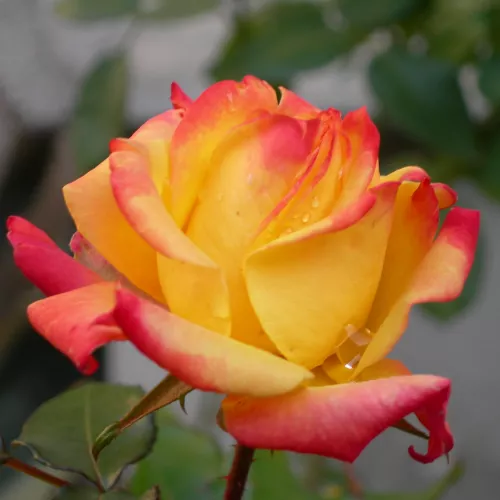
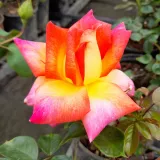
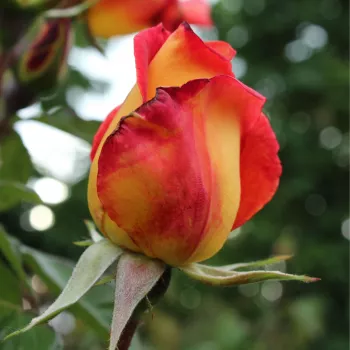
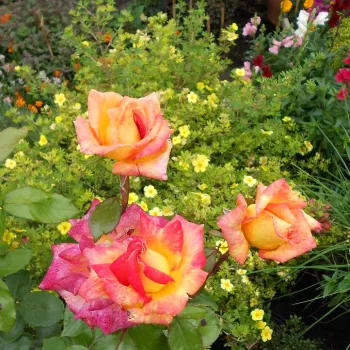
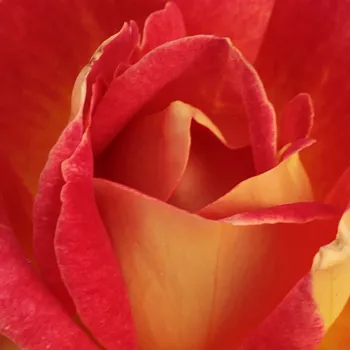
PICCADILLY – yellow-red hybrid tea rose - McGredy
Step out of your London front door after rain and meet a rose that brings instant balance to busy streets: PICCADILLY blends classic hybrid-tea elegance with practical, easy-care reliability for the small family garden. Its high-centred blooms rise on a bushy, upright framework, giving a generous display from early summer onwards with only moderate maintenance. As an own-root rose it is bred for longevity, quietly rebuilding its root system for a strong second year and then settling into full ornamental value in the third. The bright yellow and scarlet-red bicolour flowers keep their freshness well in typical UK summers, even where frequent showers and strong breezes test garden plants in exposed, rain‑washed coastal streets. Ideal for narrow beds, terraced-house front gardens and spacious containers of at least 40–50 litres, it partners naturally with sustainable planting, coping well with collected rainwater and clay soils once drainage is improved. A mild, fruity fragrance, glossy dark foliage and the occasional crop of bright red hips complete a rose that feels both decorative and reassuringly robust for everyday family use.
Usage options
| Target area | Reasoning |
|---|
| Terraced-house front garden focal point |
The bushy, upright habit and XL, high-centred blooms create a clear vertical focus in the shallow beds typical of London terraces, giving a refined look without needing complex pruning, ideal for the busy urban gardener. |
| Compact flower bed in family gardens |
With a height of 80–110 cm and moderate spread, PICCADILLY fits neatly into small mixed borders, repeating its flowering so the bed never feels bare, suiting the homeowner seeking reliable colour. |
| Rainwater-conscious urban planting |
Once established, this rose responds well to consistent, harvested rainwater and copes with wet, breezy spells in exposed streets when planted in improved, free-draining soil, supporting the sustainability-minded city gardener. |
| Cutting patch and vase use |
The pointed, high-centred form and long, straight stems are classic exhibition hybrid-tea features, giving you armfuls of structured blooms for indoor arrangements, appreciated by the creative home flower arranger. |
| Own-root long-term feature shrub |
As an own-root plant it regrows from its base if damaged, avoiding graft-related decline and supporting a longer planting life with stable form and colour, reassuring for the long-term planning gardener. |
| Clay and chalk garden borders |
Provided drainage is improved, PICCADILLY establishes well on heavier or alkaline soils common in UK housing estates, giving a dependable structural rose for years, ideal for the practical low-fuss gardener. |
| Wind-exposed coastal or open sites |
The dense, glossy foliage and medium disease resistance suit open, breezy positions where rain and wind frequently test plants, keeping the bush looking composed for the coastal-front-garden owner. |
| Formal edging and small rose hedge |
Regular spacing at 40–50 cm creates a low, colourful boundary, with repeat-flowering yellow-red blooms giving a defined, classic outline around paths or lawns, pleasing the lover of traditional structure. |
Styling ideas
- Front-Door Welcome – Line a narrow front path with PICCADILLY and low heucheras, letting the yellow-red blooms echo painted front doors – perfect for design-aware terrace owners.
- Sunset Border – Combine PICCADILLY with warm-toned dwarf Persicaria and soft ornamental grasses to create a glowing evening border – ideal for relaxed family gardens.
- Elegant Cut-Flower Nook – Plant a small block of PICCADILLY near a seating area, underplanted with low nepeta, to provide stems for vases and a gentle scent – suited to home entertainers.
- Formal Ribbon Hedge – Use PICCADILLY in a single, evenly spaced row along a drive, edged with clipped lavender for contrast and pollinator interest – attractive to lovers of classic structure.
- Container Statement – Grow a single PICCADILLY in a 40–50 litre pot with trailing thyme and dwarf sage to green a paved front or balcony – ideal for space-limited urban gardeners.
Technical cultivar profile
| Property | Data |
|---|
| Name and registration |
Hybrid tea rose, registered as MACar and marketed as Piccadilly Hybrid tea rose MACar; a classic exhibition-type, high-centred hybrid tea chosen for garden and cutting use. |
| Origin and breeding |
Bred by Samuel Darragh McGredy IV from ‘McGredy’s Yellow’ × ‘Karl Herbst’; introduced by Samuel McGredy & Son, Nurserymen in 1959 as a striking yellow-red hybrid tea. |
| Awards and recognition |
Recognised with an RNRS Certificate of Merit in 1959 and Gold Medals in Madrid and Rome in 1960, confirming its ornamental and garden performance in international trials. |
| Growth and structural characteristics |
Bushy, upright shrub reaching about 80–110 cm high and 60–85 cm wide, with dense, dark green, glossy foliage and moderate thorns; maintains a tidy, vertical outline in beds or hedges. |
| Flower morphology |
Large, high-centred, pointed-budded double blooms with around 26–30 petals; mainly solitary flowers on stems, repeat-flowering with a generous second flush through the season. |
| Colour data and phenology |
Bright yellow base with vivid red edges; ARS YR, RHS 13B outer and 45A inner; colours soften in strong sun but are freshest in cooler spells, giving a lively bicolour display. |
| Fragrance and aroma |
Mild, fruity fragrance that sits gently in the background, adding refinement around doors or seating areas without overwhelming nearby spaces or more strongly scented companions. |
| Hip characteristics |
Produces a moderate number of small, spherical bright red hips about 6–10 mm across, which can add a discreet ornamental touch to the shrub in late season if flowers are not all cut. |
| Resistance and winter hardiness |
Hardy to approximately −21 to −18 °C (RHS H7, USDA 6b); medium disease resistance overall, with good black spot resistance and moderate susceptibility to powdery mildew and rust. |
| Horticultural recommendations |
Best in full sun with improved drainage on clay or chalk; water during dry spells, particularly in containers; moderate maintenance with some deadheading and occasional health checks. |
PICCADILLY Hybrid tea rose MACar offers elegant repeat blooms, compact structure and dependable longevity from its own-root form, making a thoughtful, low-fuss choice for long-term front-garden planting.