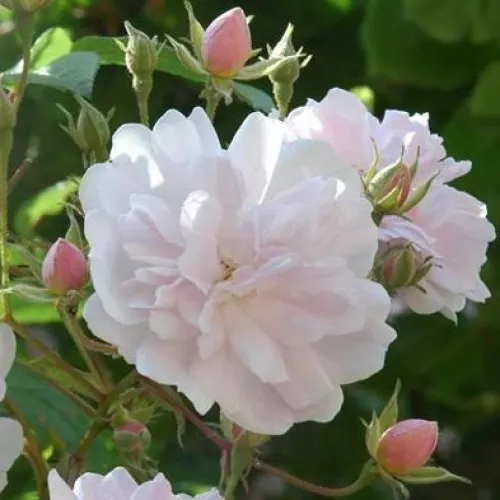
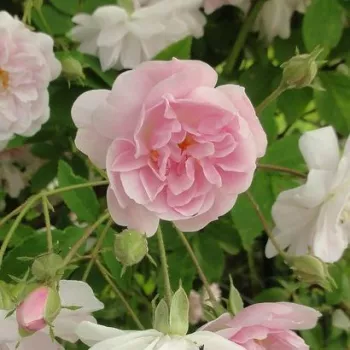
PAUL'S HIMALAYAN MUSK RAMBLER – pale pink rambler climbing rose - Paul
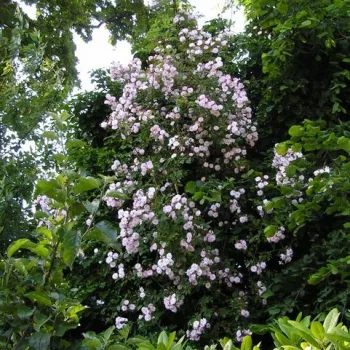
Step out after rain and let Paul’s Himalayan Musk Rambler surround you with a curtain of pale, cloud-like blossom and strong musk fragrance, ideal for softening the hard lines of a London terrace front garden where reliable flowering meets reassuring robustness against typical British weather with wind, wet spells and cool summers. This historic rambler covers pergolas, garages and mature trees with ease, clothing walls and archways in dense sea-green foliage that helps frame a calm, sustainable, low-input outdoor space. Own-root planting gives you long-term resilience and steady regeneration, so once established it shrugs off rough pruning and settles into its stride with minimal fuss. In a large 40–50 litre container or in open ground, the strong growth and good self-cleaning of spent flowers mean less deadheading and more time enjoying summer evenings, while the once-a-year massed display offers a memorable seasonal highlight. Year by year, you will see roots in the first season, structural shoots building height and coverage in the second, and by the third a full ornamental canopy weaving this rose permanently into your garden’s character, balancing romance with practical long life and low-maintenance ease.
Usage options
| Target area | Reasoning |
|---|
| Front-garden pergola in a London terrace |
Perfect for greening a narrow, hard-surfaced front garden while screening cars or bins in summer; the dense seasonal coverage and compact footprint support a more sustainable, low-maintenance entrance for busy urban gardeners. |
| Tree-climbing feature in a family garden |
Trained into a mature tree, its long, flexible canes weave among branches to create a romantic “flowering tree” effect, delivering height and drama without needing extra structures for creative home owners. |
| Large container against a courtyard wall (40–50 litres minimum) |
In a generous, deep container with a sturdy support, it offers vertical interest where borders are limited, giving strong summer impact from a small footprint with modest ongoing care for space-conscious city dwellers. |
| Rainwater-friendly gravel or clay front garden |
Planted into improved, well-drained clay or free-draining gravel, it uses vertical growth to keep roots above short-lived puddling, fitting neatly into a rainwater-friendly layout enjoyed by sustainability-minded gardeners. |
| Arbour or arch over a path |
Cascades of soft pink, strongly scented flowers transform simple arches or metal frames into immersive, scented tunnels, giving a memorable once-a-year show that repays basic tying-in and pruning for romantic beginners. |
| Screening along a fence or unsightly outbuilding |
Run along wires or trellis, its vigorous growth and dense foliage quickly blur hard edges, softening sheds or garages and adding seasonal charm with relatively little intervention for practical family gardeners. |
| Wildlife-friendly informal corner |
The abundant single flush and small red hips add seasonal interest while offering some nectar and autumn food, complementing more explicitly pollinator-focused perennials chosen by nature-aware garden owners. |
| Low-input long-term structure in a mixed planting |
Once settled, own-root plants build a durable framework that responds well to occasional hard pruning, maintaining reliable flowering and ornamental value over many years even in changeable rain and wind for time-poor gardeners. |
Styling ideas
- Romantic-arch – Train over a slim metal arch, underplant with lavender and nepeta for soft fragrance layers and a bee-friendly base – ideal for small front gardens seeking cottage charm.
- Tree-veil – Allow canes to climb into an established apple or ornamental tree, combining blossom seasons and dappled shade – perfect for wildlife-leaning gardeners wanting drama with little extra structure.
- Courtway-screen – In a 50 litre container, fan against trellis to hide bins or bike storage, with sage and sedges at the base – suited to city households needing beauty and screening in tight spaces.
- Gravel-rain – Plant in a gravel strip along a drive, guiding stems up posts while rain drains freely, with low catmint edging – good for urban drives being converted from solid paving to greener fronts.
- Evening-scent – Place near a sitting area or back door so strong musk fragrance is caught on humid evenings, framed by simple white perennials – for busy professionals craving an easy, sensory retreat.
Technical cultivar profile
| Characteristic | Data |
|---|
| Name and registration |
Paul's Himalayan Musk Rambler is a historic rambler climbing rose for garden and landscape use, traded under several similar names, and known in shows as Paul’s Himalayan Musk. |
| Origin and breeding |
Bred by George Paul Jr. of W. Paul & Son Nursery, England, around 1916, from Rosa brunonii lineage; introduced in the United Kingdom that same year and never formally registered. |
| Awards and recognition |
Holds the Royal Horticultural Society Award of Garden Merit, confirming dependable garden performance, ornamental value and relative ease of cultivation under typical UK conditions. |
| Growth and structural characteristics |
Exceptionally vigorous rambler reaching about 8–11 m high with a 4.5–8 m spread, moderately thorny, with dense, slightly glossy sea‑green foliage and long, pliable canes for training. |
| Flower morphology |
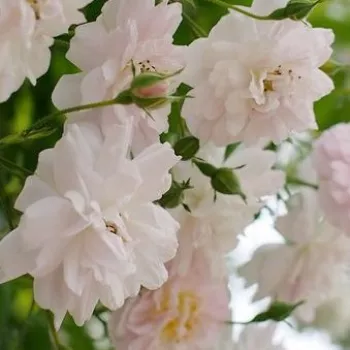
Bears many small, double, flat flowers in large, loose clusters; each bloom around 0.5–1.5 inches, with 26–39 petals, self-cleaning well, in a single, spectacular early-summer flowering. |
| Colour data and phenology |
Soft pale pink buds open to delicately veiled pastel blooms, deeper at petal bases; colour fades in strong sun to near white, creating a cloud-like effect at full, once-a-year flowering. |
| Fragrance and aroma |
Very strongly musk-scented, with fragrance detectable from a distance in still, humid air; ideal near paths or seating where evening and post-rain conditions intensify the perfume. |
| Hip characteristics |
Forms small, ovoid red hips about 5–7 mm across in modest numbers after flowering, adding subtle late-season interest without noticeably increasing maintenance requirements. |
| Resistance and winter hardiness |
Hardy to about −32 to −29 °C (RHS H7; USDA 4b), with good black spot resistance and moderate susceptibility to mildew and rust, generally needing only occasional preventative care. |
| Horticultural recommendations |
Best on supports, pergolas or into trees at 4.3–7.5 m spacing; plant in improved, drained soil, water in dry spells, and prune after flowering to manage size and encourage new growth. |
PAUL'S HIMALAYAN MUSK RAMBLER offers a once-a-year cascade of scented pale pink blossom, long-lived own-root vigour and reliable coverage for arches, pergolas or trees; consider it where you want lasting structure with minimal fuss.