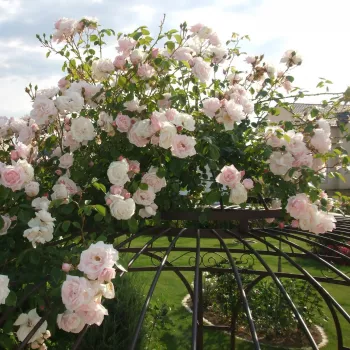
New Dawn – pale pink climbing rose
Step outside after summer rain and let New Dawn frame your path with softly scented, shell-pink blooms that thrive even where wind-whipped fences and heavy soil need reliable planting. This classic large-flowered climber is remarkably easy to live with: good disease resistance, low maintenance and forgiving of missed tasks, so you can enjoy flowers rather than fussing over care. As an own-root plant it settles in steadily and, with its graceful height, becomes a long-lived, sustainable feature for terraced-house front gardens and compact family plots. Give it time to build – roots in the first year, framework in the second and full ornamental impact by the third – and it will reward you with generous flushes of bloom, a fresh, fruity fragrance and a feeling of calm, rain-friendly balance in your green space.
Usage options
| Target area |
Reasoning |
| London terraced-house front fence |
Trains easily along low or mid-height fencing, covering it with shell-pink flowers while leaving ground space free for bins, bikes or pots; low-maintenance once established, ideal for busy homeowners |
| Rainwater-friendly front garden arch |
Works beautifully over a simple arch placed in gravel or permeable paving, its deep roots making good use of natural rainfall in exposed, breezy conditions; perfect for those planning climate-conscious gardens |
| Small pergola beside a seating area |
Moderate vigour and repeat flowering create a light, airy roof of bloom and scent without overwhelming a compact pergola, enhancing evening seating spaces for relaxed urban gardeners |
| Wall-trained accent on heavy clay soil |
Tolerates typical British clay once drainage is improved, rooting deeply on its own system for long-term stability and dependable structure, well suited to long-lived family gardens |
| Part-shaded side return walkway |
Performs reliably with a few hours of sun, brightening narrow side paths with pale flowers that lift gloomy corners, a good choice for beginners working with awkward spaces |
| Large container on balcony or roof terrace |
Can be grown in a 40–50 litre pot with a sturdy support, giving vertical interest and fragrance where borders are impossible, appealing to city-dwellers maximising limited outdoor areas |
| Low-intervention family garden backdrop |
Strong inherent health and modest self-cleaning keep upkeep manageable, with occasional deadheading and light pruning sufficient to maintain a tidy screen, reassuring for time-poor families |
| Sustainable cottage-style mixed planting |
Its soft colour and flexible canes weave easily among lavender, sage and nepeta, supporting a gentle, wildlife-aware style with long-season flower interest for environmentally minded beginners |
Styling ideas
- Front-Door Welcome – Train New Dawn over a simple metal arch with nepeta and lavender at the base to soften paving; ideal for homeowners wanting a gentle, romantic entrance with minimal upkeep.
- Soft-Edge Pergola – Let the rose clothe a compact pergola, underplant with low Santolina and ornamental grasses; suits families seeking light shade, fragrance and an easy-care outdoor dining corner.
- Balcony Statement – Grow in a 50-litre container with a slim obelisk, pairing with trailing thyme and dwarf honeysuckle; perfect for urban gardeners aiming for vertical impact without losing floor space.
- Calm-Path Panel – Fan-train along trellis beside a side-return path, with Gypsophila repens at ground level; good for beginners wanting a bright, airy corridor that still feels uncluttered.
- Rain-Garden Screen – Plant beside a permeable gravel strip catching roof run-off, mixing with sage and hardy geraniums; ideal for those designing a sustainable, low-input front garden backdrop.
Technical cultivar profile
| Parameter |
Data |
| Name and registration |
Large-flowered climbing rose ‘New Dawn’, registered cultivar name and exhibition name identical; unregistered as a formal code but widely traded under New Dawn Climbing rose. |
| Origin and breeding |
Historic sport of ‘Dr. W. Van Fleet’, bred by Henry F. Bosenberg at Somerset Rose Nursery, New Jersey, USA, introduced in 1930 and now a benchmark climber worldwide. |
| Awards and recognition |
Holds the RHS Award of Garden Merit, Earth-Kind certification from Texas A&M University and World Federation of Rose Societies Hall of Fame “World’s Favourite Rose” status. |
| Growth and structural characteristics |
Vigorous climbing habit reaching 320–500 cm in height and 200–320 cm spread, with moderately dense, mid-green glossy foliage and moderate prickliness requiring firm supports. |
| Flower morphology |
Large, double, cup-shaped blooms with 26–39 petals, generally borne singly; repeat flowers well with a generous second flush, creating a long, graceful display on trained stems. |
| Colour data and phenology |
Delicate pale shell-pink (RHS 65C–65D) with a pearlescent sheen, buds opening mid pink then fading towards white; colour holds better in cooler conditions, bleaching faster in strong sun. |
| Fragrance and aroma |
Fresh, fruity fragrance of moderate strength, clearly noticeable around paths or seating; primarily ornamental with reduced stamen access, so less suitable where pollinator support is a priority. |
| Hip characteristics |
Produces small numbers of ellipsoidal hips, 12–18 mm in diameter, orange-red when ripe; they can add subtle autumn interest if spent flowers are not regularly removed after flowering. |
| Resistance and winter hardiness |
Good general disease resistance with powdery mildew and rust resistance, moderate black spot tendency; hardy to about –26 °C (RHS H7), coping with heat if watered during prolonged drought. |
| Horticultural recommendations |
Suited to fences, arches, walls and pergolas; plant 240–400 cm apart, in improved clay or chalk with good drainage, and provide sturdy supports plus occasional pruning and deadheading. |
New Dawn offers fragrant repeat flowering, reliable health and long-lived own-root resilience, making it a thoughtful choice for sustainable arches and fences you can enjoy for many years to come.