MOZART'S LADY – pink park rose - Scarman
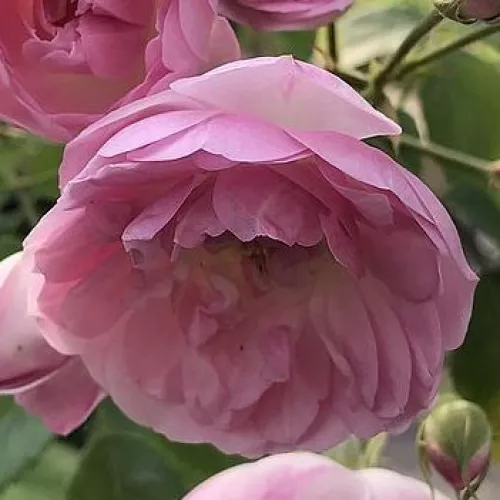
Step out after rain into a front garden where clusters of porcelain blooms glow softly against light green foliage, and enjoy a rose that combines gentle elegance with practical endurance for busy urban plots. This compact Hybrid Moschata shrub settles reliably into London-style front gardens and small family spaces, coping well with cool summers and frequent showers where good drainage helps on heavier soils and exposed, breezy sites. With own-root stability for long-term shape, it responds well to light pruning in containers of at least 40–50 litres, and steadily builds a framework of shoots that carry successive waves of clusters through the season. In its early seasons it concentrates on root strength and crown build-up, before maturing into a full, finely textured presence that supports relaxed, rainwater-conscious gardens and low-fuss weekend care.
Usage options
| Target area |
Reasoning |
| Terraced-house front garden focal shrub |
The upright, moderately dense habit and soft pink to near-white flowers give a calm, formal accent beside a path or bay window, without overpowering a narrow frontage; ideal for time-poor city homeowners and beginners |
| Rainwater-friendly container on balcony or patio |
Performs well in a large 40–50 litre pot with good drainage, pairing neatly with a water butt or permeable paving to keep rainfall on site rather than in the drain; suits compact, sustainable spaces and urbanites |
| Informal mixed border in small family garden |
A steady, medium-height framework with repeat clusters blends easily with perennials like lavender, sage or nepeta, giving long-season colour and structure for relaxed, low-effort planting schemes and homeowners |
| Lightly trained against fence or obelisk |
The upright canes can be fanned along a low fence or tied to an obelisk, creating vertical interest and a curtain of small pompon blooms with only occasional tying-in, well suited to style-conscious but busy gardeners |
| Low-maintenance park-style hedge or row |
Planted at hedge spacing, it forms a soft, flowering barrier that needs only annual pruning to maintain height, offering gentle separation between drive, pavement and garden for households preferring simple, repeatable care and families |
| Own-root long-term specimen shrub |
The own-root form supports a long lifespan and reliable regrowth after hard winters or renovation cuts, maintaining ornamental value year after year without graft worries, ideal for those planning stable plantings and planners |
| Heat-tolerant accent in sunny front plots |
Good heat tolerance allows it to cope with reflected warmth from paving or walls, provided occasional deep watering is given in long dry spells, making it practical for exposed urban aspects and balcony-owners |
| Part-shade flowering corner |
Suitable for partial shade, it flowers reliably where taller houses or street trees limit sun, bringing softness and balance to awkward side strips or shared front boundaries used by time-pressed city-front-garden owners |
Styling ideas
- Soft-Frontage – Underplant with lavender and soft grasses along a short path, letting the pale pink clusters echo painted front doors – ideal for terraced-house owners wanting calm kerb appeal.
- Balcony-Orchard – Grow in a 50-litre container with thyme and trailing nepeta beneath, using a rain barrel for watering – suits urban balcony gardeners favouring low-fuss, sustainable planting.
- Pastel-Border – Combine with sage, heuchera and white foxgloves in a narrow bed, creating a gentle, cottage-style strip – perfect for beginners seeking structure without complex maintenance.
- Vertical-Accent – Tie stems loosely to a slim obelisk, surround with low herbs and gravel to drain heavy clay – good for busy households needing upright colour in a small footprint.
- Calm-Hedge – Plant as a loose flowering line along a drive, interspersed with nepeta to soften edges and guide rain into permeable gravel – for families wanting order with an easy-care feel.
Technical cultivar profile
| Property |
Data |
| Name and registration |
MOZART'S LADY – pink park rose - Scarman, Hybrid Moschata shrub in the Park – shrub rose group; ARS exhibition name ‘Mozart’s Lady’, registered in 2003, used mainly as a garden and cut-flower shrub. |
| Origin and breeding |
Bred by John Scarman in Germany, 2003, from a cross of ‘The Lady Scarman’ × ‘Mozart’ (Lambert, 1936); introduced as a park-type shrub rose for versatile garden and landscape use. |
| Growth and structural characteristics |
Upright shrub 110–160 cm high and 80–130 cm wide, slightly thorny, with moderately dense, light green, lightly glossy foliage; suitable for borders, hedging, containers and light training. |
| Flower morphology |
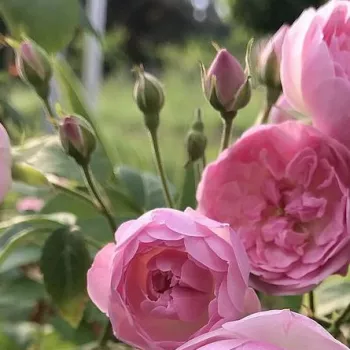
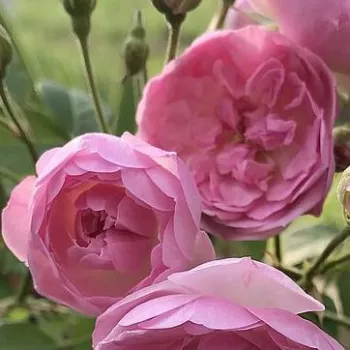
Small, 0.5–1.5 inch, very double ball to pompon blooms in clusters, 40+ petals; remontant with abundant second flush, providing repeated waves of decorative flowers in season. |
| Colour data and phenology |
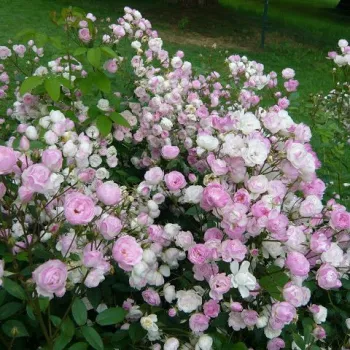
Delicate pale pink (RHS 65C outer, 65D inner), buds pastel pink with silvery tinge; flowers fade from light pink to almost white, especially in strong sun, giving a soft, porcelain-like effect. |
| Fragrance and aroma |
Very weakly scented rose with a delicately sweet character; fragrance is barely noticeable in most conditions, making it suited where visual effect is prioritised and strong perfume is not desired. |
| Hip characteristics |
Rosehip set is usually minimal due to the very double flowers; where formed, hips are small spherical orange-red fruits, around 6–10 mm diameter, adding light late-season interest. |
| Resistance and winter hardiness |
Hardy to about −21 to −18 °C (RHS H7, Swedish zone 3, USDA 6b); black spot resistant, with moderate susceptibility to powdery mildew and rust, requiring occasional protective care in humid spells. |
| Horticultural recommendations |
Suited to borders, containers, fences, obelisks, cut use and specimens; plant at 90–180 cm spacing, in well-drained soil with regular watering in prolonged drought and moderate, timely pruning. |
MOZART'S LADY offers compact elegance, repeat clusters and heat-tolerant reliability in an own-root form that builds long-term structure gently over time; a thoughtful choice if you favour calm beauty with modest upkeep.