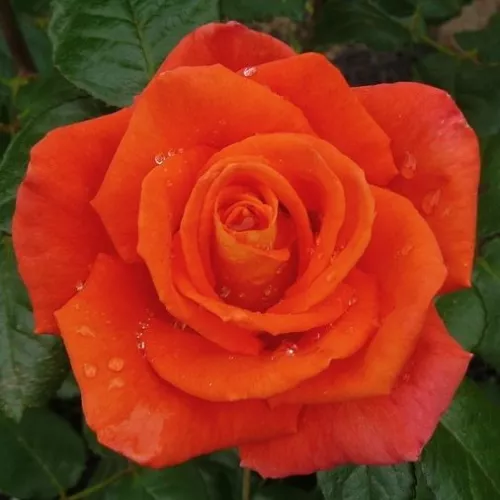
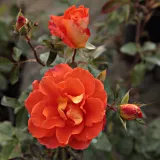
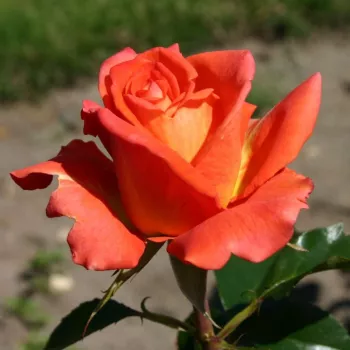
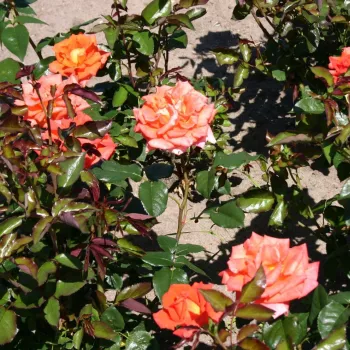
MONIKA – orange hybrid tea rose (TANaknom)
In a compact urban front garden or small family plot, MONIKA offers reliable colour and elegant hybrid tea form with minimal fuss, thriving even where heavy soil needs thoughtful drainage against persistent wind and rain. Its upright habit and dark, glossy foliage frame the glowing orange–peach blooms, bringing a refined yet approachable presence to paths, bay windows and shared front borders. As an own-root rose, it establishes steadily for long-term balance and regeneration, building roots in year one, extending shoots in year two and achieving full ornamental impact by year three. Low-intervention care and strong disease resistance suit busy routines, while the neat, cut-flower quality blooms lend elegance to both the garden and the vase.
Usage options
| Target area |
Reasoning |
| Front garden feature rose |
Planted as a single specimen by a doorway or bay window, MONIKA’s upright structure and glowing orange flowers create a strong focal point with relatively low maintenance needs, ideal for a neat, welcoming entrance for the busy homeowner |
| Small urban flower bed |
Its moderate spread and good height allow you to fit a “proper” garden rose into a narrow London terrace border, where strong resistance keeps routine care light and watering can follow simple, rainwater-friendly practices for the city gardener |
| Rain-conscious clay garden border |
In heavier clay soils where downpours linger, MONIKA responds well to improved drainage and raised planting, coping reliably with blustery, wet spells near exposed streets or coastal settings for the climate-aware planter |
| Cutting corner in a family garden |
The high-centred, exhibition-style blooms on long, straight stems lend themselves perfectly to cutting, so a small “flower picking” corner can supply vases indoors without needing complicated pruning knowledge for the home flower lover |
| Low-intervention mixed hedge |
Planted at recommended hedge spacing, its repeat flowering and healthy foliage provide a long season of colour in a narrow line, with only simple deadheading and annual feeding needed to keep it performing well for the time-poor beginner |
| Own-root long-term planting |
As an own-root rose, MONIKA ages steadily and predictably, regrowing from its own wood if cut back hard, so the original variety is preserved and ornamental value remains stable over many seasons for the long-view gardener |
| Large container on patio or balcony |
Grown in a 40–50 litre peat-free container with regular watering, its upright habit and moderate vigour make it a practical choice for hardstandings and balconies, where space is tight but a “real rose” look is desired by the compact-space owner |
| Part-shade side path planting |
MONIKA tolerates partial shade, so it can brighten a side return or path that only gets sun for part of the day, still producing regular flushes of flowers with basic feeding and deadheading for the light-limited gardener |
Styling ideas
- Terrace Welcome – Line a short front path with MONIKA underplanted with low lavender, echoing its warm orange tones against cool purple – ideal for the image-conscious townhouse owner
- Sunset Border – Combine MONIKA with nepeta and soft grasses so its coppery buds glow at dusk while the airy foliage keeps the look light – perfect for relaxed, low-fuss family gardens
- Cutting Niche – Group three MONIKA in a square bed with sage and echinacea to provide stems for vases and a soft, cottage feel – suited to home florists who want easy structure
- Clay-Ready Strip – In a narrow, improved-soil strip along a drive, pair MONIKA with drought-tolerant herbs to handle wet spells and summer dry periods – good for pragmatic, climate-aware gardeners
- Balcony Statement – Plant a single MONIKA in a 50 litre container flanked by evergreen box and thyme for year-round shape and seasonal colour – ideal for busy balcony and patio users
Technical cultivar profile
| Parameter |
Data |
| Name and registration |
Hybrid tea rose, registered as TANaknom, traded as MONIKA – orange tea-hybrid rose – Evers; exhibition name MONIKA; part of the Hybrid Tea group for garden and cutting use. |
| Origin and breeding |
Bred by Hans Jürgen Evers at Rosen Tantau, Uetersen, Germany; unnamed seedling × unnamed seedling; introduced and registered in 1985 with TANaknom cultivar code. |
| Awards and recognition |
Recognised in New Zealand Rose Trials with a Certificate of Merit in 1990, highlighting its exhibition-quality blooms and dependable garden performance under trial conditions. |
| Growth and structural characteristics |
Upright, medium-tall bush reaching about 130–170 cm high and 80–120 cm wide; moderately dense, glossy dark green foliage; moderately thorny stems with a neat, vertical habit. |
| Flower morphology |
Classic high-centred, pointed-budded hybrid tea flowers, usually solitary on stems; medium-sized, double with about 26–39 petals; remontant, producing a generous second flush in season. |
| Colour data and phenology |
Fiery orange-copper buds open to bright orange with golden-yellow shading, then fade to peach with pink-tinged edges; ARS PB, RHS 14B outer and 30A inner tones; moderate colour retention in sun. |
| Fragrance and aroma |
Primarily grown for colour and form rather than scent; fragrance is very weak and barely noticeable, so it suits gardeners prioritising visual effect over perfume in compact spaces. |
| Hip characteristics |
Hip set is limited due to typical deadheading of double blooms; when present, forms small ellipsoid orange-red hips about 6–10 mm across, adding discreet late-season interest. |
| Resistance and winter hardiness |
Rated resistant to powdery mildew, black spot and rust; hardy to around −26 to −23 °C (RHS H7, Swedish zone 4, USDA 5b); tolerates heat but needs watering in extended droughts. |
| Horticultural recommendations |
Best for flower beds, specimen use and cutting; plant 55–100 cm apart depending on effect; prefers well-drained, improved soil; partial shade tolerant; low maintenance with routine deadheading. |
MONIKA Hybrid tea rose TANaknom offers long-lived, low-maintenance, exhibition-style colour on resilient own-root plants, making it a thoughtful, enduring choice for refined yet practical gardens.