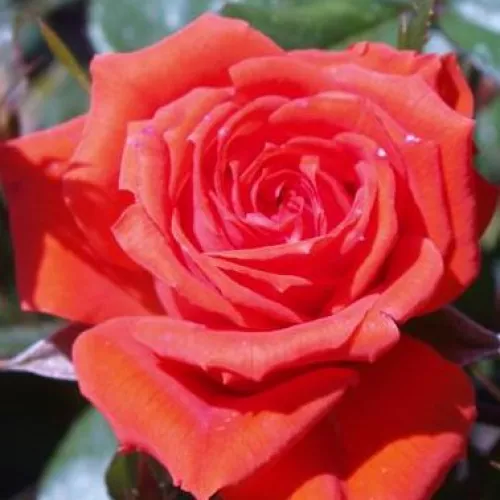
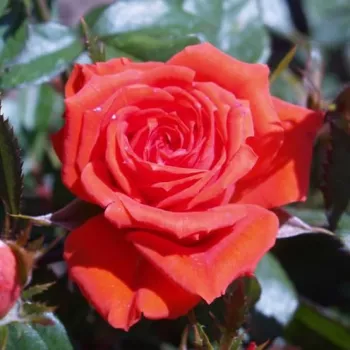
MERCEDES® – orange-red bedding floribunda rose – Kordes
Imagine your front garden glowing after rain, the paving still damp, the air cool and fresh, and clusters of orange-red blooms along the path bringing a sense of balance without demanding constant care. MERCEDES® is a compact, reliable floribunda bred for repeat flowering in typical British, often wet, conditions, quietly coping with blustery showers and heavy soil while you get on with life. Its low maintenance needs and naturally resistant foliage suit busy London terraces and rainwater-fed planters, where space is tight but colour really matters. As an own-root rose it establishes steadily and lives long, recovering well from harsh pruning or weather knocks, giving dependable structure and a reassuring, long-term investment in a small garden. Planted once with decent drainage and regular rainwater, it will grow from a settling-in year of roots, through stronger shoots the second season, to full ornamental impact by the third year, offering an easy-care, sustainable choice for family gardens and urban fronts.
Usage options
| Target area |
Reasoning |
| Front garden flowerbed in a small family garden |
The compact, 70–95 cm habit and 50–70 cm spread make MERCEDES® ideal for neat front borders where you want strong colour but limited height. Low disease pressure and little pruning keep weekend jobs minimal for the busy urban gardener. |
| Low, colourful hedge along a path or driveway |
Regular clusters of orange-red flowers and mid-green foliage create a tidy, informal hedge at around knee height, perfect for edging paths in terraced-house gardens without overwhelming the space, suited to the family with a small garden. |
| Rainwater-fed large container on balcony or patio |
Grows well in a generous 40–50 litre pot, especially where you can collect and use rainwater, giving reliable colour on balconies or paved front gardens with minimal intervention for the sustainability-minded homeowner. |
| Mixed border with perennials in heavy or clay soil |
This own-root rose establishes steadily in improved heavy ground, providing long-term structure and rebound after winter, working alongside echinacea or sedges to give lasting form for the beginner seeking resilience. |
| Compact cutting area for short-stemmed bouquets |
Clustered, double blooms on upright stems allow you to cut small bunches without stripping the plant, and own-root growth replaces stems steadily over years, pleasing the home florist and hobby gardener. |
| Low-maintenance family play garden border |
Moderate height, sparse prickles and strong disease resistance suit borders beside lawns and play areas, limiting spraying and complicated care while still giving bright colour for the time-poor family owner. |
| Coastal or exposed urban site with frequent rain and wind |
The compact form and sturdy shoots stand up well to blustery showers and changeable weather, keeping flowers presentable without constant deadheading, useful for the coastal or windswept-garden resident. |
| Long-term feature plant in a sustainable front garden |
As an own-root rose, MERCEDES® ages gracefully with good regeneration after hard pruning, delivering dependable flowering structure year after year for the gardeners planning for the long term. |
Styling ideas
- Terrace-Romance – Line a narrow London terrace path with MERCEDES® and soft grasses, letting the orange-red flowers glow against pale paving – ideal for small-front-garden owners.
- Sunset-Drift – Pair in a mixed border with Echinacea and blue agastache to create a warm, sunset palette that still feels relaxed – perfect for colour-loving beginners.
- Urban-Container – Plant a single shrub in a 50 litre pot with trailing thyme at the rim for a compact, rainwater-fed focal point – great for balcony and patio gardeners.
- Family-Edge – Use as a low edging hedge in play-friendly gardens, combining with low-care sedges for soft movement and year-round texture – suited to busy young families.
- Calm-Structure – Repeat MERCEDES® at regular intervals in a gravel or slate mulch bed to give quiet order and long-lived form – appealing to low-maintenance, minimalist gardeners.
Technical cultivar profile
| Parameter |
Data |
| Name and registration |
Floribunda bed rose; registered as MERkor, marketed as Mercedes® Bedding rose MERkor, ARS exhibition name Mercedes; florists’ and garden floribunda rose for borders and cutting. |
| Origin and breeding |
Bred by Reimer Kordes, W. Kordes’ Söhne, Germany, from ‘Anabell’ × unknown seedling; bred 1974, registered 1974, introduced 1975 via Jackson & Perkins in the USA. |
| Growth and structural characteristics |
Compact shrub 70–95 cm tall, 50–70 cm wide, moderately dense, mid-green, slightly glossy foliage; sparse prickles; best in sun, with a tidy, upright, bedding-friendly habit. |
| Flower morphology |
Large, double, cup to goblet-shaped blooms, 26–39 petals, borne in clusters; remontant with abundant second flush, offering regular garden colour and usable stems for cutting. |
| Colour data and phenology |
Uniform vivid orange-red; bud deep fiery orange-red, opening to shining centres with slightly darker edges; RHS 34B outer, 34A inner; colour holds best in cooler, less intense sun. |
| Fragrance and aroma |
Very faint fragrance, often barely noticeable in typical garden conditions; grown primarily for its colour impact and bedding performance rather than scent or aromatic uses. |
| Hip characteristics |
Sparsely produced spherical orange-red hips, around 10–14 mm in diameter, adding light seasonal interest without significantly affecting the plant’s overall ornamental performance. |
| Resistance and winter hardiness |
Good resistance to powdery mildew, black spot and rust; hardy approximately to −21 to −18 °C (RHS H7, Swedish zone 3, USDA 6b); tolerates heat if watered in prolonged dry periods. |
| Horticultural recommendations |
Suited to borders, bedding, hedging and large containers; plant 35–40 cm apart in groups, or 65 cm as a specimen; prefers sun, regular watering in dry spells, and minimal pruning. |
MERCEDES® offers compact long-season colour, reliable disease resistance and long-lived own-root performance, making it a thoughtful, low-effort choice for front gardens and patios you may wish to consider.