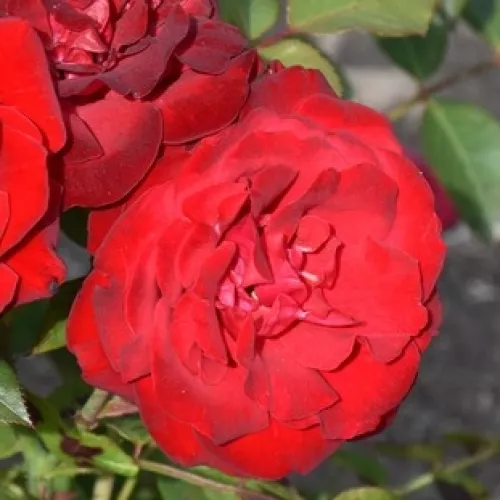
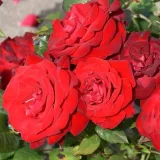
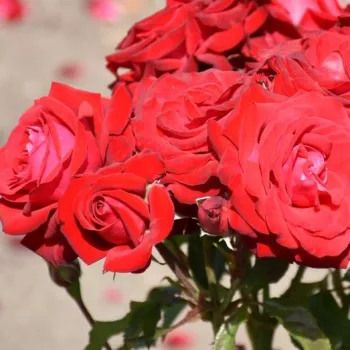
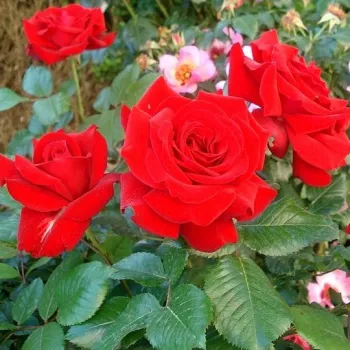
LÜBECKER ROTSPON – dark red bedding floribunda rose
Think of a narrow terraced-house path lined with glistening petals after rain, where deep, velvety blooms glow against glossy foliage and the planting quietly manages heavy soil and frequent showers with ease. Velvety clusters of dark red flowers repeat through summer, providing a long season of colour on a compact, bushy plant that suits small London front gardens and balconies as well as traditional borders. The own-root form offers reassuring longevity, with steady regeneration and a secure structure that settles in for the long term, while the modest fragrance keeps the focus on visual impact and clarity of design. You can rely on its resilience to typical UK disease pressures and winter cold, and appreciate how its hips extend interest into autumn for wildlife-friendly planting. In a large 40–50 litre container or a neat front-garden bed, it partners beautifully with lavender or nepeta for a soft, sustainable border effect, developing from strong roots to fuller shoots and finally to confident ornamental presence over three calm, rewarding years.
Usage options
| Target area |
Reasoning |
| London terraced-house front garden |
Compact, bushy growth and repeat-flowering clusters give reliable colour without overwhelming a narrow frontage, while glossy foliage reads well from the pavement, making it ideal for beginners seeking a tidy, long-season rose for the front-garden. |
| Rainwater-friendly clay or chalk border |
Performs well in typical UK conditions where heavy, moisture-retentive soil and regular showers are the norm, especially when combined with simple drainage improvements, suiting householders who want a rose that copes calmly with changeable weather in the border. |
| Large container on balcony or patio (40–50 litres) |
The moderate height and dense framework suit a single, generous pot, creating a stable focal point that flowers over a long season, ideal for urban balcony owners who prefer one strong, easy-care feature rose in a container. |
| Low hedge or path edging |
Regular, bushy growth and moderate spread allow close planting for a low, formal edging that keeps its line, appealing to gardeners who like a structured look but want to avoid high-maintenance clipping in a flowering hedge. |
| Mixed perennial bed with pollinator-friendly companions |
The velvety, dark red flowers sit beautifully among airy perennials such as lavender, sage or nepeta, where companion plants support pollinators while the rose provides structure, suiting nature-conscious gardeners designing a balanced, wildlife-aware mix. |
| Long-term family garden planting |
As an own-root plant it establishes gradually yet securely, building a stable framework that can recover from pruning or accidental damage, fitting families who want a rose that stays attractive and reliable over many seasons in a lived-in garden. |
| Low-input, disease-aware planting schemes |
Good black spot resistance and overall moderate disease tolerance keep interventions to a sensible minimum in typical humidity, appealing to busy owners who want healthy foliage without constant spraying in a small domestic scheme. |
| Autumn interest and wildlife-friendly corners |
After the main flowering, the small, red, ellipsoidal hips add quiet seasonal detail and potential food for birds, making it a thoughtful choice for householders who value subtle autumn colour and habitat in a compact planting corner. |
Styling ideas
- Velvet-Curtain – Plant in a tight row along a short front path, underplanted with soft grey thyme to contrast the dark blooms – for homeowners wanting a quietly dramatic entrance.
- Burgundy-Cloud – Combine with lavender and nepeta in a sunny bed to soften the rose’s rich red clusters – for urban gardeners aiming at a pollinator-friendly yet refined look.
- Courtyard-Jewel – Grow a single specimen in a 50-litre clay pot with gravel mulch for easy watering control – for balcony and patio users seeking one standout, low-fuss feature.
- Heritage-Stripe – Alternate with pale ornamental grasses along a low fence to echo traditional town gardens in a modern way – for families wanting structure without formal hedging.
- Autumn-Thread – Thread plants through a mixed border with late asters and verbena so hips and final blooms extend the season – for nature-focused gardeners who value subtle, long-lasting interest.
Technical cultivar profile
| Parameter |
Data |
| Name and registration |
Floribunda bedding rose; registered as TANtide, marketed as Lübecker Rotspon Bedding rose TANtide; also exhibited under the name Glad Tidings in floribunda cut-flower classes. |
| Origin and breeding |
Bred by Hans Jürgen Evers at Rosen Tantau from Seedling × Seedling; registered 1988, introduced 1990 by Rosen Tantau, representing late twentieth-century German floribunda breeding. |
| Awards and recognition |
Recognised as UK Rose of the Year 1989 and awarded the Durbanville Gold Medal 1992 in South Africa, indicating wide adaptability and proven garden merit in contrasting climates. |
| Growth and structural characteristics |
Bushy, shrub-like habit 65–95 cm high and 50–75 cm wide, with dense, glossy dark green foliage and moderate prickliness; forms a compact, rounded plant suited to bedding, edging and smaller gardens. |
| Flower morphology |
Large, double, cupped flowers with 26–39 petals, borne in clusters; remontant, with a strong second flush that extends display; spent blooms may need deadheading to maintain a tidy appearance. |
| Colour data and phenology |
Deep, saturated burgundy red with velvety sheen; buds almost black-red, opening to rich dark red (RHS 53A outer, 60A inner) then gently fading towards ruby with brownish-burgundy margins before petal fall. |
| Fragrance and aroma |
Fragrance is very weak and only slightly sweet, contributing a light background note rather than a dominant scent; selected primarily for colour impact, flowering performance and garden reliability. |
| Hip characteristics |
Produces moderately abundant, small ellipsoidal hips about 6–10 mm, coloured red; hips follow the main flowering flushes and can extend ornamental and wildlife value into the later season if not deadheaded. |
| Resistance and winter hardiness |
Rated to approximately −26 to −23 °C (USDA 5b, RHS H7, Swedish Zone 4); resistant to black spot with moderate tolerance of powdery mildew and rust, and average resilience to typical heat and short dry spells. |
| Horticultural recommendations |
Best in full sun with reasonable drainage; suitable for borders or specimens at 35–65 cm spacing; maintenance moderate, with occasional disease checks and deadheading to optimise repeat flowering and form. |
LÜBECKER ROTSPON offers velvety repeat blooms, compact, long-lived own-root growth and reassuring hardiness, making it a considered choice if you would like a reliable dark red rose for a modest family garden.