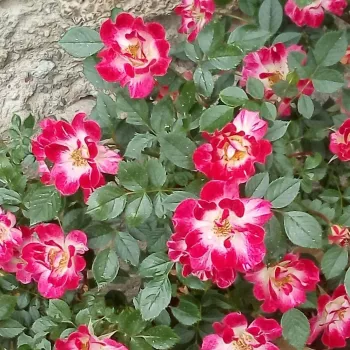
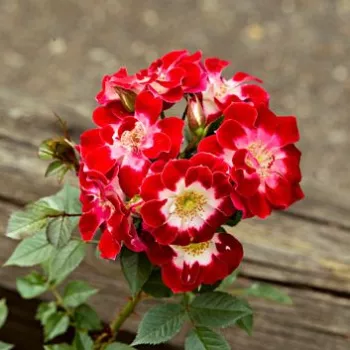
LITTLE ARTIST – red-and-white dwarf miniature rose - McGredy
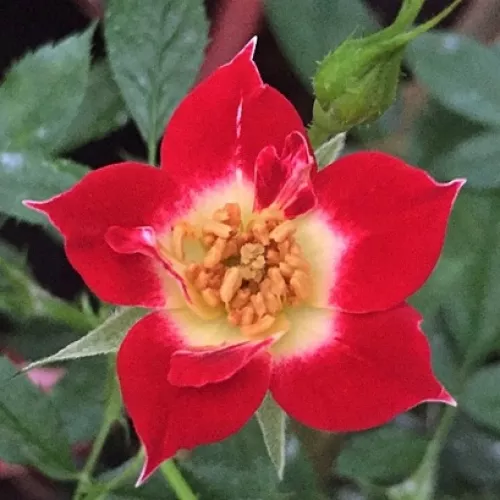
Imagine stepping out after rain to a front garden where the ground-hugging miniature cushions of LITTLE ARTIST scatter vivid red-and-white blooms along a narrow path, naturally coping with damp, heavy soils and breezier, rain-lashed streets. This hand-painted-effect petals rose stays compact and balanced, ideal for a London terrace, gravel strip or small front border where every square metre must work hard. In a large 40–50 litre pot it forms a neat, bushy mound that needs only simple watering and light trimming, rewarding you with repeat flowering through the season. Own-root planting gives reassuring longevity and easy regeneration after harsh winters, while its medium maintenance needs are straightforward for time-pressed gardeners. Over three seasons it quietly develops from establishing roots to fuller shoots and, by year three, a settled feature that anchors a sustainable, rainwater-friendly urban garden.
Usage options
| Target area | Reasoning |
|---|
| Terraced-house front garden edging |
Its low, bushy habit forms a neat edging that will not swamp narrow paths or small London front gardens, while the starry red-and-white blooms give strong visual impact from the street for beginners. |
| Rainwater-friendly gravel strip or soakaway border |
This compact rose copes well where roof run-off collects, working with permeable gravel or mulched strips to slow water, while its relatively shallow roots suit improved, free-draining clay for urbanites. |
| Large container or balcony pot (40–50 litres) |
In a generous pot it remains proportionate and easy to water, with less risk of drying out, keeping its shape without complicated pruning and providing cheerful colour close to seating areas for balcony-owners. |
| Family garden bed in small plots |
Its modest height lets children enjoy the flowers at eye level without thickets of thorns, and the plant’s steady structure keeps borders tidy and easy to manage for families. |
| Low, informal mini-hedge |
Planted in a line, the spreading growth closes gaps into a soft mini-hedge, creating definition between drive, path and planting without casting heavy shade or demanding intensive clipping for homeowners. |
| Easy-care own-root replacement for short-lived bedding |
Instead of replanting annuals every year, this own-root rose settles in, thickening gradually and recovering well after harsh winters, giving longer-term colour with fewer replanting cycles for time-pressed. |
| Low-chemical decorative feature |
With moderate disease resistance and small foliage surfaces, it’s practical to manage with minimal plant protection, especially when combined with good air flow and careful watering for eco-conscious. |
| Compact accent among perennials and groundcovers |
The vivid, hand-painted effect stands out above neat groundcovers like Japanese spurge or bellflower, adding a focal point without occupying much space or overshadowing companions for collectors. |
Styling ideas
- Front-border jewel – Set LITTLE ARTIST in a slim front strip with low lavender or nepeta behind to frame its red-and-white blooms – ideal for busy homeowners wanting instant kerb appeal.
- Balcony picture – Plant it in a 40–50 litre terracotta pot with trailing thyme and white lobelia to echo its cream centre – perfect for small-balcony gardeners seeking easy, long-lived colour.
- Rain-kissed path – Line a gravel path that channels roof run-off, interplanting with dwarf sage to keep things airy and scented – suited to urbanites creating sustainable, rainwater-conscious front gardens.
- Mini-hedge rhythm – Repeat plant along a low picket fence, underplanting with smooth rupturewort for a soft green carpet – for families wanting structure without heavy pruning chores.
- Pocket gallery – Combine with pale campanulas and small ornamental grasses in a compact bed to showcase the hand-painted petals – appealing to design-focused beginners experimenting with colour contrasts.
Technical cultivar profile
| Feature | Data |
|---|
| Name and registration |
Miniature, dwarf “Hand Painted Roses” cultivar; registered as MACmanly, sold as LITTLE ARTIST. ARS exhibition name LITTLE ARTIST; group: Mini – dwarf rose, exhibition miniature. |
| Origin and breeding |
Bred by Samuel Darragh McGredy IV (McGredy Roses International) from ‘Ko’s Yellow’ × ‘Eyepaint’; registered 1987, introduced after 1987, originally distributed from New Zealand. |
| Growth and structural characteristics |
Compact, bushy, spreading habit about 30–40 cm high and 70–90 cm wide, with dense mid-green, slightly glossy foliage and moderate prickles; medium self-cleaning of spent blooms. |
| Flower morphology |
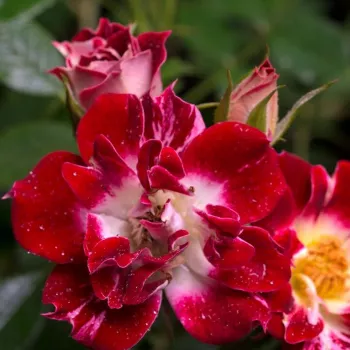
Semi-double, star-shaped, flat blooms, 13–25 petals, small size in tight clusters; remontant with a plentiful second flush, benefits from occasional deadheading to prolong decorative display. |
| Colour data and phenology |
Vibrant deep red outer petals with pure white centres; ARS rb, RHS 53A outer, NN155C inner; edging fades to raspberry while the centre stays cream-white with a yellow stamen ring. |
| Fragrance and aroma |
Very faint, fresh scent with a light apple note; fragrance is barely perceptible in typical garden conditions, so planting is usually for visual effect rather than for scented-garden schemes. |
| Hip characteristics |
Occasionally forms small ellipsoidal orange-red hips, about 5–7 mm diameter; hips are decorative in close-up plantings but not usually produced in large quantities on every specimen. |
| Resistance and winter hardiness |
Hardy to about −21 to −18 °C (RHS H7, USDA 6b, Swedish Zone 3); moderate tolerance of heat and drought with irrigation; disease resistance moderate to mildew and black spot, resistant to rust. |
| Horticultural recommendations |
Best in sunny positions for abundant flowering; suitable for beds, edging, containers and balconies; plant 50–90 cm apart, at 3.2–3.7 plants/m², with improved drainage on heavy clay soils. |
LITTLE ARTIST offers compact structure, distinctive hand-painted flowers and reassuring own-root longevity, making it a thoughtful choice for low-effort, space-conscious gardeners considering a long-term front-garden feature.