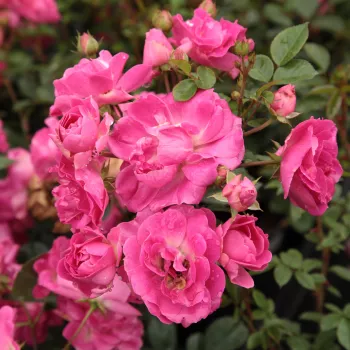
LIPPAY JÁNOS – dark pink bedding polyantha rose - Márk
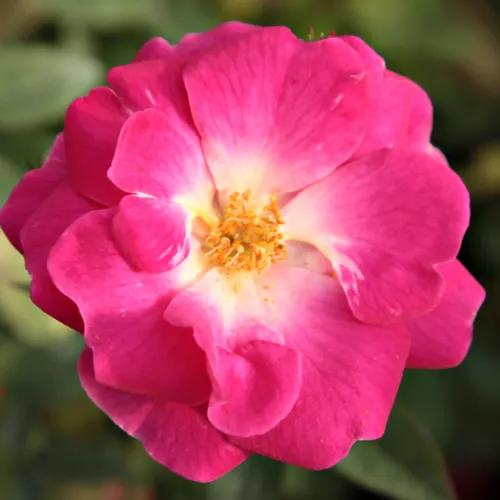
Step out to a front garden that feels quietly composed after rain, where colour and neat structure bring a sense of balance to even the smallest London terrace. LIPPAY JÁNOS forms a compact, upright border of vivid dark-pink blooms with pale centres and golden stamens, giving reliable clusters of flowers from early summer well into autumn. As an own-root plant it builds strength steadily, rewarding you with a durable, regenerative framework that suits low-input, rainwater-friendly planting on heavier urban soils and breezier sites along exposed coasts. In containers of at least 40–50 litres, or set into a small front garden bed, its long flowering season and moderate pollinator appeal create a gently animated, sustainable foreground that sits comfortably beside lavender, sage or nepeta. Over the first few seasons you see roots establish, then shoots gain volume, and by the third year the planting reaches its full impact, offering an easy-care, long-lived rhythm of bloom that fits busy lifestyle gardening.
Usage options
| Target area | Reasoning |
|---|
| Small urban front garden bed |
The compact 45–65 cm height and 40–55 cm spread make this rose ideal where space is limited, giving a structured, long-season display without dominating windows or paths. Its own-root durability suits homeowners planning a long-term planting, including the busy urban garden owners. |
| Low edging along a path |
Regularly repeated plants at 25–30 cm spacing create a neat, colourful edging that guides the eye and frames gravel or paving. The upright habit and dark green, glossy foliage keep the line looking tidy between flower flushes, reassuring beginners seeking pollinator-friendly choices. |
| Mixed pollinator-friendly border |
Semi-double flowers with visible yellow stamens offer moderate pollinator interest, especially when interplanted with lavender, nepeta or sage to boost nectar continuity. The vibrant pink acts as a focal accent within wildlife-leaning schemes, appealing to sustainability-focused family gardeners. |
| Heat- and drought-exposed spots |
Good heat and drought tolerance mean the plant keeps its colour and foliage quality in hotter, drier positions, once established. Used with mulching and rainwater harvesting, it performs reliably through dry spells, aiding rainwater-conscious city gardeners. |
| Rainwater-friendly, heavier-soil planting |
In well-prepared heavy clay or chalky soils with added drainage, this rose forms a resilient shrub that copes with typical UK winter wet, fitting designs that slow and soak up rainfall in small gardens exposed to wind and coastal conditions for sustainability-minded homeowners. |
| Large patio container (40–50 L+) |
Planted in a peat-free, free-draining mix in a 40–50 litre or larger pot, LIPPAY JÁNOS provides months of colour on balconies or paved yards. Stable own-root growth ensures the plant can be rejuvenated by pruning over time, suiting time-poor urban balcony owners. |
| Formal bedding and mass planting |
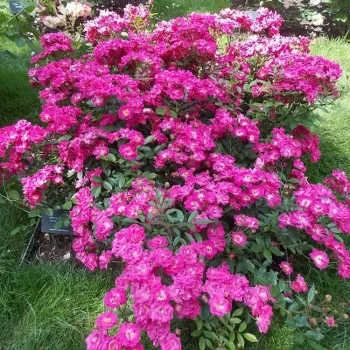
Recommended densities of around 10–11 plants/m² create a solid, even carpet of pink for front gardens or shared residential spaces. Strong colour retention and repeat flowering help beds look maintained with limited intervention, reassuring low-maintenance-focused hobby gardeners. |
| Long-term family garden framework |
The shrub’s moderate size, strong own-root constitution and reliable repeat blooming allow it to act as a long-lived “anchor” plant that can be underplanted or re-partnered over the years, supporting evolving garden plans for young families settling into a first home. |
Styling ideas
- Terrace-Romantic – Line a narrow front bed with LIPPAY JÁNOS and soft pink yarrow, using gravel mulch to keep maintenance low – ideal for style-conscious terrace owners.
- Pollinator-Ribbon – Alternate this rose with clumps of lavender along a path to mix structure, summer scent and moderate pollinator appeal – suited to eco-aware beginners.
- Urban-Container – Plant a trio in a 50-litre trough with nepeta spilling over the edge for a lively yet easy patio display – perfect for busy city flat dwellers.
- Clay-Cottage – In improved heavy soil, use short rows of LIPPAY JÁNOS in front of dwarf deutzia for a layered, cottage-style look – good for family gardens on challenging ground.
- Colour-Carpet – Mass-plant in a small front lawn replacement with gravel paths and rainwater run-off directed into the bed – for homeowners aiming at a low-mow, sustainable frontage.
Technical cultivar profile
| Property | Data |
|---|
| Name and registration |
LIPPAY JÁNOS is a dark-pink polyantha bedding rose from the Bedding rose collection, traded as a compact shrub for edging, beds and small-scale ornamental planting in family gardens. |
| Origin and breeding |
Bred in Hungary by Márk Gergely from ‘Minililla’ × ‘Titanilla’, registered in 2002 and introduced internationally in 2005, distributed by PharmaRosa® Ltd. for own-root garden use. |
| Awards and recognition |
Bronze Medal at the Rome International New Rose Competition in 2005 and Bronze Medal at the Bundesgartenschau (BUGA) Gera-Ronneburg in 2007 highlight its ornamental garden value. |
| Growth and structural characteristics |
Compact, upright shrub typically 45–65 cm high and 40–55 cm wide, with moderately dense, glossy dark green foliage and moderate prickliness, suitable for edging and small beds. |
| Flower morphology |
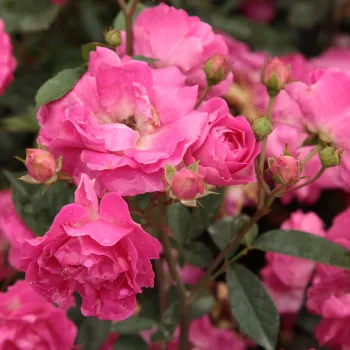
Semi-double, cup-shaped, cluster-flowered blooms with 13–25 petals, small in size yet produced abundantly, giving good repeat flowering with a notably generous second flush. |
| Colour data and phenology |
Dark pink flowers (RHS 53A outer, 60A inner) with pale centres and yellow stamens, holding colour well with only slight softening towards a mauve-pink tone as the blooms age. |
| Fragrance and aroma |
The variety is described as scentless, offering no noticeable fragrance, so it is chosen primarily for reliable colour effect, flower form and bedding performance rather than perfume. |
| Hip characteristics |
Produces moderate quantities of small, spherical rose hips about 6–9 mm across, bright red (RHS 43A) when ripe, adding a discreet late-season decorative element in established plantings. |
| Resistance and winter hardiness |
Hardy to approximately −21 to −18 °C (RHS H7, Swedish Zon 3, USDA 6b), with noted drought and heat tolerance but only medium resistance to mildew and black spot and high rust sensitivity. |
| Horticultural recommendations |
Best in sunny, well-drained beds or large containers; space 25–50 cm depending on use, monitor for fungal diseases, and use balanced feeding to support repeat flowering in busy gardens. |
LIPPAY JÁNOS offers compact structure, long-season colour and dependable heat tolerance in an own-root form that settles in for years of service; a thoughtful choice if you want lasting impact from a modest planting effort.