Climbing and Rambling Roses

80-015-1
80-015-2

Joseph's Coat

Climbing rose

- – Dr. David L. Armstrong; Herbert C. Swim

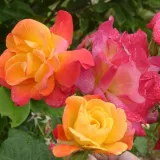
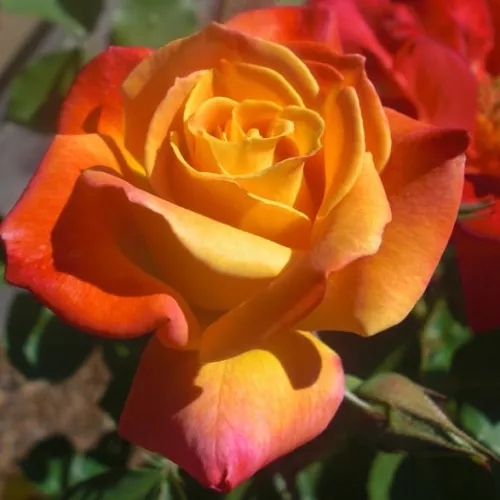
The petals range from vivid yellow through orange to carmine red. The tones change continuously throughout the flower’s life cycle. - climber, rambling rose - mild, understated-scented rose - fresh, crisp character

– Vivid, ever-changing yellow, orange and red blooms.
– Reliable repeat flowering with abundant clusters.
– Tall, vigorous climber for walls and pergolas.
– Glossy dark foliage for strong garden presence.
– Hardy to USDA Zone 4b for cold climates.
Special feature: Awarded at Bagatelle and National Rose Society trials for its striking, multicoloured display.
Dream-garden-focused decision – Trusted online shop
Joseph's Coat
eleanorROSE® ORIGINAL 2-litre own-root potted rose
24,90 £
Unfortunately, we are currently unable to ship to the United Kingdom; we only deliver to countries within the European Union. For more information, please contact us!
3.5 (5274)
facebook   twitter

JOSEPH'S COAT – yellow-red climbing rose - Armstrong & Swim

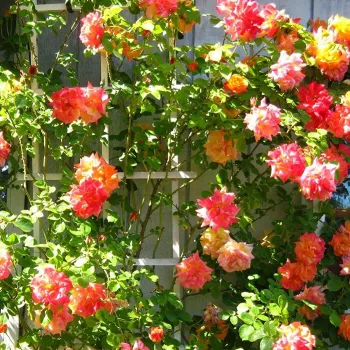
With its ever-changing colour display from golden yellow through orange to rich red, JOSEPH'S COAT brings a sense of living drama to modest London front gardens and compact family plots. This climber’s medium-sized, double blooms appear in clusters, creating generous vertical impact on fences, arches and house walls, while glossy dark green foliage gives year-round structure. As an own-root rose, it establishes steadily and is capable of long-term regrowth, offering a dependable presence with relatively little fuss once settled. Particularly reassuring where front gardens face strong wind and frequent rain on heavy soils that benefit from improved drainage, its hardiness and moderate disease tolerance suit real-life British conditions. In its first year it concentrates on roots, the second on building shoots, and by the third year it reveals its full ornamental value in a mature, multicoloured curtain of flower.


Usage options

Target area Reasoning
Front-garden house wall or terrace façade Ideal where you want maximum colour from minimal ground space: trained flat on a wall or trellis, JOSEPH'S COAT forms a slim, upright curtain of changing yellow, orange and red, giving long-season drama without crowding the path – perfect for the time-poor city-front gardener customer
Pergola, arch or walkway over a narrow path Its climbing habit and medium-sized clustered flowers allow you to frame a route with light, airy arches rather than dense, heavy growth, creating that “post‑rain walkway” feel while still letting light through – suited to romantic yet practical garden planners buyer
Rainwater-conscious, heavy-soil family garden Works well in borders where downpipes or paving run-off are directed into planting beds, as own-root plants cope better with occasional waterlogging once established, especially where soil structure has been improved for steadier drainage in wet, windy British spells – reassuring for sustainability-focused householders gardener
Specimen climber for small to medium gardens With a mature height of around 2.4–4 m and 1–1.8 m spread, it delivers a strong focal point without overpowering typical family gardens, rewarding basic training and tying-in with months of repeat flower – ideal for beginners wanting one reliable “wow” plant owner
Large containers on balcony or paved courtyard In a minimum 40–50 litre pot with good drainage, this own-root climber can be grown where borders are impossible, covering railings or privacy screens and providing long-lived structure that can regenerate from the base if winter or pruning knocks it back – helpful for balcony and patio dwellers resident
Cut-flower corner or picking route The medium, cup-shaped, double blooms with their shifting sunset tones make attractive, characterful stems for the vase; regular cutting doubles as deadheading, encouraging further flushes and keeping the plant tidy for those who like flowers indoors and out user
Low-input, long-lifespan planting plans Being supplied on its own roots means the plant ages as a single, stable individual: no graft union to fail, and damaged canes can be replaced from new basal shoots, giving decades of service with simple annual pruning and feeding once established – ideal for long-term planners household
Mixed structural backdrop with shrubs and perennials Moderately dense, glossy foliage and medium self-cleaning make it a strong visual anchor behind softer plants such as lavender, nepeta or compact grasses, adding vertical rhythm and colour while remaining manageable with standard seasonal care – suited to design-conscious yet busy gardeners visitor

Styling ideas

  • Sunset-Façade – Train JOSEPH'S COAT on a slim trellis by a London townhouse door, underplanting with low Sagina subulata to soften paving edges – for urban homeowners wanting vertical colour without losing precious floor space
  • Romantic-Arch – Use two plants at the base of a metal arch over a narrow path, interweaving with lavender for fragrance and soft contrast – for couples creating a welcoming, photo-friendly entrance to the garden
  • Courtyard-Screen – Grow it in a 50 litre pot against a rail or screen, pairing with nepeta in containers below to blur hard lines – for balcony and patio gardeners seeking privacy and all-summer flower
  • Family-Backdrop – Let it climb a sturdy fence behind a play area, mixing with Waldsteinia ternata as an easy ground layer to keep maintenance low – for busy families who still want a colourful, tidy boundary
  • Warm-Border – Combine its fiery blooms with purple sage and ornamental grasses in a sunny bed to create a long-season, drought-tolerant look once established – for gardeners who prefer resilient, characterful planting over frequent tweaking

Technical cultivar profile
Property Data
Name and registration Large-flowered climbing rose marketed as Joseph's Coat, a yellow-red climber from the Armstrong & Swim breeding partnership; recognised exhibition name Joseph's Coat in American Rose Society records.
Origin and breeding Bred in the United States in 1963 by Dr. David L. Armstrong and Herbert C. Swim from 'Buccaneer' × 'Circus', introduced and initially distributed by Armstrong Roses in 1964.
Awards and recognition Early performance confirmed by major trial successes, including National Rose Society Trial Ground Certificate in 1963 and a prestigious Bagatelle (Paris) Gold Medal in 1964.
Growth and structural characteristics Vigorous climbing habit reaching about 2.4–4 m in height with a 1–1.8 m spread, moderately dense, glossy dark green foliage and densely thorned shoots, showing medium self-cleaning of spent blooms.
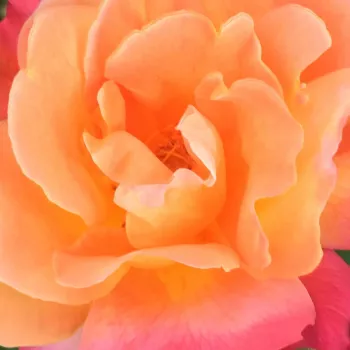
Flower morphology Medium-sized, double, cup-shaped flowers with roughly 26–39 petals, borne in clusters on the canes; remontant character provides an abundant second flush after the initial main flowering period.
Colour data and phenology Multicoloured yellow-red blooms (RHS 46A outer, 14B inner) shifting from vivid yellow, orange and red to warmer peach, golden and copper tones, with fiery red petal edges at full bloom and moderate overall colour retention.
Fragrance and aroma Fragrance is mild and understated with a fresh, crisp character rather than heavy perfume; double flowers prioritise ornamental display, so scent is noticeable close up rather than across the garden.
Hip characteristics Occasionally produces small, spherical rose hips about 8–13 mm in diameter, coloured orange-red when ripe, adding discreet seasonal interest without dominating the plant’s late-season appearance.
Resistance and winter hardiness Rated H7 with USDA hardiness around zone 4b, tolerating approximately −32 to −29 °C; disease resistance is medium for powdery mildew, black spot and rust, with moderate heat tolerance given adequate watering.
Horticultural recommendations Best on sunny, well-drained sites with support for climbing stems; suitable for walls, fences, pergolas and arches, with moderate maintenance including tying-in, seasonal pruning, feeding and occasional plant protection as needed.

JOSEPH'S COAT offers dramatic changing colour, compact vertical impact and long-lived own-root resilience for walls, arches or large containers, making it a thoughtful, low-fuss choice if you would like a climber with character.
Detailed product attributes

Product Identification Data

Product Name: JOSEPH'S COAT – yellow-red climbing rose - Armstrong & Swim
Product Type: eleanorROSE® ORIGINAL - 2-litre own-root potted rose
Cultivar Authenticity: Verified:26.04.2025
Cultivar Quality Rating: premium gold
Item Number: [1013] 80-015 (14.02.2026) eleanorrose.co.uk

Name and Registration

Meaning of Cultivar Name: The name refers to the biblical Joseph’s multicoloured coat.
Original Trade Name: Joseph’s Coat
Current Trade Name: Joseph's Coat Climbing rose Armstrong & Swim
Rose Group: Large-Flowered Climber
Commercial Type: climber, rambling rose
Commercial Group: Climbing rose
Exhibition Category: climbing rose
Collection: Climbing rose

Origin and Breeding

Initial Distributor: Armstrong Roses (USA)
Breeder: Dr. David L. Armstrong; Herbert C. Swim
Breeding Year: United States, 1963
Parentage: 'Buccaneer' × 'Circus'

Awards and Honours

Competition and Show Awards: National Rose Society Trial Ground – Certificate (1963); Bagatelle (Paris) – Gold Medal (1964)

Growth and Structural Characteristics

Height: 7.9-13.1ft (240-400 cm)
Spread: 3.3-5.9ft (100-180 cm)
Growth Habit: climbing
Foliage: The variety has moderately dense foliage, with glossy, dark green leaves.
Prickliness: densely thorned
Self-Cleaning Description: Some of the spent blooms remain on the plant and will require subsequent deadheading.
Self-Cleaning Intensity: Self-cleaning: medium.

Flower Morphology

Petal Count: 26-39
Flower Fullness: double-flowered
Flower Shape: cup-shaped
Flower Size: M (1,5-2,75 in)
Inflorescence Type: clustered
Colour Code: ARS code: rb RHS code: 46A (outer), 14B (inner)
Repeat Flowering: Remontant, its second flowering is also abundant.

Colour Data and Phenology

Colour: yellow-red
Flower Colour Description: The petals range from vivid yellow through orange to carmine red. The tones change continuously throughout the flower’s life cycle.
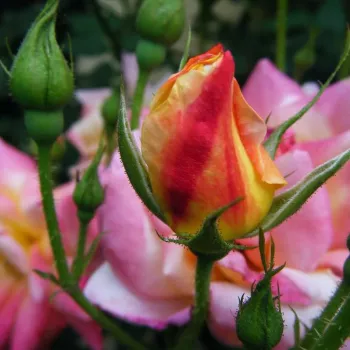
Closed Bud: Vibrant red‑orange hue with a subtle yellowish tinge.
Newly Opened Flower: The outer whorl of petals is reddish-orange, the inner petal surfaces are golden yellow.
Full Bloom: The petal edges turn fiery red, and an orange flush is visible along the fold lines.
Before Fading: The red tone softens and a warm peach‑yellow to copper tint appears.
Colour Fading Description: During opening, the vivid yellow–orange–red shades gradually mellow into warm peach–golden–copper tones, with a reduction in red intensity.

Fragrance and Aroma

Fragrance Strength: mild, understated-scented rose
Fragrance Character: fresh, crisp character
Pollinator Attraction: Double (26–39 petal) flowers with reduced stamen accessibility offer limited attraction to pollinators.
Pollinator-Friendly Rating: Its double (26–39 petal) flowers make it primarily ornamental; its pollinator-friendliness is limited.

Hip Characteristics

Hip Shape: spherical
Hip Colour: orange-red
Hip Comment: Occasionally formed, 8–13 mm in diameter, spherical, orange-red rose hip.

Resistance and Hardiness

Hardiness (°C): -32–-29 °C
Heat and Drought Tolerance Description: Heat-loving; requires watering during prolonged drought.
Disease Resistance: medium
  • powdery mildew – medium
  • black spot – medium
  • rust – medium

Horticultural Recommendations

Recommended Planting Distance: for mass planting 160 cm, for hedging 150 cm, as a specimen plant 250 cm
Planting Density: square planting 0,4 plants/m², hexagonal arrangement 0,5 plants/m²
Partial Shade Tolerance: Suitable for partial shade
Maintenance Requirement: Maintenance requirement moderate; occasionally requires plant protection treatments.
Primary Uses: pergola, fence, wall-trained, cut flowers, specimen plant

Comments

Strengths: Dream-garden-focused decision – Trusted online shop
Companion Plants: Sagina subulata - Irish moss Lonicera nitida ‘Maigrün’ - groundcover honeysuckle Waldsteinia ternata - barren strawberry
Comment: -
JOSEPH'S COAT – yellow-red climbing rose - Armstrong & Swim
The petals range from vivid yellow through orange to carmine red. The tones change continuously throughout the flower’s life cycle. - climber, rambling rose - mild, understated-scented rose - fresh, crisp character
The rose webshop. - yellow-red - Joseph's Coat - climber, rambling rose - (7.9-13.1ft (240-400 cm))
Inflorescence: clustered Height: 7.9-13.1ft (240-400 cm) Flower shape: cup-shaped Winter hardiness: 4b yellow-red - Armstrong Roses (USA) climber, rambling rose - Flower size: M (1,5-2,75 in) Flower size: M (1,5-2,75 in) - Height: 7.9-13.1ft (240-400 cm) Height: 7.9-13.1ft (240-400 cm) - Flower fullness: double-flowered Joseph's Coat - Roses in the garden | eleanorROSE® Original - premium gold Dr. David L. Armstrong; Herbert C. Swim

We showcase the external appearance of the roses available for online purchase from our webshop.


Which product type is right for you?


Information

In what condition do we send the rose from our online webshop?

Let us ask ourselves the question: What would I like to use the rose for?
Flower? - Location? - Screening? - Fragrance? - Height? - Breeder? - Rose hip?

Information on buying roses
Methods of payment - Delivery costs - Delivery - Complaints handling

Care guide

Our product is a rose grown with pharmaROSA®’s unique cultivation technology!

2-litre, own-root, potted rose.
With a shoot system appropriate to the season.
With a root system that thoroughly permeates the growing medium.
Quality compliant with the requirements of the E.N.A. (European Nurserystock Association).
Supplied in unique packaging that prevents damage.
Can be planted during frost-free periods.
True-to-variety rose bush with a unique identifier.

The pharmaROSA® own-root potted rose is a well-rooted plant that supports reliable establishment when planted and cared for properly, so it can be planted whenever the soil is not frozen.


Crop overview: several varieties and growth stages in a short crop section.
Shoot system: intensive growth of fresh basal shoots on a young plant.
Root system: demonstration of a vigorous root system permeating the growing medium, by removing the pot.
Balance: mature plant with root system and shoots in harmony with each other.

Information about the videos
The video series is not a “seasonal showcase”; it illustrates the essence of pharmaROSA® own-root cultivation in a tangible way: how the plant is built up, what the root system is like and how the shoot system regenerates. The recordings were therefore made at different times and with plants at various stages of development, so mixed foliage levels and differing stages of growth may appear in the videos. They are not a ‘sample’ of the batch dispatched, but a visual explanation of how the technology works. The current condition of the rose available to order — typical for the given period and similar to what you can expect to receive in the parcel — is shown in the upper part of the product page.

pharmarosa.itpharmarosa.sepharmarosa.fipharmarosa.eekarolinarose.pldanielarose.espharmarosa.compharmarosa.skpharmarosa.atpharmarosa.co.ukpharmarosa.czpharmarosa.depharmarosa.ropharmarosa.sipharmarosa.hrpharmarosa.frpharmarosa.grpharmarosa.dkpharmarosa.nlpharmarosa.iepharmarosa.bepharmarosa.lupharmarosa.ptpharmarosa.bgpharmarosa.ltpharmarosa.lvpharmarosa.ru

Product types

Pages for private customers
Garden roses for the family garden, with minimal care  → ORIGINAL®
Premium garden roses – instant impact, a truly showpiece garden  → EXTRA®
Pages for professionals and private customers
Roses for public spaces – large areas, sustainable maintenance  → NATURAL®
Roses for projects – hedge and row planting, fast implementation  → RAPID®
For professional partners only
Production – propagation material for garden roses, wholesale  → NEONATAL®

Company details

PharmaRosa Ltd.
Company registration number: 01-09-717479
VAT number: 13075314-2-43
Plant health registration no.: HU130721
Bank account (IBAN):
HU85117631891388688400000000
BIC (SWIFT): OTPVHUHB
Bank name: OTP Bank Nyrt.