ISKRA™ – scarlet-red climbing rose - Meilland
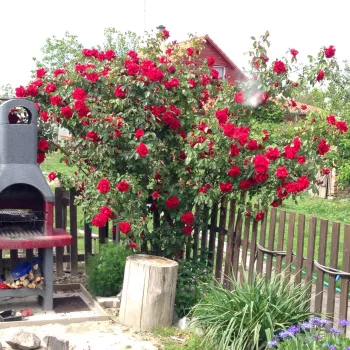
Step out after rain into a front garden washed clean, where Iskra sends scarlet clusters arching overhead and along narrow London boundaries, thriving even where wind and showers regularly test plants in exposed, town-house spaces with heavier soils. This own-root climber establishes steadily, giving you a reassuring sense of balance between vivid display and straightforward care, with no complicated pruning regime. In its first year it quietly strengthens its roots, in the second it builds confident shoots, and by the third it reaches full ornamental presence along walls, railings or pergolas. Semi-double blooms provide open centres with visible stamens, making a gently pollinator-friendly choice that still looks plush and romantic from the pavement. Once-flowering, it puts all its energy into a spectacular early-summer season, then settles into a neat green backdrop, the own-root structure supporting long longevity with stable growth and reliable cover for years to come.
Usage options
| Target area | Reasoning |
|---|
| Terraced-house front fence |
Ideal for greening narrow London frontages, its arching, creeping habit quickly clothes metal railings or timber fencing without demanding constant trimming. Once it settles, you mainly guide new canes and enjoy the concentrated early-summer flush, perfect for a time-poor homeowner |
| Pergola or rose arch |
The long, flexible canes train easily over a pergola or arbour, creating a dramatic, once-a-year scarlet tunnel that feels immersive yet manageable. After flowering, foliage remains tidy, giving shade and privacy with minimal follow-up work, suiting the relaxed hobby-gardener |
| Wall or garage-side greening |
On a sunny south or west-facing wall, Iskra provides strong vertical impact without needing intricate pruning skills. Occasional tying-in and seasonal checks for common rose problems are usually sufficient, a realistic commitment for the busy urban beginner |
| Rainwater-conscious front garden |
Suited to sites that often receive wind-driven rain, it partners well with a free-draining, improved soil so excess water moves away from the roots rather than pooling. Combined with ground-level planting, it helps soften hard landscaping for the sustainability-minded city-dweller |
| Family side boundary or hedge line |
Recommended spacing makes it practical for informal flowering screens along side paths or drive boundaries, giving colour at adult eye-level while keeping the base open for perennials. Moderate thorns discourage cutting through, yet overall care remains simple for a typical family |
| Large container on balcony or patio |
In a substantial, 40–50 litre peat-free container with good drainage, Iskra can be trained up a slim obelisk or balcony trellis, bringing vertical drama where ground space is limited. Regular watering with collected rainwater supports sustainable choices for the thoughtful balcony-owner |
| Pollinator-conscious planting strip |
The semi-double flowers offer accessible stamens and moderate insect interest, especially when combined with long-flowering companions. Use it as the structural backdrop to pollinator-focused underplanting, allowing bees to move between layers that appeal to the eco-aware gardener |
| Low-input long-term feature |
As an own-root climber, it re-sprouts reliably from its base, maintaining form even after weather damage or harder pruning. Over time it offers stable cover and repeatable performance with limited intervention, making sense for anyone planning a durable investment |
Styling ideas
- Scarlet-Statement – Train Iskra over a black metal arch with lavender and Nepeta at the base for a bold, bee-friendly entrance that suits contemporary front gardens – ideal for beginner urban homeowners
- Soft-Romantic – Pair Iskra on a wooden pergola with pale pink climbing roses and airy grasses to soften boundaries while keeping maintenance light – suited to time-pressed family gardeners
- Clay-Frontage – Improve heavy soil with grit and compost, then let Iskra climb railings above low sage and bearded iris ribbons – perfect for sustainability-focused terrace residents
- Balcony-Vertical – Grow Iskra in a 50 litre container with peat-free mix and a slim obelisk, underplanted with trailing thyme for scent – ideal for space-limited city dwellers
- Walkway-Canopy – Use Iskra to form a scarlet tunnel along a side path, with white Artemisia and Nepeta edging to attract insects – perfect for hobby gardeners wanting summer drama
Technical cultivar profile
| Feature | Data |
|---|
| Name and registration |
Climbing Hybrid Wichurana rambler; registered as MEIhaiti, marketed as Iskra™ Rambling rose MEIhaiti, also exhibited as Sparkling Scarlet in American Rose Society classifications. |
| Origin and breeding |
Raised by Marie-Louise Meilland, Meilland International SA; bred in Germany around 1969 and introduced by Meilland International (France) circa 1971 as a scarlet-red climbing garden rose. |
| Growth and structural characteristics |
Creeping, flexible climber reaching about 240–360 cm high and 150–260 cm spread, with moderately dense, slightly glossy bronze-green foliage and a moderately thorny framework suitable for training. |
| Flower morphology |
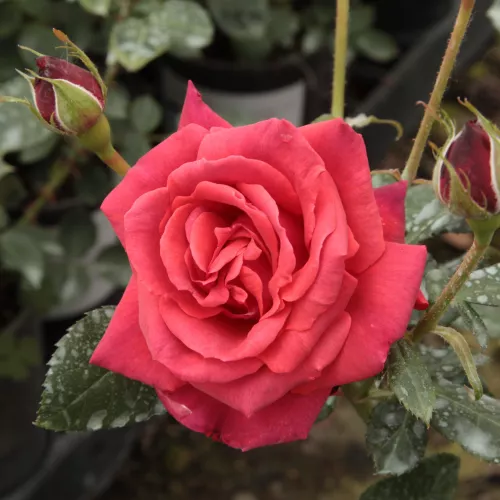
Semi-double, cupped blooms with a medium high-centred form, typically 13–25 petals and medium size, produced in clustered trusses for a single but showy main flowering period in early summer. |
| Colour data and phenology |
Bright scarlet-red with an orange tone; buds deep and velvety, then fiery red, softening to coral-red before petals fall, with generally good colour retention and visible yellow stamens at full bloom. |
| Fragrance and aroma |
Very weak, subtly rosy fragrance detectable at close range only; not chosen primarily for scent, but for visual impact and structural use over arches, pergolas, walls and similar garden features. |
| Hip characteristics |
Moderately abundant spherical hips, about 16–24 mm diameter, developing an orange-red colour that adds seasonal interest after flowering and may offer incidental wildlife value in late season. |
| Resistance and winter hardiness |
Rated H6 RHS hardiness, tolerating approximately −15 to −12 °C; black spot generally resistant, powdery mildew and rust of medium susceptibility, requiring occasional monitoring and treatment where needed. |
| Horticultural recommendations |
Best in full sun with improved drainage; ideal for pergolas, fences, walls and arbours, spaced 140–220 cm apart, with light training, medium maintenance and routine health checks through the season. |
ISKRA™ – scarlet-red climbing rose - Meilland offers a concentrated summer display, reliable climbing structure and long-term own-root resilience; a considered choice if you seek lasting colour with manageable care.