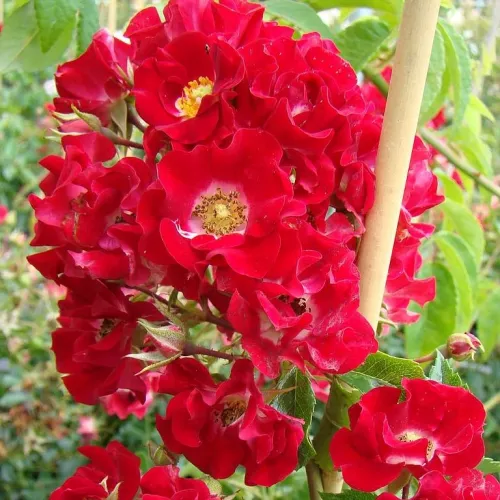
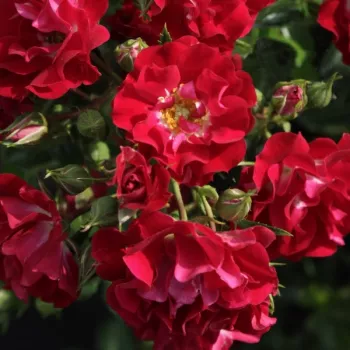
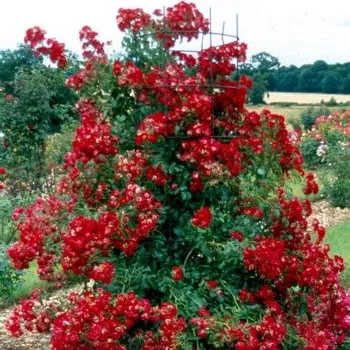
HORJASPER – red climbing rose
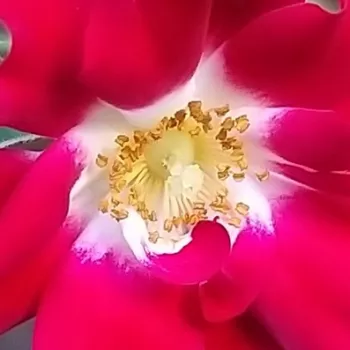
Step out after rain into a tunnel of colour and light as HORJASPER clothes arches, fences and house fronts in cascades of scarlet-red clusters that hardly pause between flushes. This repeat-flowering rambler climbs vigorously yet remains easy to guide, creating a strong sense of balance in compact London front gardens and narrow side returns. The small, semi-double blooms open in airy clusters, their white eyes catching every shaft of sunlight above dark, glossy foliage that reads as instantly ornamental even at a distance. Self-cleaning flowers mean spent petals fall away cleanly, reducing deadheading and keeping paths and gravel looking cared-for with very little effort. Planted into well-prepared soil that copes with heavy rain and sticky clay by improving drainage and structure from the outset, this climber quickly becomes a long-term investment in your front garden’s character. As an own-root rose, it regenerates from its base and settles in for decades, typically building roots in year one, stronger flowering shoots in year two, and full, arch-filling impact by year three, giving your sustainable city garden a quietly enduring presence.
Usage options
| Target area | Reasoning |
|---|
| Front-garden arch or rose tunnel |
The long, flexible canes and repeat-flowering clusters are ideal for training over a metal or wooden arch, creating a welcoming, near-continuous display through the season with minimal deadheading thanks to its self-cleaning habit, well suited to the busy urban gardener. |
| Wall or fence greening in small gardens |
Vigorous height with moderate spread lets HORJASPER quickly clothe plain brickwork or fencing without swallowing the whole garden, turning hard boundaries into a scarlet backdrop that makes the most of limited city space for the design-conscious homeowner. |
| Rainwater-friendly planting along driveways |
Planted into improved clay beside gravel strips or permeable paving, this climber draws the eye upward while leaving ground level free for soakaway planting, supporting a more rain-resilient, greener frontage for sustainability-focused residents. |
| Part-shade side return or alleyway |
Good performance in partial shade and the luminous white eye at the centre of each scarlet flower help brighten narrow side paths and alleyways that only receive a few hours of sun, adding colour and structure for light-challenged gardens. |
| Large container on terrace or balcony (50–80 L) |
In a generous, well-drained 50–80 litre container with a sturdy obelisk or trellis, HORJASPER delivers vertical drama and repeat colour where soil is limited, offering a practical way to introduce a climber for space-conscious balcony owners. |
| Family seating area backdrop |
The dense, dark green foliage and airy clusters of small blooms form a soft, textured screen behind benches or dining sets, adding privacy and seasonal interest without overwhelming conversation spaces for relaxation-seeking families. |
| Structure planting with improved drainage on heavy clay |
Where sticky soils are common, incorporating grit and organic matter before planting helps roots spread, while HORJASPER’s height and narrow footprint provide long-term vertical structure in rain-prone, clay-based plots for long-view gardeners. |
| Wildlife-friendly mixed screen |
Occasional pollinator visits to its semi-double flowers, combined with autumn hips that extend the season, make this rose a decorative component in a wildlife-aware screen when paired with insect-rich shrubs for nature-minded beginners. |
Styling ideas
- Scarlet-Frame Entrance – Train HORJASPER over a narrow arch by the front gate, underplant with Geranium macrorrhizum for scented, weed-suppressing groundcover – ideal for low-fuss city front-garden owners
- Brickwork-Softening Screen – Fan the climber along wires on a terrace wall, interweaving common ivy for winter cover and year-round texture – suited to terrace households wanting softer boundaries
- Balcony-Rose Column – Grow in a 60 litre pot with a slim obelisk, adding trailing herbs at the base for scent and extra greenery – perfect for balcony gardeners seeking vertical drama
- Companion-Arch Mix – Pair HORJASPER on a pergola with sweet autumn clematis for late-season froth over the scarlet clusters – attractive to enthusiasts building a long-season walkway
- Family-Dining Backdrop – Use as a climbing backdrop behind an outdoor table, flanked by tough perennials and low groundcovers to keep maintenance practical – great for families who entertain outdoors
Technical cultivar profile
| Characteristic | Data |
|---|
| Name and registration |
Repeat-flowering rambler and climbing rose; registered as HORjasper, marketed as HORjasper – red climbing rose, also exhibited under the American Rose Society name ‘Rambling Rosie’ for show purposes. |
| Origin and breeding |
Bred in the United Kingdom by Colin P. Horner from Super Excelsa × (Baby Love × Golden Future); introduced and first distributed by Warner’s Roses in 2005 after UK breeding work completed in 2001. |
| Awards and recognition |
Highly decorated climber with Gold Standard Award (2007), RHS Award of Garden Merit (2012), Glasgow Rose Trials Golden Prize (2010) and Hague Rose Trials Bronze Certificate (2010) confirming garden performance. |
| Growth and structural characteristics |
Strong climbing habit, typically 300–500 cm high with 100–220 cm spread, dense dark green glossy foliage and plentiful thorns; self-cleaning flowers help maintain a tidy appearance on arches, fences and pergolas. |
| Flower morphology |
Semi-double, flat, cluster-flowered blooms with 13–25 petals and small individual flower size; remontant repeat-flowering habit, with a particularly generous second flush providing extended seasonal interest on supports. |
| Colour data and phenology |
Intense scarlet-red flowers (RHS 46A outer, 46B inner) with a white eye; colour holds well then fades towards carmine-red with an almost pure white centre as blooms age, giving layered colour effects through each flush. |
| Fragrance and aroma |
Very light rose scent, generally only faintly perceptible at close range, so chosen more for visual impact than perfume; suitable where strong fragrance is not required or might compete with scented companion plants. |
| Hip characteristics |
Produces moderate quantities of small, spherical hips about 6–10 mm across, orange-red when ripe; hips add modest late-season colour and can provide incidental wildlife interest in mixed planting schemes. |
| Resistance and winter hardiness |
Hardy to approximately −21 to −18 °C (RHS H7, USDA 6b, Swedish Zone 3); tolerates heat well with moderate drought tolerance, but shows moderate mildew and black spot and high rust susceptibility, needing regular protection. |
| Horticultural recommendations |
Best on walls, fences, pillars, arches or pergolas, also in 50+ litre containers; space 140–240 cm depending on use, allowing airflow; in disease-prone areas plan consistent hygiene and preventative care through the season. |
HORJASPER offers award-backed repeat flowering, strong vertical structure and self-cleaning clusters on a long-lived own-root framework, making it a thoughtful choice for gardeners ready to commit to a characterful climbing rose.