HONORINE DE BRABANT – pink historic Bourbon rose - Tanne
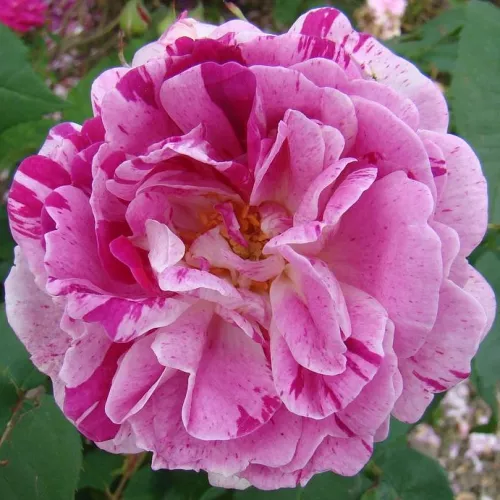
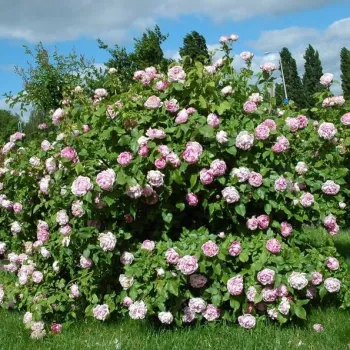
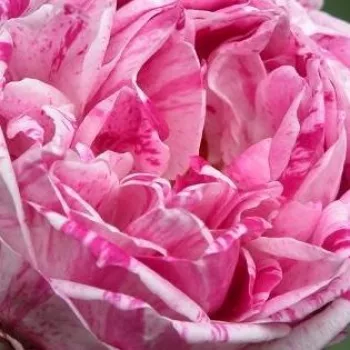
Step through your front gate and you meet fragrance, a historic Bourbon rose whose richly striped pink blooms release a strong, sweet, fruity perfume after rain, creating a calm sense of balance in even the smallest London terrace. Tall, upright, arching growth gives gentle structure for narrow front gardens, while the semi-double flowers offer accessible pollen for visiting bees, adding a quietly pollinator-friendly note to your planting. As an own-root shrub, it ages with reassuring stability, capable of regenerating from the base and keeping its ornamental value for decades with modest care. It copes reliably with blustery showers and city weather, supporting gardens where heavy soil and regular rainfall call for planting that works with water rather than against it. Over time you will see the natural rhythm of an own-root rose: in year one it concentrates on roots, in year two it builds stronger shoots, and by year three it settles into its full historic charm, rewarding patient gardeners with abundant, repeat-flowering display.
Usage options
| Target area | Reasoning |
|---|
| Narrow London front gardens |
The upright, arching habit and 150–220 cm height create a vertical curtain of scented colour without stealing precious pavement space, ideal beside a path, railings or low wall for those who want character in a tight footprint, particularly beginners. |
| Rainwater-friendly, heavy-soil borders |
This rose performs reliably in moisture-retentive ground, working well with mulched clay or improved chalky soils where regular rain accumulates, supporting gardens that manage water on site rather than paving it over, well suited to sustainability-focused. |
| Low-effort cottage-style planting |
Remontant flowering with an abundant second flush gives a long season of colour with only moderate maintenance, perfect for relaxed cottage schemes where a little deadheading and occasional pruning fit easily into the routine of busy-owners. |
| Long-lived family garden feature |
As an own-root historic shrub, it can mature into a durable, regenerative presence that regrows from the base if weather or pruning are harsh, offering a reassuring, long-term focal point for evolving family spaces valued by homeowners. |
| Partial-shade side returns |
Tolerant of partial shade, it will still flower and scent walkways on east- or west-facing boundaries, softening side paths between house and garden where sun hours are limited yet visual charm is appreciated by terrace-dwellers. |
| Romantic, “girly” entrances |
Striped pink, mauve and carmine blooms read as soft and feminine, pairing beautifully with gravel, vintage pots and painted railings to frame an entrance with a gentle, nostalgic mood that particularly appeals to romantics. |
| Pollinator-friendly mixed borders |
Semi-double, cluster-flowering blooms provide accessible nectar and pollen through repeat flushes, especially when partnered with herbs such as thyme or lavender, supporting foraging routes for urban bees appreciated by wildlife-lovers. |
| Large containers on balconies or patios |
In a 40–50 litre or larger pot with peat-free compost and regular watering, it becomes a tall, scented accent that screens views and creates privacy, ideal where soil is limited but a substantial, classic rose is still desired by balcony-gardeners. |
Styling ideas
- Striped-Boulevard – Underplant with creeping thyme and low gravel to echo the stripes and allow rain to drain between stones – perfect for design-conscious terrace-dwellers.
- Front-Drama – Train the arching stems against dark railings, with lamb’s ear at the base to catch petals and light – ideal for homeowners seeking strong kerb appeal.
- Pastel-Blend – Mix with soft nepeta and pale salvias so pollinators drift between flowers all summer – suited to wildlife-friendly family gardens.
- Heritage-Hedge – Plant a loose row at 80–90 cm spacing along a boundary for a fragrant, semi-transparent historic screen – attractive to lovers of traditional streetscapes.
- Balcony-Muse – Grow one specimen in a large, 50 litre terracotta pot with trailing thyme to soften the rim and catch rain – ideal for busy urban beginners.
Technical cultivar profile
| Feature | Data |
|---|
| Name and registration |
Bourbon shrub rose, collection Historic rose; trade names Honorine de Brabant, Historic rose, Tanne; ARS exhibition name Honorine de Brabant; unregistered cultivar with verified authenticity. |
| Origin and breeding |
Natural mutation of ‘Commandant Beaurepaire’, bred by Hyacinthe Rémi Tanne in France and introduced in 1916; initially distributed by Rémi Tanne; historical, own-root form for garden use. |
| Awards and recognition |
Holds the RHS Award of Garden Merit, indicating proven performance, reliability and ornamental value under typical UK garden conditions when grown with reasonable care. |
| Growth and structural characteristics |
Upright, arching shrub 150–220 cm high and 110–160 cm wide, with dense, lightly glossy mid-green foliage and relatively few thorns, forming a soft yet structural presence in borders. |
| Flower morphology |
Semi-double, cup-shaped, cluster-flowering blooms of medium size with 13–25 petals; remontant with an abundant second flush, though spent flowers benefit from light manual deadheading. |
| Colour data and phenology |
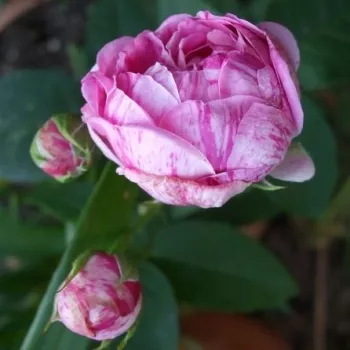
Base colour light pink broadly striped crimson-purple (RHS 65D, 67A); buds creamy pink with lilac streaks; colours soften and striping blurs in strong sun as flowers age on the plant. |
| Fragrance and aroma |
Strong, distinctive perfume with sweet, fruity, rosy character; scent often intensifies in humid, post-rain conditions, making it especially noticeable near doors, paths and seating. |
| Hip characteristics |
Moderate formation of small, ovoid orange-red hips around 10–15 mm, adding autumn interest and a light wildlife resource if flowers are not all deadheaded after the main flush. |
| Resistance and winter hardiness |
Hardy to about −26 to −23 °C (RHS H7, USDA 5b); disease resistance moderate to black spot, mildew and rust, so occasional preventative care is advisable in humid summers. |
| Horticultural recommendations |
Ideal as a scented specimen, loose hedge or park shrub; suitable for partial shade; plant 80–150 cm apart; thrives in improved, well-drained soil with regular watering during hot spells. |
HONORINE DE BRABANT offers strong fragrance, long-season flowering and a tall, structural presence in a durable own-root form, making it a thoughtful choice if you would like a romantic yet reliable historic rose.