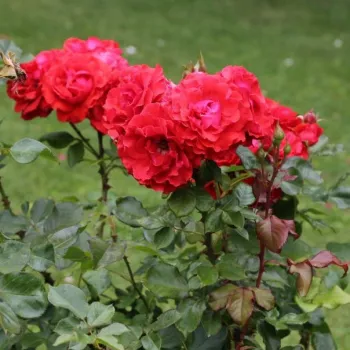
HANSESTADT LÜBECK® – red bedding floribunda rose - Kordes
In a compact London front garden or on a small terrace, sustainable planting matters as much as colour, and HANSESTADT LÜBECK® offers a quietly reliable, deep-red focus without demanding your weekends. This upright floribunda builds a stable framework over time, rewarding you with generous repeat flowering and a balanced, mid‑green backdrop that works effortlessly with gravel, brick or paving in rainwater‑friendly spaces, even where the soil stays heavy and holds winter wet after prolonged showers. Its semi‑double blooms have a classic rose look and invite visiting pollinators, while own‑root plants mean fewer concerns about graft failure and a naturally longer lifespan in family gardens. Given a sunny spot and ordinary attention, it settles in as a dependable hedge, low border or structural feature, developing strong roots in the first year, fuller shoots in the second, and its true ornamental potential by the third season.
Usage options
| Target area |
Reasoning |
| Small front-garden flower bed |
The neat 100–140 cm height and mid‑green foliage give strong structure without overpowering tight urban spaces, while the deep-red repeat blooms carry the border visually for months with only light seasonal pruning, ideal for time-pressed beginners and busy-owners |
| Low informal hedge along a path |
Planted at about 50 cm intervals, the upright habit forms a low, continuous line that frames paths or drives, the semi‑double flowers adding softness while own‑root resilience supports a long-lived, easily refreshed hedge for family-gardeners |
| Mixed perennial and shrub border |
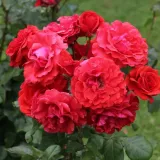
Clustered red cups combine well with perennials like lavender or Nepeta, repeating from summer into autumn and providing a reliable vertical accent that maintains interest even when surrounding perennials are cut back, suiting design-minded home-owners |
| Rainwater-aware urban planting strip |
This rose copes with typical British heavy clay once drainage is improved, sitting comfortably in front gardens that collect runoff from paving, and its sturdy frame stands up well where wind funnels between buildings, supporting sustainability-focused city-gardeners |
| Pollinator-supportive family garden |
Semi‑double flowers with 13–25 petals offer moderate access to stamens, giving visiting insects usable pollen while still looking full and decorative, a good compromise for those wanting wildlife value without sacrificing display, especially eco-conscious |
| Low-maintenance bedding schemes |
Once established, it repeats flower with modest feeding and routine deadheading, the floribunda habit giving clusters of colour that knit together into a solid sheet of red, simplifying care for those who prefer straightforward, once-over maintenance, particularly beginners |
| Long-term structural planting |
As an own‑root shrub it ages evenly, with no graft line to fail and strong regeneration from the base after harder pruning, making it a sound investment where you want a stable, repeat-flowering feature that will anchor the space for years, reassuring planners |
| Large container on terrace or balcony |
In a 40–50 litre peat‑free compost mix with good drainage, the upright, moderately thorny shoots and dense foliage create a vertical accent that partners well with underplanted herbs, bringing classic rose character to paved spaces for balcony-owners |
Styling ideas
- Terrace-Accent – Place a single HANSESTADT LÜBECK® in a 50-litre pot with trailing thyme to highlight its upright shape and repeat flowering – for balcony-owners seeking strong structure.
- Front-Border – Line a short front path with a loose row, underplanting with lavender and gravel to keep maintenance light and access easy – for busy-owners who favour order.
- Perennial-Mix – Thread plants through a border with sage and Nepeta so the red clusters rise above soft blues and purples all season – for home-owners who enjoy layered colour.
- Wildlife-Strip – Combine with wallflowers and a small patch of meadow-style perennials so semi-double blooms sit within a broader nectar corridor – for eco-conscious families.
- Clay-Garden – Set in a loosened, compost-enriched strip beside a driveway, using gravel mulch to manage surface water while the rose provides long-term structure – for planners in heavy-soil plots.
Technical cultivar profile
| Parameter |
Data |
| Name and registration |
Floribunda shrub rose, commercial type flowerbed floribunda; current trade name HANSESTADT LÜBECK® Border rose Kordes, ARS exhibition name Lübeck, unregistered cultivar in formal registration terms. |
| Origin and breeding |
Bred by Reimer Kordes, W. Kordes’ Söhne, Germany; parentage unknown. Introduced in 1960 via W. Kordes’ Söhne and Samuel McGredy & Son for Northern Ireland, representing classic mid‑century floribunda breeding. |
| Growth and structural characteristics |
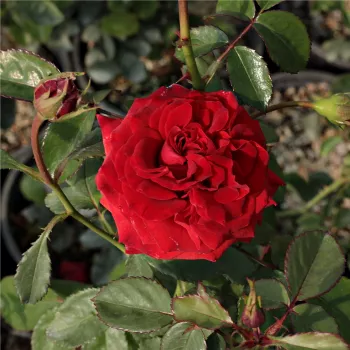
Upright shrub reaching about 100–140 cm tall and 65–95 cm wide, moderately thorny with mid‑green, slightly glossy foliage of medium density, forming a tidy, well-branched framework suitable for beds and low hedging. |
| Flower morphology |
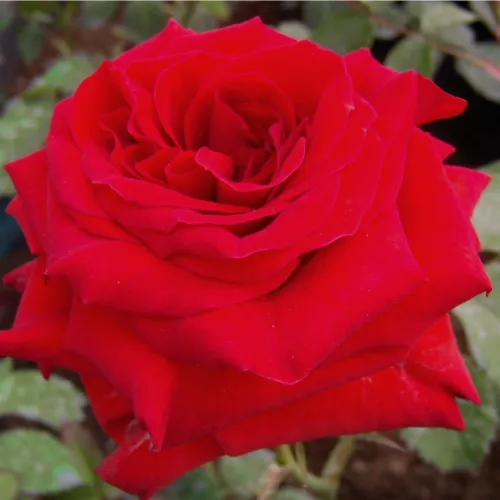
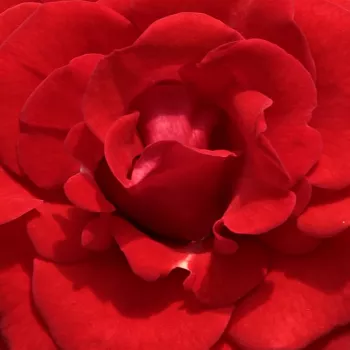
Semi‑double, cupped blooms with roughly 13–25 petals, borne in clusters of three to seven per stem. Large flower size in the 2.75–3.95 inch range, with remontant, freely repeating flushes across the main season. |
| Colour data and phenology |
Rich, velvety deep red with ARS code MR; RHS 46A outer, 46B inner. Buds open vivid scarlet‑carmine, deepen to burgundy, then soften towards brick‑mahogany tones, with moderate overall colour retention before gently fading. |
| Fragrance and aroma |
Very weak scent, only just perceptible on close inspection, carrying a classic rose character rather than complex notes, so the variety is chosen primarily for colour, form and garden performance rather than perfume impact. |
| Hip characteristics |
Produces ovoid, egg-shaped orange-red hips around 8–12 mm in diameter in moderate quantities, adding a subtle seasonal feature in late summer and autumn, suitable for visual interest rather than heavy harvest use. |
| Resistance and winter hardiness |
Rated to approximately −21 to −18 °C, RHS H7, USDA Zone 6b, Swedish Zone 3. Disease profile: resistant to powdery mildew and rust, medium resistance to black spot, benefitting from standard preventative care in humid seasons. |
| Horticultural recommendations |
Best in full sun with well-drained but moisture-retentive soil; prefers improved heavy clay or loam. Plant about 50–55 cm apart in beds or hedges, or as a 90 cm solitary; moderate maintenance with occasional pest and disease checks. |
HANSESTADT LÜBECK® offers long-lived own-root reliability, generous repeat red flowering and straightforward care in family gardens and containers, a thoughtful choice if you would like a classic rose that quietly earns its place.