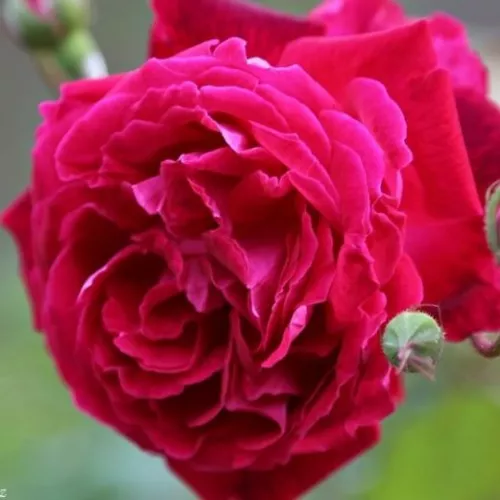
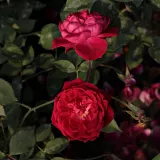
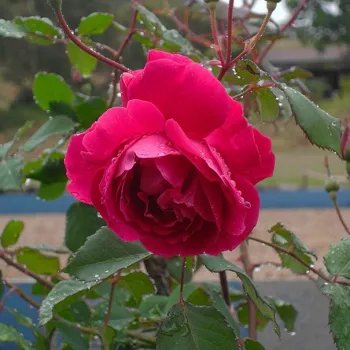
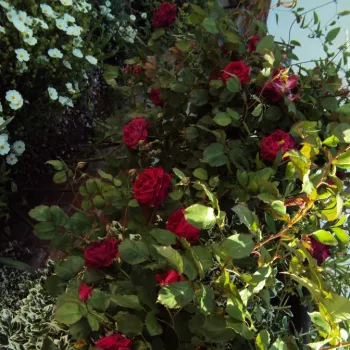
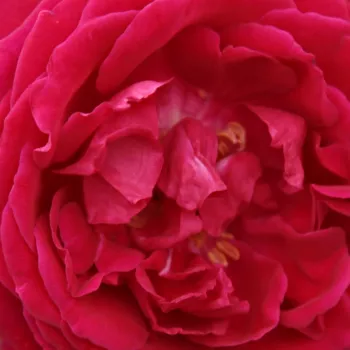
Gruss an Teplitz – deep crimson historic China rose
Step from pavement to front garden and be met by crimson clusters of cupped blooms, their fragrance rich and spicy after rain, even in exposed, coastal conditions with blustery showers and lingering damp air. This historic China rose builds a bushy, upright structure that fits effortlessly into compact London plots, thriving in a sunny spot with simple, regular watering. As an own-root shrub it offers reassuring longevity, quietly regenerating from its base if cut back hard or nipped by frost, so your investment matures rather than weakening with age. Over time its slightly glossy, medium-green foliage frames each flush of velvety petals, while manageable medium maintenance suits busy owners who prefer light deadheading to complex pruning. In a 2-litre pot it settles in quickly, with container use possible in large, 40–50 litre planters for paved front gardens where soil is limited. Expect steady development – first year roots, second year stronger shoots, third year full ornamental impact – bringing dependable colour and character to a sustainable, rainwater-conscious home entrance.
Usage options
| Target area | Reasoning |
|---|
| Sunny front-garden flower bed |
The bushy, upright habit and medium height make it ideal as a feature shrub along a short front path, where its rich spicy scent can be enjoyed passing by and its continuous flowering keeps the entrance welcoming for the busy homeowner. |
| Small hedge or boundary line |
Planted 55–60 cm apart, its moderately dense framework and repeat-flowering crimson clusters build a low, living boundary that softens railings or fences while remaining easy to trim and lightly deadhead for the low-maintenance gardener. |
| Rainwater-conscious urban border |
Suited to full sun with good heat and moderate drought tolerance, it partners well with drought-resilient perennials, making it a strong choice where downpipes feed beds and paving run-off is managed more sustainably for the eco-aware urbanite. |
| Large container on paved forecourt |
In a 40–50 litre pot with quality peat-free compost, its moderate spread and upright structure give vertical interest without overpowering a small space, ideal for hard-surfaced entrances that need colour yet still allow easy access for the terraced-house resident. |
| Feature rose for historic character |
As a celebrated late-19th-century China rose, it lends authentic period charm to modest city plots, offering traditional form and depth of colour without demanding specialist pruning skills, especially appealing to the heritage-loving beginner. |
| Mixed border with perennials |
Its medium size and continuous flowering integrate neatly with lavender, catmint or sage, providing a repeating crimson focus above softer planting while moderate self-cleaning keeps upkeep manageable for the time-pressed hobbyist. |
| Resilient planting in exposed situations |
Good tolerance of heat and moderate drought, along with reliable performance in changeable, damp weather, gives confidence where rain and wind quickly test less robust roses, reassuring for the coastal-climate gardener. |
| Long-term structural shrub |
On its own roots it builds up year by year into a stable, rejuvenating framework, recovering well from hard pruning and maintaining flower quality rather than declining with age, which particularly suits the long-view homeowner. |
Styling ideas
- Victorian – Combine with catmint and brick edging to echo period London front gardens, using its historic status and rich crimson blooms as a nostalgic focal point – ideal for heritage-conscious homeowners.
- Minimalist – Plant a single specimen in a generous charcoal-grey container on pale paving so the dark flowers and glossy foliage read as simple, modern sculpture – for design-led city dwellers.
- Cottage – Thread through mixed perennials such as Siberian bugloss and soft grasses, letting its continuous flowering punctuate looser planting – for romantic, informal gardeners.
- Structured – Use a short line of shrubs along a low fence, underplanted with lavender or sage, creating a fragrant, easy-care green boundary – for busy families wanting order with little effort.
- Rain-garden – Position near a downpipe in a free-draining bed with drought-tolerant companions, so it enjoys extra rainwater yet copes between showers – for sustainability-minded urban owners.
Technical cultivar profile
| Parameter | Data |
|---|
| Name and registration |
Gruss an Teplitz, historic China rose; ARS exhibition name identical. Registered cultivar name and current trade name coincide; unregistered in formal registers but long established in cultivation. |
| Origin and breeding |
Bred by Rudolf Geschwind in Hungary and introduced by Peter Lambert in Germany in 1897; complex China and Hybrid Tea ancestry gives repeat flowering and a distinctive historic character. |
| Awards and recognition |
Inducted into the World Federation of Rose Societies Old Rose Hall of Fame in 2000; consistently well rated by enthusiasts, including an ARS garden performance score of 8.0. |
| Growth and structural characteristics |
Bushy, upright shrub 120–170 cm high and 75–110 cm wide, with moderately dense, slightly glossy medium-green foliage and moderate prickliness; suitable for specimens, beds and low hedging. |
| Flower morphology |
Medium-sized, cupped, double flowers with 26–39 petals, usually borne in clusters of 3–7 per stem; repeats strongly through the season, with moderate self-cleaning that benefits from light deadheading. |
| Colour data and phenology |
Strong crimson-red blooms with carmine tint; buds dark ruby, opening to vivid purplish crimson, deepening to velvety burgundy before gently paling in strong heat while remaining richer in cooler conditions. |
| Fragrance and aroma |
Notable for a rich, spicy perfume of strong intensity that lingers well around the plant, especially effective near paths or doors where passing air currents and post-rain humidity magnify the scent. |
| Hip characteristics |
Produces only a few small hips; spherical, bright red, approximately 8–12 mm across, so seed set is limited and ornamental effect is driven mainly by repeat flowering rather than autumn fruit display. |
| Resistance and winter hardiness |
Hardy to about -21 °C (RHS H7, Swedish zone 3, USDA 6b). Good heat and moderate drought tolerance; generally resistant to powdery mildew and black spot, with rust susceptibility moderate. |
| Horticultural recommendations |
Best in sunny sites with decent drainage; medium maintenance with occasional health checks. Allow space per recommended planting distances; irrigate during prolonged dry spells, especially in containers. |
Gruss an Teplitz offers rich fragrance, continuous crimson flowering and resilient structure on its own roots, maturing into a long-lived feature shrub that rewards a thoughtful planting choice over many years.