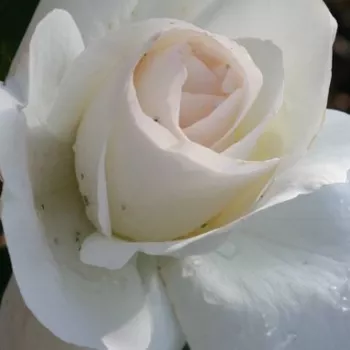
GRAND NORD – white hybrid tea rose – Delbard
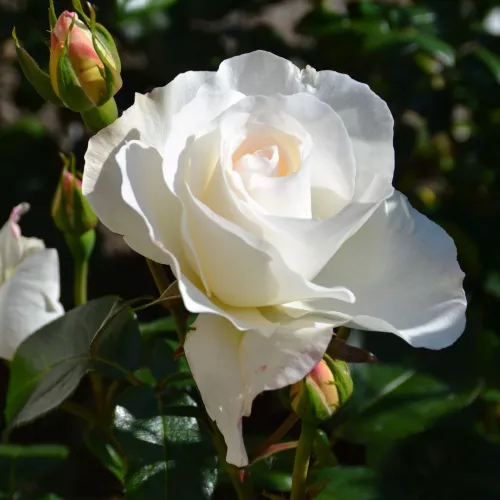
Step through your front gate and imagine a row of ivory blooms catching the light after rain, their subtly scented hybrid tea form recalling quiet, snow-bright mornings. GRAND NORD settles comfortably into compact, rainwater-wise city plots, coping reliably with damp, breezy days and heavier soils near the coast and in exposed streets. Its upright, almost thornless stems and glossy mid-green foliage make light pruning and deadheading straightforward, while the long-lasting flowers hold their snow-white poise beautifully as they open from faintly pink-tinted buds. Grown on its own roots, this premium 2-litre rose is bred for a long, steady life in family gardens, quietly regenerating from the base and maintaining a stable display with minimal fuss over many seasons. In a generous pot of at least 40–50 litres, or in the ground, it gradually builds from strong roots in the first year to confident shoots in the second, reaching full ornamental presence by the third, with an easy-going routine that fits neatly into busy urban life.
Usage options
| Target area |
Reasoning |
| Sunny London front garden bed |
The classic, high-centred blooms and clear white colouring give an immediate sense of order and calm beside front steps or railings. Moderate maintenance and almost thornless stems make it practical near paths for busy urban gardeners |
| Specimen rose in a rainwater-fed feature border |
Planted in improved, free-draining soil with a simple mulch, GRAND NORD responds well to regular watering from a water butt, rewarding this light care with repeat flushes all summer for eco-conscious homeowners |
| Large container on balcony or paved courtyard |
In a 40–50 litre pot with peat-free compost, its upright habit and dense foliage create vertical interest without sprawling, while the mild fragrance can be enjoyed at close quarters by space-limited city residents |
| Short hedge along a narrow path |
Regular spacing allows the uniform, bushy plants to knit into a low, elegant hedge; light deadheading keeps the line tidy and enhances its long-lived structure for low-fuss garden planners |
| Mixed planting with lavender or nepeta |
The snow-white flowers contrast beautifully with soft blues and mauves, while aromatic companions support simple, wildlife-friendly care and reduce the feel of formality for informal cottage-style enthusiasts |
| Cutting corner for home flower arrangements |
The long-stemmed, exhibition-quality blooms are ideal for vases; the plant’s sturdy structure renews flowering stems steadily when watered and lightly fed, suiting home flower arrangers |
| Coastal or wind-exposed suburban garden |
Its upright, well-branched framework and firm petals cope reliably with blustery, damp conditions, offering a composed look even after strong showers for weather-aware householders |
| Family garden focal point with sustainable care |
Own-root vigour builds year by year, so once established it bounces back well from pruning and occasional setbacks, supporting a long garden life with modest inputs for time-poor beginners |
Styling ideas
- Snowline – edge a short path with a row of GRAND NORD underplanted with dwarf sedges for a clean, rainwater-friendly look – ideal for design-conscious terrace owners
- Polar – pair one or three bushes with lavender and nepeta in a gravel strip to echo pale northern light – suited to low-maintenance front gardens
- Gallery – grow a single specimen in a tall, 50-litre container by the front door to showcase its exhibition-style blooms – attractive to flat and townhouse residents
- Calm – weave GRAND NORD through a soft, pastel border with sages and ornamental grasses to balance structure and movement – appealing to relaxed family gardeners
- Solitaire – use one plant as a focal point in a small lawn island bed, with a simple mulch ring to simplify mowing – helpful for practical-minded homeowners
Technical cultivar profile
| Parameter |
Data |
| Name and registration |
Hybrid tea rose, registered as DELgrord, marketed as GRAND NORD in the Great Fragrances collection; ARS exhibition name Grand Nord; premium own-root stock in 2-litre containers. |
| Origin and breeding |
Bred by Georges Alphonse Delbard, France, 1973 from complex hybrid tea lines; introduced by Pépinières et Roseraies Georges Delbard in 1975, registered in 1974 as DELgrord. |
| Awards and recognition |
Decorated with two gold medals at rose competitions, reflecting the quality of its flower form, colour purity and overall garden performance in formal and exhibition settings. |
| Growth and structural characteristics |
Upright, bushy shrub 110–150 cm high and 70–110 cm wide, with dense, glossy, mid-green foliage and very few prickles; best effect from sunny positions and good soil preparation. |
| Flower morphology |
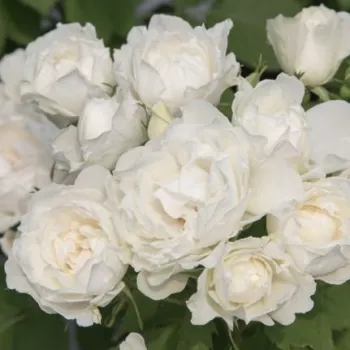
Large, double, high-centred hybrid tea blooms with 26–39 petals, usually solitary on long stems; remontant with notably abundant second flush, suitable for cutting and display. |
| Colour data and phenology |
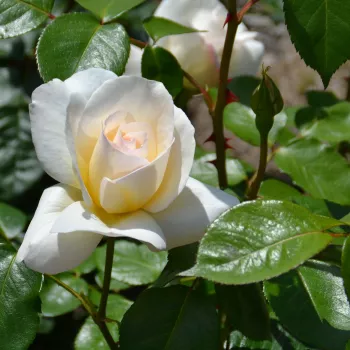
Pure white to ivory flowers, RHS NN155C–NN155D; buds creamy with faint pink edges, opening to snow-white with soft cream centre, holding colour well and fading only gently in strong sun. |
| Fragrance and aroma |
Pleasant, mild fragrance with a soft, classic rose character; best appreciated at close range in still air, lending a discreet scent to entrances, patios and indoor cut-flower use. |
| Hip characteristics |
Occasionally develops small, 6–10 mm, ovoid orange-red hips; ornamentally modest but a subtle seasonal accent if some spent blooms are left untrimmed in late summer and early autumn. |
| Resistance and winter hardiness |
Hardy to about −21 to −18 °C (RHS H7, USDA 6b, Swedish zone 3); disease resistance medium for black spot, mildew and rust, benefitting from good air movement and basic preventive care. |
| Horticultural recommendations |
Best in full sun with regular watering in dry spells; respond to deadheading and moderate feeding. Space 55–100 cm depending on use; avoid prolonged drought, as heat tolerance is only moderate. |
GRAND NORD combines snow-white, exhibition-quality blooms, an upright, almost thornless habit and long-lived own-root reliability, making it a thoughtful choice for understated, sustainable front gardens and balconies.