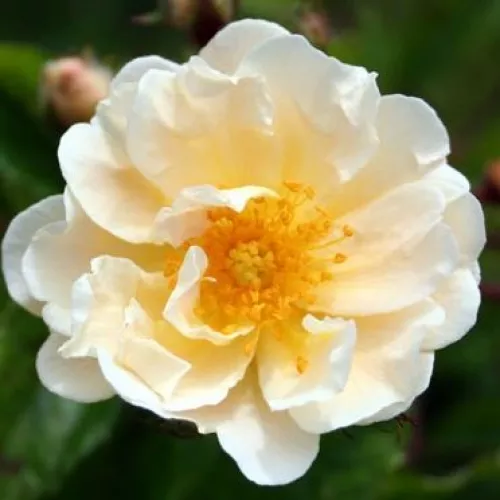
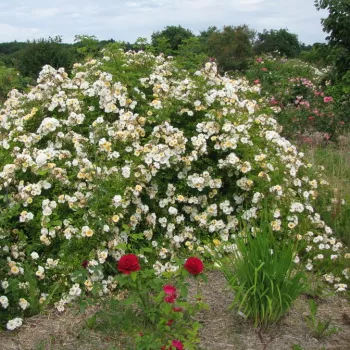
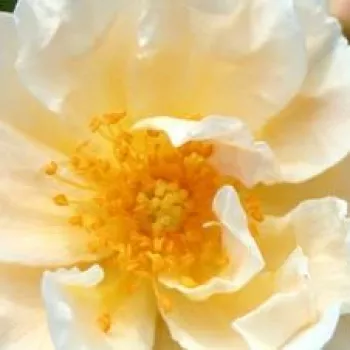
Initially deep golden yellow, fading to a buttery yellow in sunlight. - historical, old garden rose - strong, well-scented rose - fresh, fruity character
– Strong, fresh fruity fragrance for summer
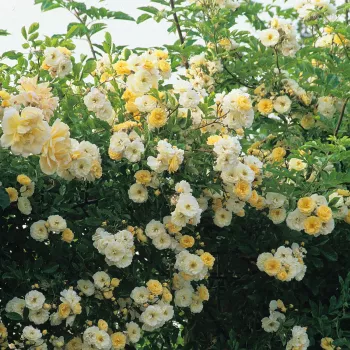
– Abundant lemon-yellow clusters on arches
– Vigorous rambler, ideal for pergolas
– Healthy foliage with very good disease resistance
– Almost thornless canes for easier training
– Special feature: Historic 1907 rambler, beloved for its golden tones and romantic charm.
Consistent quality – Value-based choice
eleanorROSE® ORIGINAL 2-litre own-root potted rose
18,00 £
Unfortunately, we are currently unable to ship to the United Kingdom; we only deliver to countries within the European Union. For more information, please contact us!
4(5886)
GOLDFINCH – yellow historic old garden rose - Paul
Step out after the rain and let Goldfinch draw you into a fresh, fruity cloud of scent, its semi-double clusters shimmering from golden yellow to creamy petals along an arch, fence or narrow townhouse front garden. This historical rambler offers naturally good disease resistance, coping steadily with blustery weather and heavy downpours common in many British gardens, making it reassuringly unfussy on exposed, wetter sites. Own-root plants settle in for the long term, building a resilient framework that regenerates from the base with minimal effort from you and keeps ornamental value stable year after year. In a typical family plot or rainwater-conscious city space, expect it to focus first on establishing roots, then on extending graceful shoots, before reaching full flowering impact and romantic character by about the third season.
Goldfinch in bloom, showing its strong, fresh fruity fragrance.
Goldfinch showing different flower opening phases side by side.
Usage options
Target area
Reasoning
Front garden arch or porch
A compact rambler height fits most small London-style front gardens, dressing an arch or porch with one generous wave of scented bloom in early summer. Low maintenance and soft colouring suit busy homeowners.
Rainwater-friendly fence line
Long, flexible canes are ideal for training along open fencing that also guides downpipes or water butts, adding beauty where rain collects while tolerating exposed, breezy, often wet suburban conditions. Perfect for sustainability-minded gardeners.
Family seating corner
Strong, fresh-fruity fragrance and semi-double flowers make a charming backdrop beside a bench or small terrace; barely thorny shoots reduce snags around children and pets in everyday family gardens.
Wildlife-friendly cottage border
Semi-double, clustered blooms and later red hips offer pollen and seasonal interest, working well with echinacea, verbena, lavender or nepeta to support diverse insects in a relaxed, wildlife-aware setting.
Low-intervention pergola or obelisk
Good self-cleaning flowers and naturally healthy foliage mean little deadheading or spraying, so a pergola, pillar or obelisk remains tidy with only light tying-in and an occasional seasonal trim for time-poor beginners.
Part-shaded side return
This variety accepts partial shade, so a narrow side passage or overlooked wall can still host a reliable once-a-year display, brightening otherwise gloomy spots near bins or sheds for urban terrace owners.
Large container by a doorway
In a 40–50 litre peat-free container with good drainage, it can be trained on a slim trellis, bringing historic charm and fragrance to a doorstep where in-ground planting is impossible, ideal for paved-front households.
Exposed coastal-style boundary
Robust leaves and disease resistance suit blustery boundaries that face frequent wind and rain, giving a reliable, low-spray screen that softens hard lines and thrives in weather-beaten plots for practical-minded owners.
Styling ideas
Porch-Perfumed – Train Goldfinch around a small porch with underplanting of lavender and thyme for scent layers – ideal for fragrance-loving doorway greeters.
Cottage-Rambler – Weave canes along a rustic fence with catmint and foxgloves to echo romantic cottage gardens – for those chasing a soft, historic look.
Rain-Garden – Pair with moisture-tolerant grasses and verbena near a water butt or rain chain – perfect for sustainability-focused city gardeners.
Family-Nook – Frame a bench with Goldfinch and low mounds of sage and geraniums – suited to families wanting a cosy, low-prickle retreat.
Balcony-Arch – In a 50-litre container, guide stems over a slim metal arch with trailing herbs – for urban renters seeking movable, vertical greenery.
Technical cultivar profile
Parameter
Data
Name and registration
Goldfinch is a historic rambler from the Old rose group, also classed as Hybrid Multiflora and Polyantha; commercial names include Goldfinch and Goldfinch Historic rose Goldfinch.
Origin and breeding
Bred in the United Kingdom by George Paul Jr. at Paul & Son, Cheshunt Nurseries; introduced in 1907, from ‘Hélène’ crossed with an unknown seedling, later distributed by Hazlewood Bros in Australia.
Growth and structural characteristics
A vigorous climbing rambler reaching about 320–500 cm high and 180–280 cm wide, with moderately dense, glossy dark green foliage, flexible canes and notably sparse prickles for easier handling and training.
Flower morphology
Semi-double clusters of small, cupped to flat-opening blooms, about 0.5–1.5 inches across, bearing roughly 13–25 petals; it flowers once per season in a very abundant, nostalgic early-summer display.
Colour data and phenology
Flowers open vivid lemon to golden yellow, then soften to buttery and creamy tones before fading almost white in strong sun; RHS 11C outer and 4D inner shades capture its fresh yet transient yellow character.
Fragrance and aroma
Blooms are strongly scented with a fresh, fruity character that reads as light yet assertive in the garden, particularly noticeable along paths, by doorways or around seating where air movement carries the perfume.
Hip characteristics
After flowering, it can produce small, spherical red hips around 6–9 mm in diameter, offering subtle autumn interest and an additional resource for wildlife where spent clusters are left unpruned.
Resistance and winter hardiness
Shows good resistance to powdery mildew, black spot and rust, with foliage staying clean in humid seasons; hardy to roughly -15 to -12 °C (RHS H6, Swedish zone 2, USDA 7b) under normal garden conditions.
Horticultural recommendations
Suited to arches, pergolas, walls and fences, planted 120–220 cm apart; prefers moisture-retentive but free-draining soil, regular watering in dry spells, and light training and pruning to renew flowering wood.
Goldfinch offers once-a-year golden bloom, strong fragrance and dependable health on a long-lived own-root framework, making it a thoughtful choice for arches or porches if you value characterful, low-fuss planting.
Detailed product attributes
Product Identification Data
Product Name:
GOLDFINCH – yellow historic old garden rose - Paul
Product Type:
eleanorROSE® ORIGINAL - 2-litre own-root potted rose
Our product is a rose grown with pharmaROSA®’s unique cultivation technology!
2-litre, own-root, potted rose.
With a shoot system appropriate to the season.
With a root system that thoroughly permeates the growing medium.
Quality compliant with the requirements of the E.N.A. (European Nurserystock Association).
Supplied in unique packaging that prevents damage.
Can be planted during frost-free periods.
True-to-variety rose bush with a unique identifier.
The pharmaROSA® own-root potted rose is a well-rooted plant that supports reliable establishment when planted and cared for properly, so it can be planted whenever the soil is not frozen.
Crop overview: several varieties and growth stages in a short crop section.Shoot system: intensive growth of fresh basal shoots on a young plant.Root system: demonstration of a vigorous root system permeating the growing medium, by removing the pot.Balance: mature plant with root system and shoots in harmony with each other.
Information about the videos
The video series is not a “seasonal showcase”; it illustrates the essence of pharmaROSA® own-root cultivation in a tangible way: how the plant is built up, what the root system is like and how the shoot system regenerates. The recordings were therefore made at different times and with plants at various stages of development, so mixed foliage levels and differing stages of growth may appear in the videos. They are not a ‘sample’ of the batch dispatched, but a visual explanation of how the technology works. The current condition of the rose available to order — typical for the given period and similar to what you can expect to receive in the parcel — is shown in the upper part of the product page.
Pages for private customers Garden roses for the family garden, with minimal care → ORIGINAL® Premium garden roses – instant impact, a truly showpiece garden → EXTRA® Pages for professionals and private customers Roses for public spaces – large areas, sustainable maintenance → NATURAL® Roses for projects – hedge and row planting, fast implementation → RAPID® For professional partners only Production – propagation material for garden roses, wholesale → NEONATAL®
Company details
PharmaRosa Ltd. Company registration number: 01-09-717479 VAT number: 13075314-2-43 Plant health registration no.: HU130721 Bank account (IBAN): HU85117631891388688400000000 BIC (SWIFT): OTPVHUHB Bank name: OTP Bank Nyrt.