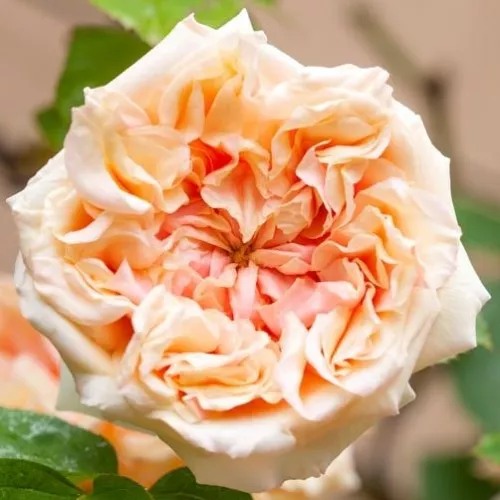
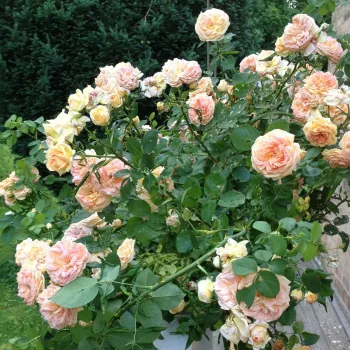
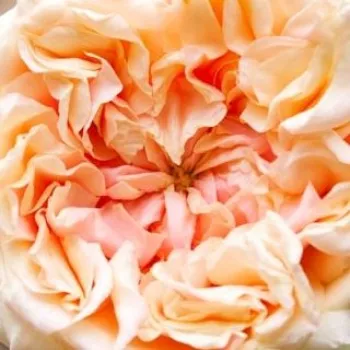
GLOIRE DE DIJON – apricot historic rambler-climbing rose
Step through your front gate and let Gloire de Dijon lead you along a softly scented path, its richly tea-fruity perfume hanging in the air after rain, while its pliable canes and generous rebloom weave a living curtain of flowers that feels both nostalgic and reassuringly modern. This historic rambler-climbing rose has earned its place in gardens for over a century thanks to its resilient growth, reliable disease resistance and capacity to cope with typical British conditions, including breezy sites and heavier soils where sensible drainage helps in wetter spells and humidity. As an own-root plant, it settles in steadily and can regenerate from its base, supporting a long, dependable lifespan with less intervention than traditional budded climbers, while partial-shade tolerance and low maintenance needs make it a gentle, sustainable choice for busy city gardeners. Give it space on a wall, arch or balcony in a large 40–50 litre container and you can enjoy the classic apricot rosettes at eye level, gradually moving from Year 1 root-building, through Year 2 framework shoots, to full ornamental impact by Year 3 as it becomes a fragrant, romantic backdrop to everyday family life.
Usage options
| Target area |
Reasoning |
| London terraced-house front wall |
Ideal for narrow, vertical spaces, this rose can be trained flat against brickwork or railings, softening hard lines with vintage apricot rosettes and a powerful fragrance at the front door; low maintenance suits time-poor urban gardeners |
| Rainwater-conscious urban courtyard |
Its deep, own-root system uses natural rainfall effectively once established, working well with permeable paving and simple soakaway beds, which handle blustery showers and heavier soil while supporting a calmer, greener outlook for sustainability-minded homeowners |
| Romantic pergola in a family garden |
Long, flexible canes arch easily over a pergola, creating a shaded tunnel of repeat-flowering, tea-scented blooms that feels immersive yet requires only basic tying-in and occasional pruning, making it manageable for busy families |
| Shared boundary or screen planting |
Its tall, climbing habit and moderately dense foliage help create a soft-focus screen between neighbouring gardens; the long lifespan of an own-root plant supports a stable, long-term structure well suited to settled homeowners |
| Large container on balcony or roof terrace |
In a 40–50 litre peat-free container with good drainage, it offers vertical colour and scent where soil is limited, while partial shade tolerance and moderate water needs after establishment fit compact spaces used by balcony gardeners |
| Low-intervention, historic-style planting |
Combining antique charm with good disease resistance, it brings classic rose character to mixed borders without demanding complicated spraying routines, leaving more time to enjoy its scent and soft colours for hobby gardeners |
| Clay or chalky suburban plots |
Performs reliably on heavier or chalk-leaning soils when planted into improved, free-draining ground, rewarding straightforward preparation with persistent flowering and a robust framework valued by new gardeners |
| Fragrant seating area or evening terrace |
Positioned near a bench or patio, its very strong tea-fruity fragrance gathers in still evening air, with repeat flushes extending enjoyment across the season and needing only simple deadheading, ideal for relaxed evening hosts |
Styling ideas
- Romantic-arch – Train Gloire de Dijon over a narrow metal arch with underplanting of lavender and nepeta to draw the eye from pavement to doorway – perfect for terraced-house front gardens.
- Courtyard-screen – Use a slim trellis panel in a permeable, gravel-mulched bed, pairing with soft grasses and sage for movement and good rainwater infiltration – ideal for sustainability-focused city dwellers.
- Balcony-column – Grow it in a 50 litre pot with a tall obelisk and companion herbs such as thyme and compact rosemary for scent and pollinator interest – suited to container-based urban gardeners.
- Heritage-border – Combine this historic climber at the back of a mixed border with foxgloves and Liatris spicata ‘Kobold’ for a cottage-garden feel – appealing to lovers of period planting.
- Evening-pergola – Drape its canes along a simple wooden pergola above outdoor seating, underplanted with white sage and nepeta to catch the dusk light – ideal for after-work relaxation spaces.
Technical cultivar profile
| Parameter |
Data |
| Name and registration |
Historic Noisette rambler-climber marketed as Gloire de Dijon, a traditional garden favourite; unregistered cultivar used under its long-established trade name in heritage rose collections. |
| Origin and breeding |
Bred in France around 1850 by Pierre and Henri Jacotot from ‘Desprez à fleurs jaunes’ × ‘Souvenir de la Malmaison’; introduced by Jacotot, Dijon in 1853 and widely distributed thereafter. |
| Awards and recognition |
Honoured in the World Federation of Rose Societies Old Rose Hall of Fame in 1988 and granted the Royal Horticultural Society Award of Garden Merit in 1993 for reliable ornamental value. |
| Growth and structural characteristics |
Strong, climbing habit reaching 3.8–6.5 m in height with 1.2–2.4 m spread; moderately thorny canes and medium-dense, slightly glossy dark green foliage, forming a substantial vertical framework. |
| Flower morphology |
Large, very double rosette blooms with over 40 petals produced in clusters; remontant with a generous second flush, offering classic, full flowers suited to cutting and close-up viewing. |
| Colour data and phenology |
Soft creamy-peach to apricot blooms (ARS YB; RHS 14C, 22C); buds open deep yellow-tinted then lighten, with centres fading towards pastel peach cream under heat and strong sun over the season. |
| Fragrance and aroma |
Exceptionally strong, garden-filling perfume with a rich tea and fruity character; fragrance is one of its main ornamental features and can be enjoyed best when planted near paths or seating areas. |
| Hip characteristics |
Produces moderate quantities of ellipsoidal rose hips, approximately 9–15 mm in diameter; hips colour to orange-red and can contribute an additional, subtle ornamental element in late season. |
| Resistance and winter hardiness |
Good heat tolerance with watering needed in extended droughts; reliably hardy to around −15 to −12 °C (RHS H6, Swedish zone 2, USDA 7b) and shows solid resistance to mildew, black spot and rust. |
| Horticultural recommendations |
Best on walls, arches, arbours or pergolas at 1.1–2 m spacing; suitable for partial shade and large containers; low maintenance when tied in and lightly pruned, with some manual deadheading required. |
Gloire de Dijon offers towering, strongly fragrant apricot blooms on a long-lived, low-maintenance own-root climber that matures steadily into a dependable feature, making it a thoughtful choice for your next garden planting.