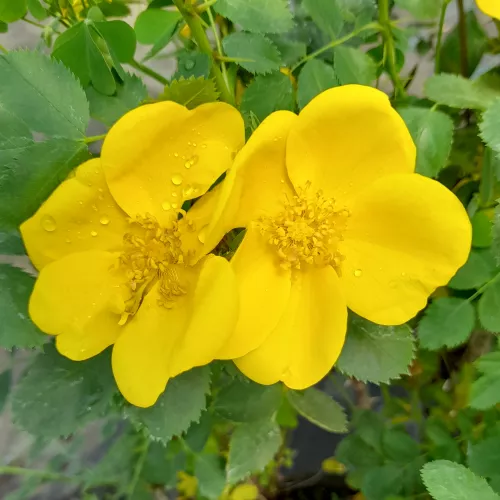
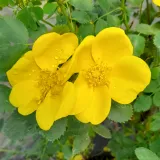
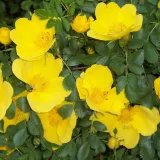
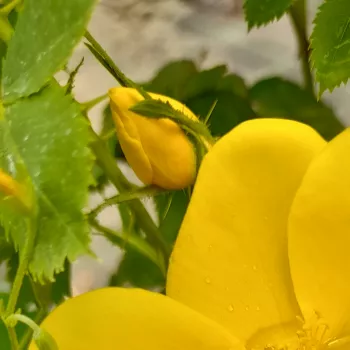
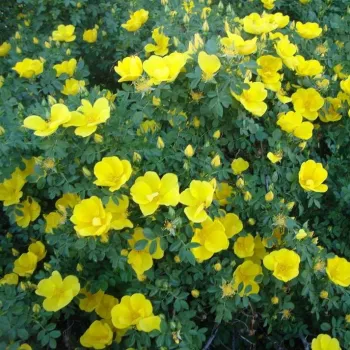
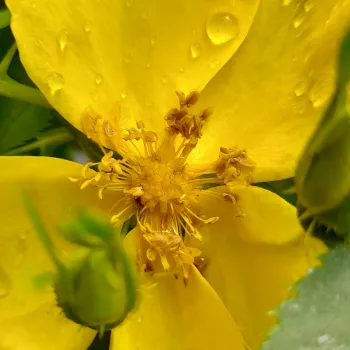
FOETIDA – yellow wild rose
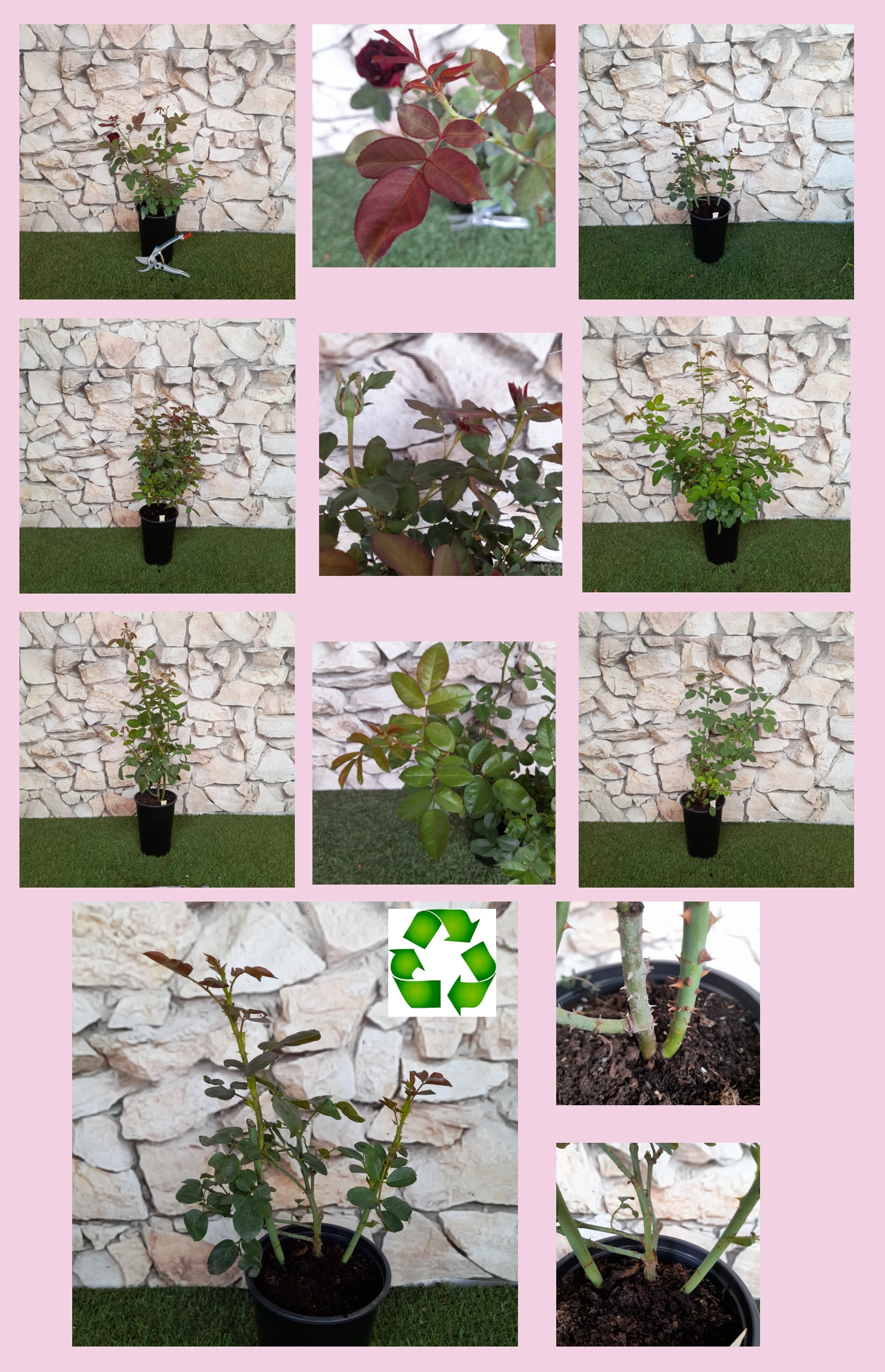
Step outside after rain and this historic yellow wild rose brings a quietly grounding sense of balance, its arching branches echoing the rhythm of a traditional cottage hedge while coping calmly with blustery coastal weather and typical British garden conditions. Once planted, its low-maintenance character soon becomes clear: robust own-root growth, reliable flowering on mature wood and a natural, unforced shape that needs very little intervention in a busy family routine. Over time, roots establish deeply and steadily, then shoots build up, and by the third season you can expect full ornamental presence with rich bark texture and dark foliage setting off the golden flowers. Its single early-summer flush is generous enough for a striking display yet brief enough to avoid constant deadheading, leaving you to enjoy the seasons instead of chasing garden tasks. Medium-height, arching stems are ideal where you want a defined line without hard edges, guiding the eye along a narrow front path or zoning a compact lawn from the street with relaxed elegance. Because it is supplied as a half- to one-year-old own-root plant in a manageable container, transplanting is straightforward and aftercare is simple, well suited to newer gardeners seeking long-term security rather than short-lived impact. As the years go by, any winter dieback is naturally replaced from the base, so the plant keeps its shape and ornamental value with minimal pruning, supporting a more sustainable, planted frontage instead of hard paving.
Usage options
| Target area |
Reasoning |
| Front-garden specimen shrub |
Use as a single focal shrub in a small or medium front garden where its arching, bushy habit provides height without overwhelming the space; the once-a-year flowering keeps upkeep low for the busy urban gardener. |
| Informal flowering hedge |
Plant in a row at 90 cm intervals to create a loose, country-style hedge that offers privacy, seasonal colour and structure with minimal clipping, appealing to the family seeking easy boundaries. |
| Low-maintenance landscape strip |
Ideal for driveways or front-of-plot planting where irrigation is limited, as its good heat and drought tolerance reduces watering demands for the water-conscious homeowner. |
| Rain-friendly terraced-house frontage |
Works well in narrow beds along town-house paths, where its deep roots and sturdy frame accept regular rain and wind, supporting sustainable drainage for the environmentally-aware city dweller. |
| Mixed shrub border backbone |
Place towards the middle-back of a border to give long-lived structure; its strong own-root system regenerates from the base if pruned hard, reassuring the planner of long-term plantings. |
| Cottage-style path edge |
Line a garden path with widely spaced plants so the arching stems and golden flowers brush the edges, softening hard lines while needing little pruning for the romantic but time-poor gardener. |
| Wildlife-tinged family garden corner |
Although only partially attractive to pollinators, its simple flowers and occasional hips still introduce some seasonal interest and gentle habitat value for the nature-curious household. |
| Large container on paved front area |
In a 50–60 litre pot with free-draining compost, it offers a long-lived structural shrub where planting into soil is impossible, giving enduring value to the space-limited balcony owner. |
Styling ideas
- Golden-hedge – Create an informal hedge with FOETIDA interplanted with white sweet alyssum for a soft yellow-and-white ribbon – for families wanting relaxed front-garden privacy.
- Cottage-curve – Position one shrub at a path bend and underplant with Verbena hastata ‘White Spires’ to contrast vertical spires with arching stems – for those who enjoy traditional charm with little pruning.
- Sunny-anchor – Use as the tallest element in a mixed sunny pot (minimum 50–60 litres) with trailing alyssum to spill over the rim – for urban renters needing movable structure.
- Yellow-focus – Place a single plant against dark fencing, adding pale grasses for movement, to highlight the early-summer golden flush – for homeowners seeking a clear focal point with low upkeep.
- Heritage-corner – Combine this historic rose with simple green shrubs and minimal companion flowers to showcase its species character – for collectors who value long-lived, characterful planting.
Technical cultivar profile
| Parameter |
Data |
| Name and registration |
Wild botanical rose, current trade name “Rosa foetida Botanical rose”; ARS exhibition name Rosa foetida; classified as a wild species rather than a modern hybrid cultivar. |
| Origin and breeding |
Wild species originating from the Caucasus–Iran region, introduced into European cultivation around 1583; breeder unknown, distributed historically by various nurseries, including Exotic Nursery in the USA. |
| Growth and structural characteristics |
Erect, arching, bushy shrub reaching about 160–240 cm high and 120–190 cm wide, with moderately dense dark green foliage and moderate prickliness, forming a striking, structural garden presence. |
| Flower morphology |
Medium-sized, mainly single, flat flowers with about 5–12 petals, typically borne solitarily; a non-remontant species that produces one main flowering period each year on established wood. |
| Colour data and phenology |
Deep, radiant golden-yellow blooms; buds intensely yellow, opening to even gold, then fading to straw yellow with a soft creamy tone, especially in hotter weather, giving a changing seasonal display. |
| Fragrance and aroma |
Medium-strength, distinctly spicy aroma that reflects the species’ characteristic scent; foliage and flowers together contribute to a noticeable, slightly unconventional fragrance in warm, still weather. |
| Hip characteristics |
Hip set is generally modest, with occasional spherical red hips around 10–14 mm across; these may add a discreet autumn accent but are not a dominant ornamental feature of the plant. |
| Resistance and winter hardiness |
Very hardy shrub rose, tolerating approximately -40 to -37 °C (RHS H7, Swedish zone 6, USDA 3a); noted for resistance to powdery mildew, black spot and rust, with good heat and moderate drought tolerance. |
| Horticultural recommendations |
Best in full sun, in well-drained soil; suitable for hedges, specimens and landscape uses. Low maintenance once established, with self-cleaning flowers and simple pruning to manage size and shape. |
FOETIDA – yellow wild rose offers a long-lived, low-maintenance structural shrub with distinctive golden flowers, and as an own-root plant it establishes steadily for years of reliable presence; consider it where you want durable, characterful planting.