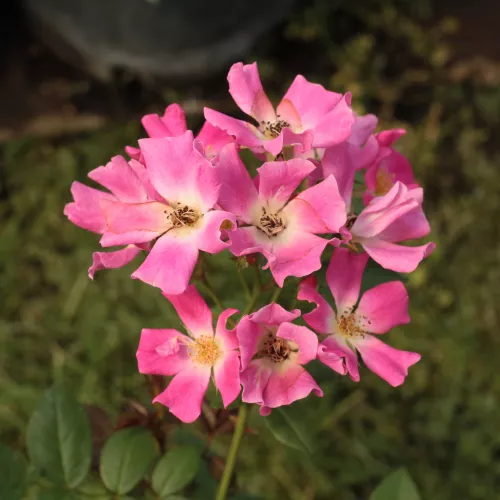
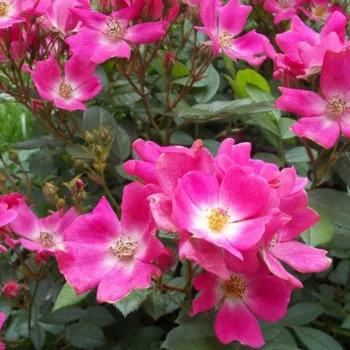
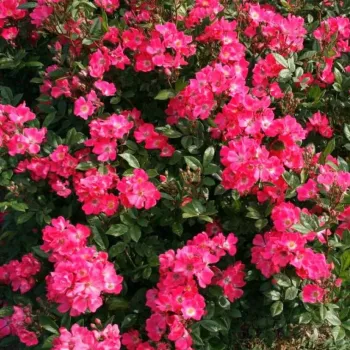
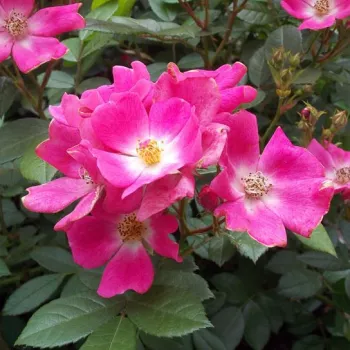
ERNYE – pink bedding floribunda rose – Márk
With its clear pink single blooms and compact, spreading habit, ERNYE offers an easy way to bring gently structured colour to small London front gardens and shared family spaces where reliable, low-input planting really matters. This floribunda shrub rose flowers repeatedly in generous clusters from early summer to autumn, and its open, single flowers are naturally attractive to bees. As an own‑root plant it is bred for longevity, quietly building strength below ground before producing more abundant top growth, following the natural rhythm of year‑one roots, year‑two shoots and year‑three full display. Once established, ERNYE shows reassuring resilience in heat and drier spells, making it a calm choice for sustainable, rainwater‑fed beds on heavier soils or chalky ground often challenged by wind and wet weather. Use it to create balance at the front of mixed borders, line a narrow pathway with low, friendly colour, or plant in a single generous container of at least 40–50 litres for a soft urban focal point. ERNYE’s modest size keeps maintenance manageable, and its moderately thorny stems and tidy foliage help it sit comfortably alongside perennials and low shrubs in a family setting. Choose it where you want dependable colour, eco‑minded planting and pollinator support without complicated rose care.
Usage options
| Target area |
Reasoning |
| Front garden bedding strip |
Compact height and spreading habit make ERNYE ideal for narrow front beds, giving a low, even band of pink that stays below window level and copes well with everyday street exposure, suiting the needs of the busy urban gardener |
| Bee‑friendly family border |
Single, open flowers with visible stamens offer accessible pollen all season, so ERNYE slots naturally into wildlife‑minded borders as a colourful nectar stop without needing special treatment from the pollinator‑conscious beginner |
| Low maintenance sustainable bed |
Good tolerance of heat and drier periods, combined with moderate disease resistance, keeps spraying and watering demands low, fitting rainwater‑wise schemes for heavier or chalky soils that often face wind and heavy showers for the eco‑aware homeowner |
| Own‑root long‑term feature |
Grown on its own roots, ERNYE matures steadily into a stable, long‑lived shrub that can regenerate from the base if cut back or weather‑damaged, holding its shape and display for years and rewarding the patient long‑view gardener |
| Container on balcony or patio |
A single plant in a 40–50 litre pot offers long flowering with modest pruning needs, bringing structured pink colour to balconies or paved patios where ground is limited and watering is occasional, ideal for the time‑pressed flat‑dweller |
| Small hedge or path edging |
Recommended spacings allow ERNYE to knit into a low, informal hedge that guides the eye and gently encloses seating or paths, without feeling heavy or overgrown, which works well for the design‑curious beginner |
| Mixed perennial combinations |
Its clear pink flowers and medium‑green foliage mix easily with silver leaves and late perennials, giving long colour without dominating, and freeing surrounding plants to shine, which appeals to the creative home gardener |
| Family‑friendly play‑adjacent bed |
Moderate height and spreading form keep blooms within easy view but away from boisterous play, while own‑root resilience and medium maintenance needs suit shared family spaces used by the practical child‑aware gardener |
Styling ideas
- Urban‑Ribbon – run a low row of ERNYE along a townhouse front fence, underplanting with drought‑tolerant Stachys byzantina for silver contrast – perfect for sustainability‑minded city households
- Bee‑Border – weave groups of ERNYE between Rudbeckia and airy grasses to give bees an extended buffet of open flowers – ideal for wildlife‑focused families
- Pastel‑Courtyard – place ERNYE in a large clay pot with soft pinks and whites from nearby perennials to create a calm corner – suited to balcony and patio gardeners
- Play‑Edge – edge a lawn or play space with ERNYE and lamb’s ear so children see flowers and soft foliage while main activity stays central – good for young families with limited time
- Cottage‑Stripe – mix ERNYE with small clematis and herbs like lavender or nepeta in a narrow bed to echo traditional cottage borders – ideal for romantic, low‑maintenance front gardens
Technical cultivar profile
| Parameter |
Data |
| Name and registration |
Current trade name ERNYE – pink bedding floribunda rose – Márk; bedding floribunda rose in the bed rose group, used mainly for low planting schemes and compact, informal flowering hedges. |
| Origin and breeding |
Bred by Hungarian rose breeder Márk Gergely in 1988 from cross ‘Zsófi’ × ‘Minililla’, introduced to the market by PharmaRosa® Ltd., with wider distribution data and registration years not fully documented. |
| Growth and structural characteristics |
Compact, spreading shrub reaching about 40–50 cm in height and 50–70 cm spread, moderately thorny, with slightly glossy, medium‑green foliage of moderate density forming a low, cohesive planting unit. |
| Flower morphology |
Single to semi‑single blooms with around 5–12 petals, small flower size in large, multi‑flowered clusters; cup‑shaped, opening fairly flat, with remontant, abundantly repeating flushes through the main season. |
| Colour data and phenology |
Pure, saturated pink with a slightly warm tone; buds deep pink, opening to bright light pink and then softening to pastel as petals mature; ARS code DP, RHS 68B–68C, with moderate colour retention in full sun. |
| Fragrance and aroma |
Classed as unscented; no notable fragrance detected in garden conditions, so selection focuses on colour, structure and pollinator appeal rather than scent, useful where fragrance is not a primary design requirement. |
| Hip characteristics |
Produces spherical, orange‑red hips where flowers are not deadheaded; typically 5–8 mm in diameter and borne moderately, adding discreet seasonal interest without overwhelming the compact shrub form. |
| Resistance and winter hardiness |
Good tolerance to heat and drier periods, with moderate resistance to powdery mildew, black spot and rust; winter hardy approximately to −21 to −18 °C, aligning with RHS H7 and USDA zone 6b performance. |
| Horticultural recommendations |
Best in sunny positions with reasonable drainage; plant 35–40 cm apart in beds or hedges, or singly at 65 cm; suitable for beds, borders, low hedging and larger containers where moderate maintenance is acceptable. |
ERNYE – pink bedding floribunda rose – Márk offers long‑lasting colour, bee‑friendly single blooms and resilient own‑root growth, making it a thoughtful, durable choice for your next front garden or patio planting decision.