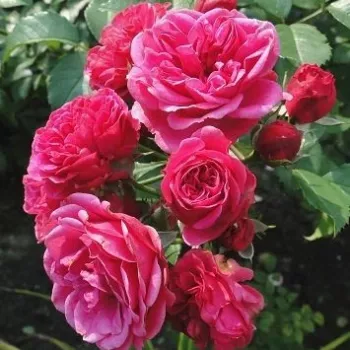
ELMSHORN® – deep pink park rose – Kordes
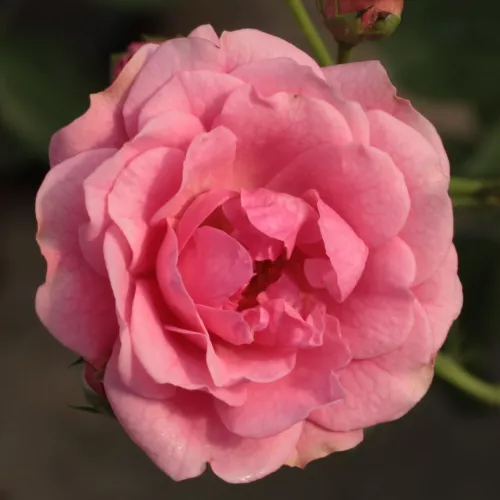
In a London terrace or small family garden, Elmshorn® brings relaxed, upright structure and a cloud of deep pink, cluster-flowered colour that feels quietly romantic rather than formal. Its semi-double blooms repeat generously in flushes, giving a long, remontant season that keeps the front garden alive well beyond early summer, even where breeze, showers and changeable skies are normal and soils need careful drainage. As an own-root rose, it develops steadily into a bushy, medium-tall hedge or backdrop, with the root system maturing first, the framework filling out in the second year and full ornamental presence by the third, for reassuring long-term lifespan. The moderately open centres offer accessible pollen for visiting bees, adding quiet wildlife interest that suits rainwater-conscious, urban gardens.
Usage options
| Target area |
Reasoning |
| Front-garden flowering hedge along a terrace boundary |
Elmshorn® forms an upright, moderately tall shrub, ideal for a low privacy hedge along a path or front boundary, with repeated deep pink flushes softening hard lines and providing a familiar, cottage-style feel for homeowners |
| Mixed flowerbed in a small to medium family garden |
The bushy habit and cluster-flowered form integrate well with perennials; underplant with lavender, sage or nepeta to disguise slower self-cleaning and to support pollinators throughout summer for hobby-gardeners |
| Rainwater-conscious urban planting near downpipes |
Plant slightly raised above heavy clay or near soakaways so water drains away from the crown, creating a resilient, long-lived shrub that copes well with typical urban roof run-off patterns for city-dwellers |
| Feature shrub in a narrow front garden bed |
The compact footprint against railings or a low wall gives vertical impact without overwhelming the space, while the deep pink clusters frame doorways and bay windows in classic, welcoming colour for beginners |
| Pollinator-friendly ribbon along a front path |
Semi-double blooms offer moderately accessible pollen, especially if you mix in aromatic companions that extend foraging time, giving a softer, wildlife-aware alternative to paved-only frontages for eco-conscious |
| Informal park-style group in communal green areas |
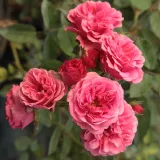
At 120 cm spacing in small groups, Elmshorn® reads as a coherent mass of colour, creating an inviting, traditional rose display that rewards occasional deadheading and standard spraying schedules for residents |
| Large container on balcony or paved front area |
In a 40–50 litre peat-free container with good drainage, Elmshorn® offers vertical structure and repeated pink blossom where soil is limited, making it suitable for paved, car-free or bin-screening spaces for balcony-owners |
| Wildlife-accented, family-friendly play garden |
Moderately thorny stems and moderate hips add seasonal texture; situate away from narrow play routes, combining it with grasses like Panicum for movement and a gentle, naturalistic backdrop for families |
Styling ideas
- Terrace-Classic – Line a low front fence with Elmshorn® and soft blue nepeta to create a traditional, storybook frontage – ideal for families wanting charm without formal topiary.
- Urban-Rain – Position near a downpipe in a raised bed, with gravel mulch and drought-tolerant sage, to celebrate rainwater while protecting roots – suited to sustainability-minded city gardeners.
- Cherry-Glow – Pair the deep pink clusters with silvery grasses and white feverfew for a luminous, evening-friendly scheme – perfect for after-work garden viewers.
- Doorway-Welcome – Use a single shrub by the front step, backed by clipped Ilex crenata spheres, for a composed yet romantic entrance – good for design-conscious homeowners.
- Playful-Prairie – Mix Elmshorn® with Panicum ‘Sangria’ and low herbs to create a soft, moving backdrop that still offers structure – appealing to families wanting a relaxed, natural look.
Technical cultivar profile
| Characteristic |
Data |
| Name and registration |
Elmshorn® is a hybrid musk / Lambertiana shrub rose, marketed as a park-shrub type; trade name Elmshorn® – deep pink park rose – Kordes, ARS exhibition name Elmshorn. |
| Origin and breeding |
Bred by Reimer Kordes, W. Kordes’ Söhne, Germany, from ‘Hamburg’ × ‘Verdun’; introduced in 1951 as an unregistered variety within the park-shrub rose assortment. |
| Awards and recognition |
Received an ADR rating in 1950, later withdrawn, and gained an RNRS Certificate of Merit in 1950, reflecting strong historic garden and exhibition interest. |
| Growth and structural characteristics |
Upright, bushy shrub reaching about 120–190 cm in height and 100–160 cm spread; moderately thorny shoots with moderately dense, glossy, light green foliage giving a full, traditional outline. |
| Flower morphology |
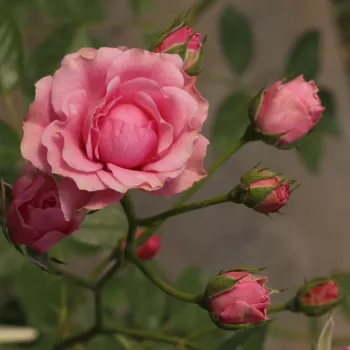
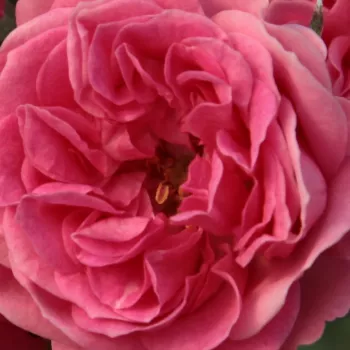
Semi-double, cup-shaped blooms with 13–25 petals, produced in clusters on branching stems; small flower size (around 0.5–1.5 in) but carried in generous, repeat-flowering trusses. |
| Colour data and phenology |
Deep pink flowers with cherry-red tones; outer petals RHS 52A, inner 53B; colour lightens in heat and with age, with petal edges paling before the centre, which stays more saturated. |
| Fragrance and aroma |
Fragrance is very weak and barely perceptible, with no defined scent character; selected more for its flower colour, habit and cluster effect than for perfume or aromatic uses. |
| Hip characteristics |
Produces moderate quantities of small, spherical hips, approximately 6–10 mm in diameter, coloured red (RHS 40A), adding discrete late-season interest without dominating the shrub. |
| Resistance and winter hardiness |
Extremely hardy shrub rose, tolerating approximately −32 to −29 °C (USDA 4b, RHS H7, Swedish zone 5); however, shows very high susceptibility to black spot, mildew and rust. |
| Horticultural recommendations |
Best in full sun with good air movement; requires regular disease control and deadheading; allow 110–120 cm for hedges and groups, up to 200 cm for solitary specimens in gardens or parks. |
Elmshorn® offers long-season deep pink clusters, reliable hedge structure and a durable own-root framework that rewards patient, attentive gardeners seeking a characterful, traditional shrub rose to enjoy for years to come.