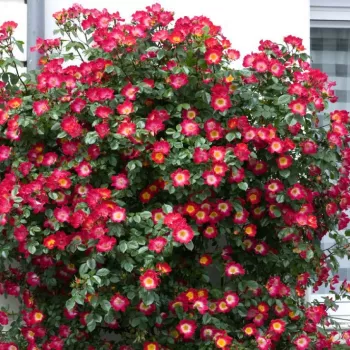
COCTAIL® – red-yellow park rose - Meilland
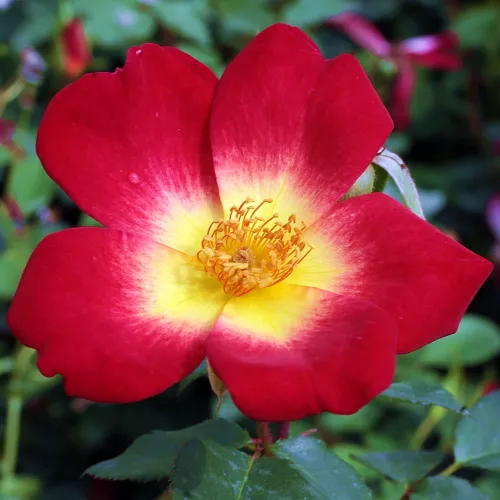
With COCTAIL® You can create a compact vertical feature that feels both playful and composed, ideal for a small London front garden where every inch matters and reliable flowering meets the reality of rainfall-soaked, sometimes heavy soil after wet spells and coastal winds. This classic Meilland rose produces clouds of single, scarlet-and-gold blooms from early summer, drawing in bees while largely tidying itself thanks to good self-cleaning. As an own-root shrub supplied in a manageable 2-litre pot, it is designed for long life, steady structure and easy recovery if pruned hard or wind-damaged. In year one it quietly builds roots, year two brings stronger shoots, and by year three You can expect a mature wall of colour with minimal intervention.
Usage options
| Target area | Reasoning |
|---|
| Small urban front garden feature |
COCTAIL® works beautifully as a restrained climber on railings or a narrow trellis by the front door, giving months of bright colour without demanding complex pruning, ideal for a low-input, high-impact focus for the time-poor homeowner |
| Rainwater-friendly façade planting |
Trained flat against a warm wall above a gravel strip, this rose partners well with simple surface drainage, coping with typical British showers and breezy corners where water runs off paving, suiting environmentally aware city-dweller |
| Pollinator strip with vertical height |
Its open flowers provide easy pollen access, so when combined at the base with lavender or nepeta it forms a buzzing corridor, adding height without overshadowing smaller perennials and supporting the wildlife-focused gardener |
| Low-maintenance family boundary |
Used along a fence, its upright habit and dense foliage create a colourful, semi-transparent screen that largely cleans itself of spent petals, keeping maintenance modest for busy families who still want seasonal theatre, reassuring the practical parent |
| Large container on balcony or patio |
In a 40–50 litre, well-drained container with peat-free compost, COCTAIL® offers vertical interest where ground space is scarce, rewarding basic watering and feeding with repeat flowering, suiting the compact, design-conscious balcony-owner |
| Classic pergola or archway display |
Its moderate height and flexible, upright shoots allow easy training over a slim arch or lightweight pergola, giving a coloured canopy without overwhelming the structure, attractive for those seeking a romantic entrance for everyday visitors |
| Mixed shrub and perennial border |
Planted at the back of a bed with sage, gaura or asters in front, the scarlet-and-gold flowers pop above softer textures, adding structure and a long season of colour for the style-driven yet relaxed hobbyist |
| Long-lived specimen on its own roots |
As an own-root plant, COCTAIL® regrows reliably from the base, avoiding problems with graft suckers and maintaining its character over time with straightforward annual pruning, ideal for those wanting a one-off planting that matures alongside the household |
Styling ideas
- Urban-edge – Train COCTAIL® on slim black metal railings, underplant with nepeta and gravel mulch for easy rainwater soak-away – ideal for contemporary city-front owners
- Romantic – Combine over a narrow arch with pale gaura and soft grasses to create a light, fluttering entrance – perfect for cottage-style enthusiasts
- Graphic – Place in a large square planter with clipped lavender corners, letting the red-yellow blooms rise above – suited to design-conscious balcony gardeners
- Family – Run along a low fence with asters and dwarf weigela, giving colour, structure and bee interest with simple annual pruning – good for busy households
- Timeless – Use as a single specimen against warm brick, with sage and gravel at the base for low fuss and long life – appealing to low-maintenance traditionalists
Technical cultivar profile
| Aspect | Data |
|---|
| Name and registration |
MEImick, marketed as COCTAIL®, a park shrub rose used as an ornamental climber on supports, registered within the shrub and floribunda groups for garden and landscape use. |
| Origin and breeding |
Bred by Francis Meilland (Meilland International, France) from (Independence × Orange Triumph) × Phyllis Bide, introduced in 1957 and now an established classic of mid-20th-century French rose breeding. |
| Awards and recognition |
Highly decorated: Certificate in Rome (1956), first prize at Paris–Bagatelle (1957), Gold Medal at Orléans (1960) and inducted into the WFRS Hall of Fame as the 16th “World’s Favourite Rose” in 2015. |
| Growth and structural characteristics |
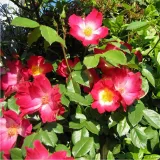
Upright shrub-climber reaching about 200–300 cm in height and 120–180 cm spread, with dense, glossy dark green foliage and plentiful thorns, forming a well-furnished vertical framework on modest supports. |
| Flower morphology |
Single, flat, small flowers (around 0.5–1.5 in) in clusters, with approximately 5–12 petals per bloom, remontant through the season, with a lighter but noticeable second flush after the main early-summer display. |
| Colour data and phenology |
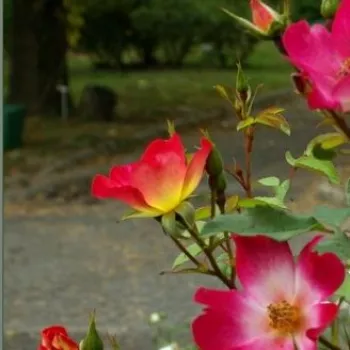
Striking bicolour flowers: vivid scarlet red margins with a bright golden-yellow eye, ARS RB, RHS 46A outer and 13C inner, gradually lightening to salmon and creamy lemon tones as blooms age and sunlight intensifies. |
| Fragrance and aroma |
Fragrance is very weak and barely perceptible, with only a fresh, lively character noted in close proximity; grown more for colour effect and pollinator appeal than for scent-driven planting schemes. |
| Hip characteristics |
Produces moderate quantities of small, spherical red hips, roughly 7–13 mm in diameter, adding discreet late-season interest and potential wildlife value without dominating the plant’s overall ornamental character. |
| Resistance and winter hardiness |
Hardy to approximately −26 to −23 °C (RHS H7; Swedish Zone 4; USDA 5b), tolerates heat well with watering in long dry spells, and shows moderate susceptibility to common fungal diseases such as black spot, mildew and rust. |
| Horticultural recommendations |
Best on supports, fences, pergolas or as a park shrub at 125–210 cm spacing; tolerates partial shade, prefers well-drained soil, benefits from occasional plant protection and regular training or pruning to maintain form. |
COCTAIL® offers eye-catching scarlet-and-gold flowers, bee-friendly single blooms and a self-renewing own-root structure, making it a considered long-term choice for those ready to give a classic rose a home.