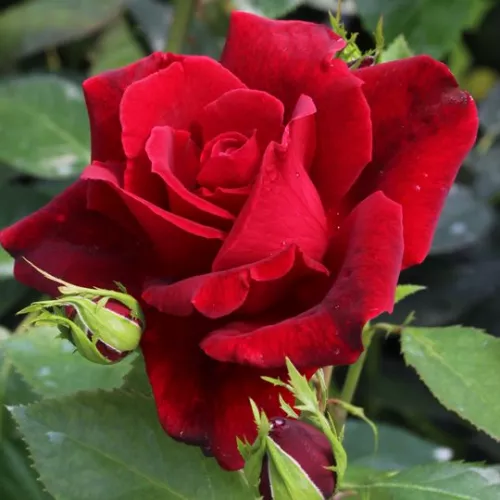
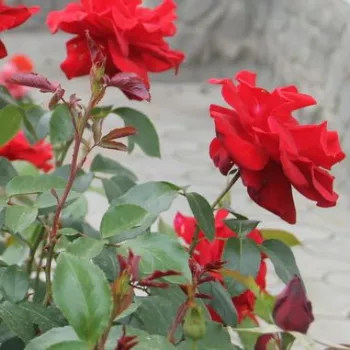
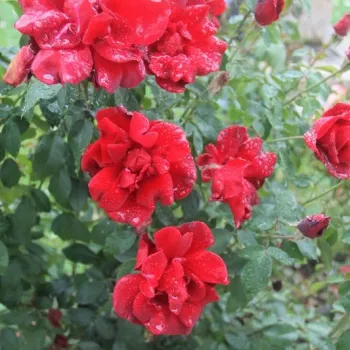
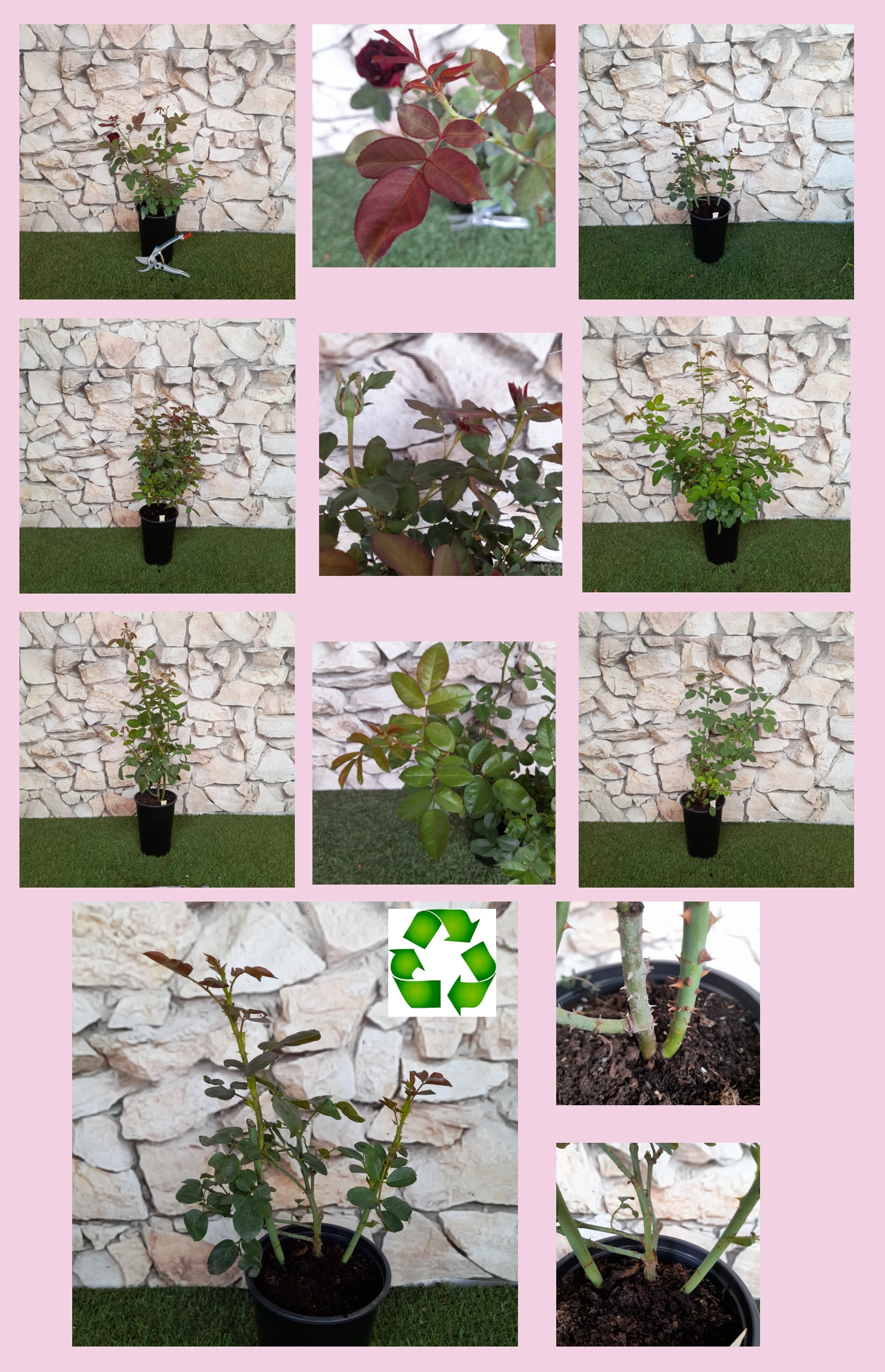
CHÂTEAU D´AMBOISE – dark red hybrid tea rose – Delbard-Chabert
Step out to your front garden after rain and meet CHÂTEAU D´AMBOISE, a compact hybrid tea that offers an easy introduction to classic dark-red roses for busy urban homes. Its bushy habit, glossy foliage and long-stemmed, exhibition-style blooms create a quietly formal structure that suits narrow London frontages and small family plots where every plant must earn its space. Colour remains remarkably stable, shifting from ruby to dusky burgundy without fading out, even in exposed sites that see frequent wind and showers along with cooler UK summers. As an own-root shrub, it builds a resilient underground framework that supports a long-lived plant, able to regenerate if pruned harder or nipped by frost, keeping your display reliable with simple deadheading and seasonal feeding. In its first year it concentrates on roots, the second on building strong shoots, and by the third year it reaches its full ornamental potential with regular repeat flushes for vases and evening enjoyment, all while remaining compact enough for a generous 40–50 litre container on steps or balconies, giving you sustainable, low-fuss elegance.
Usage options
| Target area |
Reasoning |
| Formal front-garden focal point |
Use as a single specimen by the gate or front door at the recommended wider spacing; the upright, bushy habit and exhibition-style blooms deliver strong visual structure with minimal shaping, appealing to the busy-urban gardener |
| Small family border in sun |
Plant in a mixed border where its medium height and dense, glossy foliage create a neat backdrop for perennials; repeat flowering keeps interest going with manageable care for the relaxed-homeowner |
| Large container on steps or terrace |
Grow in a 40–50 litre peat-free container with good drainage and regular watering; the compact footprint and vertical stems give classic roses on balconies and paved front areas, ideal for the space-conscious beginner |
| Cutting row for home arrangements |
Position in a sunny strip or narrow bed where long, straight, hybrid-tea stems can be cut without spoiling the overall display; the repeat bloom ensures a steady vase supply for the home-flower enthusiast |
| Clay or chalky urban front garden |
Suited to typical UK front gardens where heavier clay soils are improved with compost and chalky patches are common, offering a robust, adaptable choice for the practical city-gardener |
| Structured rose-and-lavender scheme |
Combine with low lavender or nepeta edging to underline its formal shape and support airflow; this simple pairing reduces visible disease impact and complements dark blooms for the design-aware homeowner |
| Low-maintenance family planting |
Choose for borders where moderate disease resistance and own-root resilience reduce long-term replacement needs; straightforward pruning and deadheading routines suit the time-pressed beginner |
| Front garden with strong wind and rain exposure |
Use where frequent showers and coastal-style winds would challenge lighter blooms; the firm petals, strong colour retention and sturdy growth maintain display with limited fuss for the weather-conscious gardener |
Styling ideas
- Terrace Classic – One rose in a 50 litre terracotta pot, underplanted with dwarf lavender for scent and structure – suited to balcony and small-terrace dwellers
- Burgundy Border – Mix with heuchera and dark-leaved grasses to echo the flower tones – ideal for style-focused front-garden renovators
- Cutting Strip – Plant a straight row along a path, edging with nepeta to soften lines – perfect for home florists wanting repeat stems
- Clay-Tolerant Formal – In improved clay beds, alternate with white perennials for contrast and clarity – good for owners of traditional urban terraces
- Evening Entrance – Flank a front door with two container-grown plants lit by warm LEDs – appealing to busy professionals seeking impact with little upkeep
Technical cultivar profile
| Parameter |
Data |
| Name and registration |
Hybrid tea rose, registered as DELrouvel, marketed as Château D´Amboise Hybrid tea rose DELrouvel; ARS exhibition name Château d’Amboise, part of the hybrid tea rose collection. |
| Origin and breeding |
Bred by André Delbard-Chabert, Delbard (France), 1988; complex parentage including ‘Tropicana’, ‘Rome Glory’, ‘Impeccable’, ‘Rouge Meilland’ and ‘Soraya’, introduced by Delbard Roses International. |
| Growth and structural characteristics |
Bushy, erect hybrid tea with dense, glossy dark green foliage, moderate prickles, around 80–105 cm tall and 45–65 cm wide, forming a clump-forming structure suitable for borders and specimens. |
| Flower morphology |
Medium-sized, double, cup-shaped blooms with 26–39 petals, usually solitary on stems; repeat-flowering with a strong second flush, providing classic hybrid tea form for garden and cutting use. |
| Colour data and phenology |
Deep dark-red blooms, ruby on opening, deepening to dusky burgundy and brownish-red edges; excellent colour retention, slight lightening in strong sun, delivering a rich, even tone throughout flowering. |
| Fragrance and aroma |
Soft, fruity character with mild intensity; fragrance is noticeable at close range rather than across the garden, offering a discreet scent suited to entrances and seating areas. |
| Hip characteristics |
Occasionally sets small, egg-shaped orange-red hips, about 10–14 mm across; hips appear sporadically after flowering and can add a modest decorative accent in late season. |
| Resistance and winter hardiness |
Hardy to approximately –21 to –18 °C (RHS H7, Swedish Zone 3, USDA 6b); disease resistance moderate overall, with good black spot resistance and moderate tolerance of powdery mildew and rust. |
| Horticultural recommendations |
Best in full sun with fertile, well-drained soil; spacing 45–95 cm depending on use, planting 3.3–3.8 plants/m² for groups; medium maintenance, requiring occasional pest control and regular deadheading. |
CHÂTEAU D´AMBOISE offers long-lasting dark-red blooms, compact structure and reliable repeat flowering on a resilient own-root framework, making it a thoughtful choice for those refining a small garden or terrace.