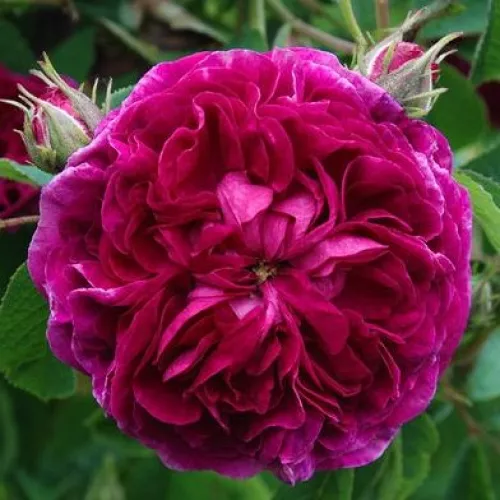
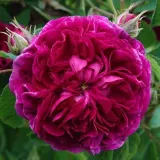
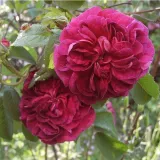
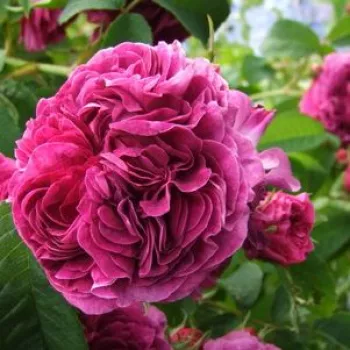
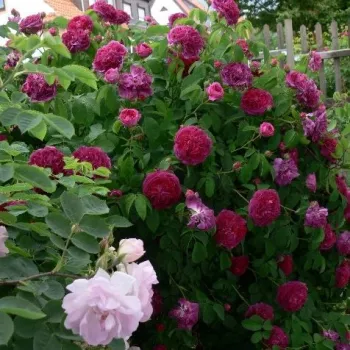
Deep, velvety crimson-purple base colour with subtle lilac undertones. Slight wine-red tones appear in darker lighting conditions. - historic, gallica rose - strong, far-scented rose - full, classic gallica scent
– XL rosette blooms with historic gallica charm.
– Deep crimson‑purple petals with lilac undertones.
– Strong, far‑reaching classic gallica fragrance.
– Hardy to about –30 °C, reliable in cold winters.
– Awarded RHS Award of Garden Merit for performance.
– Special feature: Forms handsome orange‑red hips for autumn interest if flowers are not deadheaded.
Long-lasting plant – Sustainable gardenscape
eleanorROSE® ORIGINAL 2-litre own-root potted rose
21,00 £
Unfortunately, we are currently unable to ship to the United Kingdom; we only deliver to countries within the European Union. For more information, please contact us!
5(7094)
CHARLES DE MILLS – purple-lilac historic Gallica rose
Steeped in history yet perfectly suited to today’s smaller urban plots, CHARLES DE MILLS brings a single, unforgettable summer of fragrance and colour to the front of your home with generous clusters of extra-large, rosette blooms in deep crimson-purple and lilac tones. Its once-flowering habit gives a concentrated few weeks of rich blossom that feels like walking a narrow path in post-rain air, with a classic gallica perfume that carries across a modest London terrace. On its own roots it develops steadily for long-term longevity, quietly building a resilient framework that will remain part of your garden for decades. In a typical family garden, the upright, bushy habit forms a dense, matt-green backdrop that works beautifully in rainwater-conscious front gardens where improved drainage protects roots on heavier soils and breezier, wetter sites. Peat-free compost and collected rainwater support a sustainable choice, while year one focuses on rooting, year two on stronger shoots, and by year three you enjoy the full ornamental impact.
Charles de Mills in closed bud, showing a dark crimson-purple form.
Charles de Mills at full bloom, with deep crimson-purple, very double gallica flowers.
Usage options
Target area
Reasoning
Front garden focal shrub
The strong gallica character and XL, rosette blooms create a single, highly memorable flowering moment, ideal for a compact front garden where you want impact without fuss, suiting those who enjoy a statement plant with seasonal drama for homeowners.
Informal flowering hedge
Its upright, dense growth and mid-green foliage form a leafy screen, while the once-a-year flush turns a boundary into a richly coloured hedge; after flowering, discreet hips follow, giving a soft, lived-in look that appeals to family-gardeners.
Feature in heritage-style beds
As a historic rose with an RHS Award of Garden Merit, CHARLES DE MILLS anchors mixed cottage-style beds, pairing well with airy perennials and herbs, ideal for gardeners who appreciate authenticity and period character for heritage-enthusiasts.
Rainwater-conscious urban border
The deep roots and strong framework of an own-root shrub suit small, permeable front gardens where surface water needs to soak away, particularly in wetter, wind-exposed conditions around townhouses, aligning with gardeners focused on practical sustainability for urban-owners.
Cut-flower collecting corner
The extra-large, very double, rosette blooms with intense colour and classic gallica scent make luxurious, short-stemmed indoor arrangements for a few peak weeks, rewarding those who enjoy cutting prized stems for special occasions for flower-lovers.
Peat-free, own-root long-term planting
As an own-root shrub, it builds a durable framework that can regenerate from the base if ever damaged, making it a sound long-term choice in a peat-free planting scheme for gardeners who prefer planting once and enjoying for decades for long-term-planners.
Part-shade side garden
This shade-tolerant gallica copes with light shade from buildings or neighbouring trees, still offering a strong seasonal show, making it well suited to narrow side gardens where sun is limited and space is tight for busy-beginners.
Seasonal, low-intervention feature shrub
Outside its main flowering window it behaves as a tidy, mid-sized shrub needing only occasional maintenance and optional deadheading, fitting those who want a beautiful highlight plant without year-round attention for time-poor-gardeners.
Styling ideas
Townhouse Romance – Underplant with lavender and soft nepeta to frame the rich crimson-purple blooms beside a front path – ideal for terrace owners seeking a period feel in limited space.
Heritage Hedge – Create a loose boundary line, weaving in Stachys byzantina for silvery foliage contrast – suited to families wanting privacy with a traditional cottage character.
Vintage Cutting Patch – Combine with dusky salvias and tall alliums for stems that complement old-style arrangements – perfect for home florists who cut a few special vases each summer.
Shaded Side Walk – Plant along a part-shaded side return with ferns and shade-tolerant perennials – good for urban gardeners turning an overlooked strip into a quietly elegant corridor.
Rain-Softened Entrance – Set in a permeable, gravel-mulched frontage with drought-tolerant herbs to work with rainwater soakaway – appealing to sustainability-minded owners redesigning paved fronts.
Technical cultivar profile
Characteristic
Data
Name and registration
Historic Gallica rose marketed as CHARLES DE MILLS, an old garden cultivar from the Heritage rose collection, also recognised by the American Rose Society under the same exhibition name.
Origin and breeding
Originating in the Netherlands, bred around 1786 and introduced circa 1790, with parentage and breeder unknown, representing a classic example of traditional Gallica and Provins rose groups.
Awards and recognition
Holds the prestigious RHS Award of Garden Merit (1993), confirming reliable performance, stable ornamental value and dependable garden behaviour under a range of typical UK conditions.
Growth and structural characteristics
Forms an upright, bushy shrub 120–180 cm tall and wide, with dense, matt mid-green foliage and only slight prickliness, creating a solid, leafy structure suitable for hedging or specimen use.
Flower morphology
Produces very double, rosette-shaped, cluster-borne flowers over 3.5 inches across, with more than 40 petals; blooms once in early summer, then carries spent heads into attractive autumn hips.
Colour data and phenology
Displays deep, velvety crimson-purple with lilac undertones, RHS 60A outer and 60C inner, developing a mauve-silvery edge as flowers age, with colour lightening slightly in intense sunlight.
Fragrance and aroma
Offers a strong, far-reaching classic Gallica perfume, rich and complex, particularly pronounced in still, humid air, making it especially rewarding near paths, doorways or regularly used seating areas.
Hip characteristics
Develops moderately abundant, spherical orange-red hips, around 9–15 mm in diameter, if spent blooms are left in place, bringing subtle seasonal interest and structure into late summer and autumn.
Resistance and winter hardiness
Hardy to around −32 to −29 °C (USDA 4b, RHS H7), with medium resistance to powdery mildew, black spot and rust, performing best with reasonable watering and avoidance of prolonged drought stress.
Horticultural recommendations
Use in beds, informal hedges, parks or as a specimen, spacing 90–165 cm; tolerates partial shade, benefits from regular watering, and suits well-prepared, drained soil in peat-free, own-root plantings.
CHARLES DE MILLS offers an intensely fragrant, once-a-year display on a long-lived own-root shrub, rewarding patient gardeners who value historic charm, lasting structure and a quietly reliable investment in their garden.
Detailed product attributes
Product Identification Data
Product Name:
CHARLES DE MILLS – purple-lilac historic Gallica rose
Product Type:
eleanorROSE® ORIGINAL - 2-litre own-root potted rose
Flower Colour Description:
Deep, velvety crimson-purple base colour with subtle lilac undertones. Slight wine-red tones appear in darker lighting conditions.
Closed Bud:
Dark crimson purple, shading to nearly black towards the tip.
Newly Opened Flower:
Deep crimson mid‑tone, with a more vivid purplish sheen on the inner petal edges.
Full Bloom:
Uniform, deep crimson-purple surface with a slightly lighter crimson shade in the centre.
Before Fading:
Fading crimson with a subtle mauve‑silver sheen on the petal edges.
Colour Fading Description:
A deep, velvety crimson‑purple slightly lightens by the end of opening, with a mauve-silvery tone appearing along the petal edges; in strong sunlight it fades a little further.
Pollinator Attraction:
The very double flower form limits pollinators’ access to the stamens and thus reduces attractiveness, although butterflies may appear occasionally.
Our product is a rose grown with pharmaROSA®’s unique cultivation technology!
2-litre, own-root, potted rose.
With a shoot system appropriate to the season.
With a root system that thoroughly permeates the growing medium.
Quality compliant with the requirements of the E.N.A. (European Nurserystock Association).
Supplied in unique packaging that prevents damage.
Can be planted during frost-free periods.
True-to-variety rose bush with a unique identifier.
The pharmaROSA® own-root potted rose is a well-rooted plant that supports reliable establishment when planted and cared for properly, so it can be planted whenever the soil is not frozen.
Crop overview: several varieties and growth stages in a short crop section.Shoot system: intensive growth of fresh basal shoots on a young plant.Root system: demonstration of a vigorous root system permeating the growing medium, by removing the pot.Balance: mature plant with root system and shoots in harmony with each other.
Information about the videos
The video series is not a “seasonal showcase”; it illustrates the essence of pharmaROSA® own-root cultivation in a tangible way: how the plant is built up, what the root system is like and how the shoot system regenerates. The recordings were therefore made at different times and with plants at various stages of development, so mixed foliage levels and differing stages of growth may appear in the videos. They are not a ‘sample’ of the batch dispatched, but a visual explanation of how the technology works. The current condition of the rose available to order — typical for the given period and similar to what you can expect to receive in the parcel — is shown in the upper part of the product page.
Pages for private customers Garden roses for the family garden, with minimal care → ORIGINAL® Premium garden roses – instant impact, a truly showpiece garden → EXTRA® Pages for professionals and private customers Roses for public spaces – large areas, sustainable maintenance → NATURAL® Roses for projects – hedge and row planting, fast implementation → RAPID® For professional partners only Production – propagation material for garden roses, wholesale → NEONATAL®
Company details
PharmaRosa Ltd. Company registration number: 01-09-717479 VAT number: 13075314-2-43 Plant health registration no.: HU130721 Bank account (IBAN): HU85117631891388688400000000 BIC (SWIFT): OTPVHUHB Bank name: OTP Bank Nyrt.