BORDURE ROSE™ – pink floribunda bedding rose – Delbard
With its compact, border-hugging habit and generous flowering, BORDURE ROSE™ slips neatly into small London front gardens where every inch matters and balance between paving, planting and rainfall really counts. This low, cushion-like floribunda builds a long-lived, own-root framework that supports steady, season-long colour without demanding specialist pruning. Its dense, glossy foliage and softly cupped blooms create a fresh post-rain ambience, coping reliably with cool, damp spells and brisk winds in exposed or coastal locations. In containers of at least 40–50 litres it forms a rounded structure that softens steps, railings and parking bays, bringing a quietly elegant edge to sustainable town planting. Over time the own-root system underpins a resilient lifetime presence in your border. Expect steady root establishment in year one, stronger shoots in year two and full ornamental impact by year three, for a durable, easy-going pavementside display.
Usage options
| Target area | Reasoning |
|---|
| Front garden edging for terraced houses |
The compact 50–70 cm height and spread form a neat, low edging that frames paths and small gravel strips without overwhelming narrow plots, giving reliable structure close to paving for the busy urban gardener. |
| Low-maintenance family flower bed |
Remontant flowering gives repeated flushes of medium-sized, double blooms, so beds stay colourful across the season with only basic deadheading and occasional pest checks needed, ideal for the time-poor homeowner. |
| Rainwater-friendly gravel or permeable drive borders |
The dense, cushion-like habit sits happily beside permeable gravel or brick, softening hard edges while leaving space for surface water to soak away efficiently, suiting the sustainability-conscious householder. |
| Large container on balcony or patio |
In a 40–50 litre or larger pot, the bushy, rounded form and glossy foliage give a tidy, long-season display; own-root plants re-shoot well after pruning, rewarding the container-focused beginner. |
| Small, low flowering hedge |
Planted at 35 cm intervals, the even, compact plants knit into a soft, colourful line that defines front boundaries or separates play areas from borders, practical for the family-garden planner. |
| Coastal or wind-exposed sites |
Its sturdy framework and H7 hardiness meet cool, windy, showery conditions with dependable form and foliage, supporting borders where spray and gusts challenge other roses, reassuring the weather-aware gardener. |
| Clay or chalky suburban soils with improved drainage |
Once established, the own-root plant forms a resilient, well-branched base that copes with typical UK clay or chalk, provided initial drainage is improved and watering is regular in the first summers, suiting the average-plot owner. |
| Formal bedding and geometric layouts |
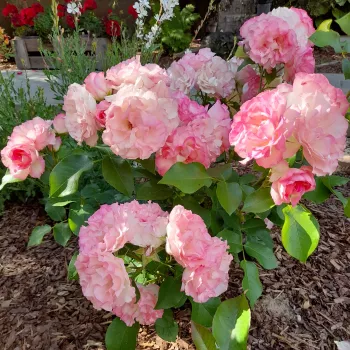
The uniform height, rounded habit and clear bicolour blooms create crisp patterns in squares or ribbons, giving long-lived definition that is easy to refresh by pruning back and allowing strong regrowth for the design-minded amateur. |
Styling ideas
- Ribbon – run a single line along a short front path, underplanting with low thyme to fill gaps and emphasise the rose’s neat outline – ideal for space-conscious city dwellers
- Cushion – mass-plant in a shallow curve beside a permeable driveway, interspersed with small gravel pockets to keep the look soft and rainwater-friendly – suitable for sustainability-focused households
- Contrast – pair with blue nepeta or lavender in a sunny bed to set off the cream-and-pink flowers against cool-toned companions – appealing to colour-loving beginners
- Courtyard – place one plant in a 50 litre terracotta pot with trailing sage or helichrysum to frame a front step or balcony corner – perfect for container gardeners
- Geometry – plant in a tight square or diamond around a small ornamental tree, keeping a low floral outline that feels ordered yet soft – attractive to design-led homeowners
Technical cultivar profile
| Characteristic | Data |
|---|
| Name and registration |
Floribunda bed rose from the Border roses collection; registered as DELbara, marketed as BORDURE ROSE™ and also known in exhibition circles under the name Strawberry Ice. |
| Origin and breeding |
Bred by Georges Delbard in France before 1973 from complex floribunda parentage, first introduced and distributed by Delbard; Georges Delbard SA in France in 1973. |
| Awards and recognition |
Highly decorated bedding rose with Lyon Gold Medal 1975, Monza Silver Medal 1975 and a total of 14 national and international medals recognising garden and show performance. |
| Growth and structural characteristics |
Compact, cushion-form shrub reaching around 50–70 cm in height and spread, with dense, dark green glossy foliage and moderate prickles, ideal for edging, low hedging and bedding. |
| Flower morphology |
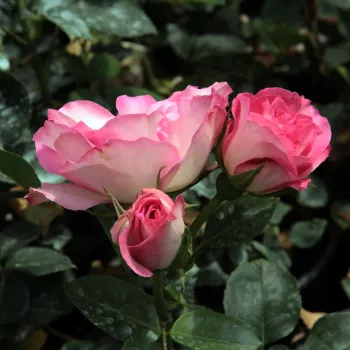
Medium-sized, double, cupped blooms with 26–39 petals, borne in clusters of 3–7 per stem; remontant habit giving abundant first and very good second flushes through the season. |
| Colour data and phenology |
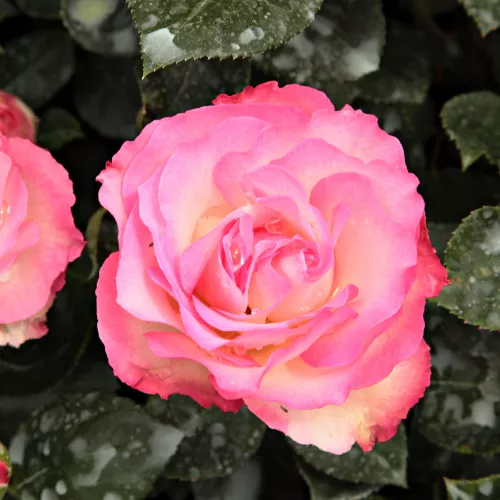
Cream-white petal base edged vivid pink (RHS 68B outer, 36D inner); buds medium pink, colour softens in strong sun to a paler, creamy-white effect while remaining clearer in cooler weather. |
| Fragrance and aroma |
Classed as scentless with no noticeable fragrance; flowers are primarily ornamental, with double form and weak scent meaning they are chosen for colour impact rather than perfume or pollinator value. |
| Hip characteristics |
Occasional small spherical hips, about 5–9 mm, coloured orange-red (RHS 40A), adding a light seasonal accent but not a major feature of the plant’s ornamental appeal. |
| Resistance and winter hardiness |
Rated H7 and USDA Zone 6b, tolerating down to about –21 °C; disease resistance is moderate for black spot, mildew and rust, so basic monitoring and timely treatment will be beneficial. |
| Horticultural recommendations |
Best in sunny sites with decent drainage; plant at 35–65 cm spacing depending on use, water regularly during dry spells, feed annually, and prune back to maintain the compact, flowering cushion. |
BORDURE ROSE™ offers compact cushions of long-season colour and dependable structure on its own roots, rewarding modest care with lasting presence in small gardens and containers, making it a thoughtful choice for understated urban planting.