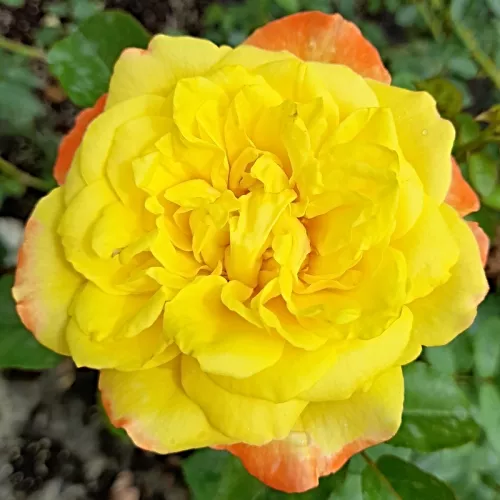
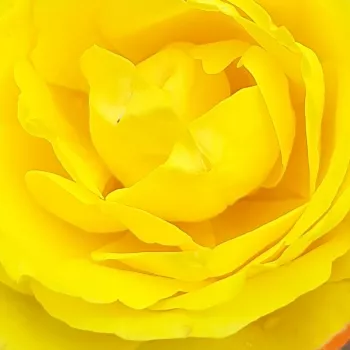
BANZAI – yellow hybrid tea rose – Meilland & Mouchotte
Imagine a London front garden after rain, where a compact hybrid tea quietly holds its line in wind and wet while your paving drains cleanly and the borders stay bright. BANZAI brings balance to small, busy spaces: an upright, compact bush that slips easily into narrow beds, raised planters or a generous 40–50 litre pot. Its golden-yellow blooms repeat reliably from early summer, giving long-season colour with minimal intervention and only moderate plant protection. As an own-root rose, BANZAI is designed for longevity, regenerating from the base rather than depending on grafts, so you gain years of steady structure and ornamental stability in the same spot. Simple to plant in improved clay or chalky soil, it settles in quickly, then spends its time quietly providing flowers for both the garden and the vase.
Usage options
| Target area |
Reasoning |
| Urban front garden bed |
The upright, compact habit fits the narrow borders typical of terraced front gardens, giving a structured, formal look without shading windows or paths and suiting time-pressed, design-conscious beginners. |
| Feature rose in a large container |
In a 40–50 litre pot with peat-free compost, BANZAI forms a dense, well-foliated shrub whose own-root vigour maintains performance year after year on balconies and paved yards valued by urbanites. |
| Cut-flower corner in a family garden |
High-centred, florist-style blooms on strong stems provide reliable cutting material through summer, so one bush can supply repeated vases indoors for households keen on home-grown flowers. |
| Rainwater-smart planting by driveway or path |
The compact spread and upright structure sit neatly beside permeable gravel or paving, helping keep access routes clear while complementing gardens planned for wetter, breezier British conditions. |
| Mixed planting with perennials |
Its warm yellow flowers pair beautifully with lavender, sage, nepeta or lady’s mantle, giving a soft, “girly” planting that still feels calm and ordered for aesthetically minded homeowners. |
| Low-maintenance, long-lived focal point |
Own-root growth means no graft union to fail, so the shrub can be lightly pruned and quietly maintained in the same position for many years, suiting planners of sustainable, long-term borders. |
| Part-shade side passage or narrow yard |
BANZAI tolerates partial shade and keeps a tidy outline, so it performs where light is limited but space is tight, ideal for overlooked side returns and alleyways used by busy families. |
| Water-wise, wind-exposed planting |
Dense foliage and moderate disease resistance make the plant a good candidate for coastal or breezier plots where rainfall and air humidity fluctuate, reassuring cautious new gardeners. |
Styling ideas
- Golden-Frontage – Line a narrow front bed with BANZAI and soft lady’s mantle, edging with gravel to keep runoff tidy – ideal for style-aware terraced-house owners.
- Balcony-Bouquet – Plant one BANZAI in a 50 litre container with trailing thyme to enjoy cut flowers from a compact footprint – perfect for flat-dwellers with limited space.
- Sunny-Panel – Combine BANZAI with nepeta and low lavender in a rectangle bed for a calm, feminine look – suited to beginners wanting easy structure and colour.
- Doorway-Focus – Flank the front door with matching pots of BANZAI underplanted with parsley for a kitchen-garden twist – great for urban cooks and entertainers.
- Pathway-Glow – Repeat BANZAI at intervals along a permeable driveway, linking with soft grasses for a contemporary feel – aimed at homeowners refreshing a small front garden.
Technical cultivar profile
| Parameter |
Data |
| Name and registration |
Hybrid tea rose, registered as MEIquitos, marketed as BANZAI – yellow hybrid tea rose – Meilland & Mouchotte; ARS exhibition name ‘Banzai’, hybrid tea exhibition category. |
| Origin and breeding |
Bred by Meilland International (Jacques Mouchotte) in France, 2006; parentage not disclosed. Introduced and registered in 2010 by Meilland International, Le Cannet-des-Maures. |
| Growth and structural characteristics |
Compact, upright shrub 70–100 cm high and 40–60 cm wide, with dense mid-green, matt foliage and moderate prickles; suitable for beds, hedging rhythms and container cultivation. |
| Flower morphology |
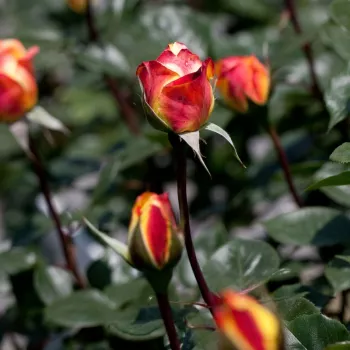
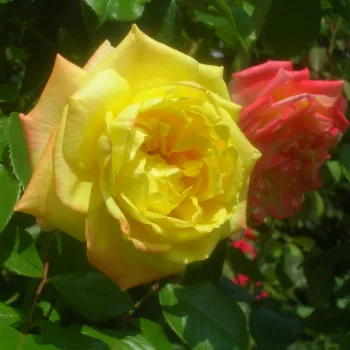
Hybrid tea, high-centred, pointed buds with medium-sized, double flowers bearing roughly 26–39 petals; blooms are mainly solitary on stems and repeat freely through the season. |
| Colour data and phenology |
Rich, even golden yellow (RHS 11B outer, 12A inner) when opening, gradually fading through lemon yellow to a pale, lightly creamy yellow before petal drop in later stages. |
| Fragrance and aroma |
Very weakly scented; any fragrance is barely noticeable in most garden conditions, so it is chosen primarily for colour impact, flower form and garden structure rather than perfume. |
| Hip characteristics |
Small, spherical orange-red hips, around 8–12 mm, produced only occasionally due to double flowers; visually discreet and generally secondary to the plant’s flowering display. |
| Resistance and winter hardiness |
Rated to approximately −21 to −18 °C (RHS H7, USDA 6b, Swedish Zone 3). Moderate resistance to black spot, powdery mildew and rust; standard preventive care is recommended. |
| Horticultural recommendations |
Best in fertile, well-drained soil with regular feeding. Plant 40–90 cm apart depending on use; square spacing 4 plants/m² or 4.6 in hexagonal layouts; thrives in sun or partial shade. |
BANZAI – yellow hybrid tea rose – Meilland & Mouchotte offers compact structure, long-season colour and dependable cutting stems on an own-root plant that matures into a durable, low-fuss feature worth making room for.