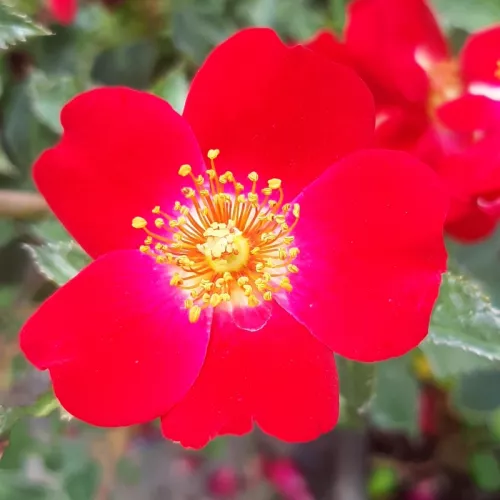
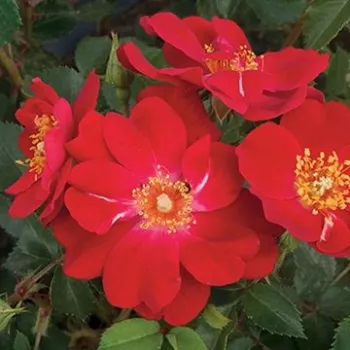
Uniform, intense bright red shade. - polyantha bedding rose - very weak, barely noticeable scented rose - scent description not available
– Compact, low shrub for neat planting schemes.
– Vivid bright red flowers with strong colour hold.
– Long flowering season with abundant reblooming.
– Dense, glossy dark green foliage backdrop.
– Good hardiness to around –20 °C winters.
– Special feature: Single blooms rich in pollen, highly attractive to bees and other pollinators.
Sensitive landscaping – Built on experience
eleanorROSE® ORIGINAL 2-litre own-root potted rose
17,60 £
Unfortunately, we are currently unable to ship to the United Kingdom; we only deliver to countries within the European Union. For more information, please contact us!
3(4488)
AMULET™ – red bedding polyantha rose - Tanjga
In a small London front garden or balcony, Amulet offers an easy, contemporary way to bring long‑season colour and wildlife into everyday life. Its compact, naturally rounded habit is ideal where space is limited, while masses of vivid single blooms create a soft, dramatic carpet of red that stays bright even in unsettled summer weather and fits gardens coping with wet, heavy soils and brisk coastal breezes. With clearly visible stamens and a simple flower form, this rose is reliably pollinator-friendly, drawing bees and hoverflies whenever it is in bloom. Own‑root planting supports a quietly resilient, long‑lived shrub that regenerates well after pruning or winter damage, giving a stable display over many years. In the first season it concentrates on roots, in the second on building shoots, and by the third you can expect its full ornamental value with minimal fuss. Even in busy urban settings it remains compact, tidy and easy to integrate into sustainable, rainwater‑fed planting schemes.
Freshly opened bright red Amulet™ bloom.
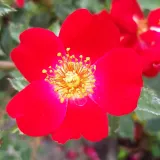
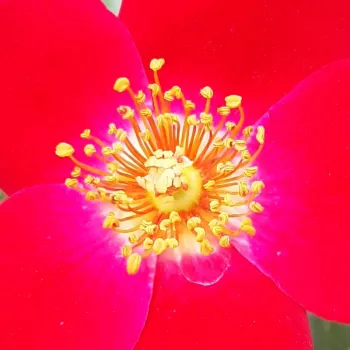
Close view of the open flower center of Amulet™.
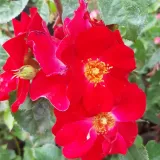
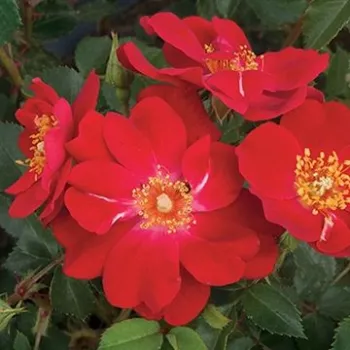
Amulet™ shows small, flat, single red blooms in clustered sprays.
Usage options
Target area
Reasoning
Small front gardens in terraced streets
The compact, naturally rounded habit stays within bounds on narrow plots yet still covers soil with dense foliage and flowers, giving structure without overwhelming the space or the paving-focused layout, ideal for the time-pressed homeowner
Pollinator-friendly urban planting strips
Open, single flowers with exposed stamens provide easy pollen and nectar access from spring into autumn, creating a reliable feeding station for bees and hoverflies along pavements and front fences, rewarding any wildlife-minded beginner
Low-maintenance family borders
Once established, this own-root shrub forms a durable framework that responds well to simple annual pruning and occasional mulching, maintaining flowering and shape without complex care routines, suiting a busy family
Coastal or wind-exposed gardens
The sturdy, compact structure and dense, glossy foliage cope well with breezy, rain-prone situations, offering reliable colour where more delicate roses might struggle, especially in gardens combining wind, humidity and heavier soils for the practical urban gardener
Rainwater-conscious, clay or chalk soils
Once drainage is improved at planting, own-root growth knits steadily into heavier clay or chalk, using stored rainwater efficiently and supporting steady flowering without constant intervention, reassuring the sustainability-focused owner
Informal low hedging along paths
Regular spacing creates a continuous, knee-high ribbon of red bloom that naturally defines paths and driveways, with repeat flowering providing a long season of interest and neat foliage that frames access points for the style-aware householder
Large containers on balconies or patios
In a 40–50 litre peat-free container, the compact root system and rounded canopy balance well, giving a long-lived potted shrub that responds to simple watering with rainwater and light feeding, attractive to the space-limited city dweller
Mixed perennial beds with soft colour themes
The intense red flowers stand out against dark green foliage yet combine smoothly with pastel perennials, while good disease resistance reduces the need for sprays, simplifying care in biodiverse borders for the environmentally conscious gardener
Styling ideas
Urban-edge – Line a small front garden rail with a low row of AMULET™, underplanting with thyme between paving to soften hard edges – ideal for compact terraced-house plots.
Bee-ribbon – Weave AMULET™ through a strip of nepeta and single dahlias to create a continuous nectar line – perfect for wildlife-focused families.
Pot-theatre – Grow AMULET™ in a 50-litre clay pot with trailing ivy and heuchera for foliage contrast – suited to balcony and patio gardeners.
Soft-hedge – Plant a loose hedge along a path, interspersed with lavender for scent and structure – attractive to those wanting easy, formal-informal definition.
Raspberry-glow – Combine AMULET™ with pale pink campanulas and white gaura for a light, airy border – appealing to lovers of gentle, romantic colour schemes.
Technical cultivar profile
Property
Data
Name and registration
Polyantha shrub and bedding rose, registered as BOZamulpap and marketed as Amulet™ Mella®; classified within bed roses for compact, massed garden and landscape use.
Origin and breeding
Bred by Biljana Božanić Tanjga of Pheno Geno Roses in Serbia around 2018; introduced to the market in 2019 through PhenoGeno Roses as an adaptable modern garden polyantha.
Growth and structural characteristics
Forms a compact, bushy shrub 35–55 cm high and wide, with dense, dark green, glossy foliage and moderate prickles, creating a neat, low mound suitable for bedding or edging.
Flower morphology
Clusters of small, flat, single flowers with 5–12 petals; remontant, with a notably abundant second flush that maintains colourful cover across the season on each well-branched stem.
Colour data and phenology
Uniform bright fire-red blooms, ARS MR, RHS 46B outer and 46A inner; colour stays saturated to full bloom, then softens slightly to a pale raspberry red near petal fall.
Fragrance and aroma
Fragrance is very weak and barely noticeable, so this cultivar is selected primarily for visual effect, colour persistence, compact form and pollinator value rather than for scent.
Hip characteristics
Moderate crop of small, spherical red hips, around 5–8 mm diameter, adding a light decorative effect and seasonal wildlife interest after flowering if spent blooms are left on the plant.
Resistance and winter hardiness
Rated hardy to approximately −21 to −18 °C (RHS H7, Swedish zone 3, USDA 6b); resistant to powdery mildew and rust with medium black spot resistance, supporting lower-input care.
Horticultural recommendations
Suited to mass planting, low hedging or specimens at 35–70 cm spacing; prefers a sheltered, well-ventilated site, with plant protection advisable in enclosed, humid urban courtyards.
AMULET™ offers compact structure, long-season red flowers and reliable pollinator appeal in a durable own-root form that suits smaller gardens and containers, making it a thoughtful choice for relaxed, sustainable planting.
Detailed product attributes
Product Identification Data
Product Name:
AMULET™ – red bedding polyantha rose - Tanjga
Product Type:
eleanorROSE® ORIGINAL - 2-litre own-root potted rose
Closed Bud:
Velvety, deep-red surface with a subtle sheen.
Newly Opened Flower:
Bright fire-red petals with a clear, uniform colouring.
Full Bloom:
The colour of the vivid red petals remains unchanged and saturated.
Before Fading:
The red tone slightly fades, taking on a pale raspberry‑red shade.
Colour Fading Description:
The bright red colour remains saturated until full bloom and, just before the end of flowering, fades slightly to a pale raspberry red.
Pollinator Attraction:
Its single flowers of 5–12 petals strongly attract pollinators because the simple flower form and exposed stamens provide easy access to nectar and pollen, increasing their attractiveness.
Pollinator-Friendly Rating:
Single-flowered variety with open blooms of 5–12 petals, explicitly pollinator-friendly and highly attractive to pollinators.
Maintenance Requirement:
Maintenance requirement moderate; performs well in a sheltered, well‑ventilated position, but in enclosed, humid urban courtyards may require plant protection.
Our product is a rose grown with pharmaROSA®’s unique cultivation technology!
2-litre, own-root, potted rose.
With a shoot system appropriate to the season.
With a root system that thoroughly permeates the growing medium.
Quality compliant with the requirements of the E.N.A. (European Nurserystock Association).
Supplied in unique packaging that prevents damage.
Can be planted during frost-free periods.
True-to-variety rose bush with a unique identifier.
The pharmaROSA® own-root potted rose is a well-rooted plant that supports reliable establishment when planted and cared for properly, so it can be planted whenever the soil is not frozen.
Crop overview: several varieties and growth stages in a short crop section.Shoot system: intensive growth of fresh basal shoots on a young plant.Root system: demonstration of a vigorous root system permeating the growing medium, by removing the pot.Balance: mature plant with root system and shoots in harmony with each other.
Information about the videos
The video series is not a “seasonal showcase”; it illustrates the essence of pharmaROSA® own-root cultivation in a tangible way: how the plant is built up, what the root system is like and how the shoot system regenerates. The recordings were therefore made at different times and with plants at various stages of development, so mixed foliage levels and differing stages of growth may appear in the videos. They are not a ‘sample’ of the batch dispatched, but a visual explanation of how the technology works. The current condition of the rose available to order — typical for the given period and similar to what you can expect to receive in the parcel — is shown in the upper part of the product page.
Pages for private customers Garden roses for the family garden, with minimal care → ORIGINAL® Premium garden roses – instant impact, a truly showpiece garden → EXTRA® Pages for professionals and private customers Roses for public spaces – large areas, sustainable maintenance → NATURAL® Roses for projects – hedge and row planting, fast implementation → RAPID® For professional partners only Production – propagation material for garden roses, wholesale → NEONATAL®
Company details
PharmaRosa Ltd. Company registration number: 01-09-717479 VAT number: 13075314-2-43 Plant health registration no.: HU130721 Bank account (IBAN): HU85117631891388688400000000 BIC (SWIFT): OTPVHUHB Bank name: OTP Bank Nyrt.