AMADEUS® – red climbing rose - Kordes
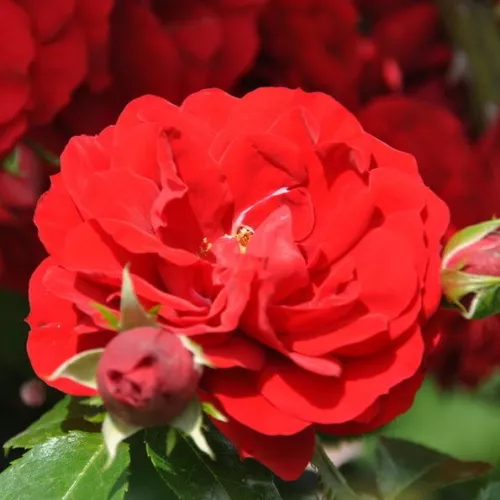
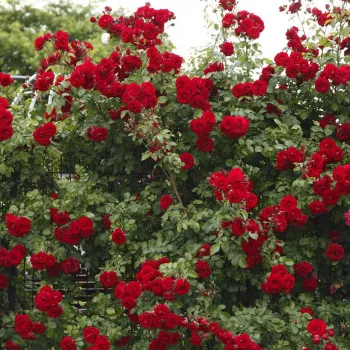
Step out after rain and let AMADEUS® line your narrow London path with balance, its lustrous deep-red blooms echoing front‑door drama while sturdy canes give long‑term structure and vertical impact. As a climber for walls, arches or railings, it works with simple rain‑saving ideas, easing heavy soils with thoughtful drainage solutions even where wind and showers regularly sweep through coastal gardens. Semi‑double flowers offer a gentle, fresh fragrance and accessible stamens for visiting bees, adding movement and life to compact urban plots. Planted as a young own‑root rose in a 2‑litre pot, it settles quietly in its first year, pushes confident new shoots in the second, and by the third year creates full, reliable colour along your chosen support.
Usage options
| Target area |
Reasoning |
| Terraced-house front wall |
Use AMADEUS® to frame a doorway or bay window, training its long canes on discreet wires for a vertical curtain of long-season red flowers that keeps precious ground space free for paving or a small bin store, ideal for the urban homeowner |
| Rainwater-conscious city garden |
Plant in a slightly raised bed with grit or green waste compost mixed into heavy soil so runoff from roofs can soak in slowly without waterlogging roots, its climbing habit greening brick and capturing rainfall splash where space is tight, perfect for the sustainability-focused gardener |
| Family pergola or seating nook |
Clothe a compact pergola or corner arbour to create a shaded “den” for children and a sheltered reading spot for adults, with semi-double flowers bringing occasional bee visits yet not overwhelming fragrance, well suited to the family-garden planner |
| Small balcony or patio in a large container |
Grow in a 40–50 litre frost-resistant pot with a slim obelisk, using peat-free compost and regular watering to enjoy generous clusters of scarlet flowers without sacrificing floor area, a manageable project for the busy balcony owner |
| Shared urban courtyard or communal space |
Train along railings or a mesh panel so it softens hard boundaries and provides a dependable, long-lived vertical accent, its own-root base helping the plant recover if cut back after building works, reassuring for the long-term resident |
| Bee-friendly front garden framework |
Combine with low perennials like lavender, nepeta or sage to create a layered pollinator corridor, where semi-double blooms offer partially open centres that moderately attract bees and complement other nectar sources, attractive to the wildlife-conscious beginner |
| Wind-exposed or coastal urban plot |
Use sturdy supports and deep planting so the flexible canes can sway without snapping, while its resilient foliage and colour-fast blooms stay presentable through changeable weather with frequent showers and brisk sea-breezes, reassuring for the coastal gardener |
| Low-maintenance long-term feature rose |
Once established on its support it needs only annual tying-in, basic pruning and periodic deadheading, with the own-root system helping it reshoot strongly from the base, keeping the display reliable over many years for the time-poor home gardener |
Styling ideas
- Doorway-Drama – Train AMADEUS® up narrow trellis either side of a front door, underplanting with Geranium macrorrhizum to soften the base – ideal for style-conscious terraced homeowners
- Ruby-Arch – Cover a slim rose arch over a path, pairing with lavender for scent and soft contrast – for couples wanting a romantic but manageable entrance feature
- Crimson-Screen – Run wires along a fence to form a living screen, edging the bed with Potentilla neumanniana for sunny groundcover – perfect for overlooked city gardens
- Balcony-Pillar – Grow a single plant in a 50 litre pot with a tall obelisk, adding trailing herbs for underplanting – suited to renters seeking reversible, portable planting
- Courtyard-Canvas – Fan-train AMADEUS® against bare brick, interplanting with Euonymus japonicus ‘Microphyllus’ for evergreen structure – for those transforming hard-paved spaces into green retreats
Technical cultivar profile
| Parameter |
Data |
| Name and registration |
Climbing, large-flowered rose from the Klettermaxe® collection; registered as KORlabriax, traded as AMADEUS® / Amadeus™; exhibition climbing rose in deep red tones. |
| Origin and breeding |
Bred by W. Kordes III, W. Kordes’ Söhne, Germany; breeding and registration 2003, first introduced 2007; parentage officially unknown, selected for colour and garden performance. |
| Awards and recognition |
Gold medals at The Hague and Geneva International Rose Trials (2004), Lyon (2005), plus Certificate of Merit at Bagatelle, Paris (2004), confirming strong ornamental merit. |
| Growth and structural characteristics |
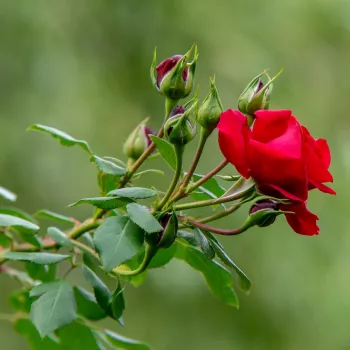
Vigorous climber reaching about 240–380 cm high and 90–160 cm wide, with dense, glossy dark green foliage and moderate prickles; suitable for walls, arches and pergolas when supported. |
| Flower morphology |
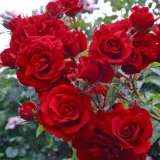
Semi-double, cup-shaped blooms of 13–25 petals, large flower size in clustered trusses; remontant habit with a good second flush, offering repeated displays through the season on trained canes. |
| Colour data and phenology |
Rich, lustrous deep-red flowers (RHS 53A outer, 46A inner) from ruby buds; colour holds extremely well in strong sun, darkening slightly as blooms age without noticeable bluing or browning. |
| Fragrance and aroma |
Mild, fresh classic rose scent, present but not overpowering near seating areas; semi-double flowers offer partly visible stamens, giving moderate appeal for bees and other visiting pollinators. |
| Hip characteristics |
Forms small spherical hips 9–15 mm across, in orange-red RHS 40A; produced in moderate quantities where spent blooms are not removed, adding late-season colour and wildlife interest. |
| Resistance and winter hardiness |
Hardy to about −26 to −23 °C (RHS H7, USDA 5b, Swedish zone 4); heat tolerant with watering in drought; disease resistance weaker, particularly to powdery mildew, so monitoring is advisable. |
| Horticultural recommendations |
Best on sunny or lightly shaded supports in fertile, well-drained soil; allow space per spacing guidelines, tie in new shoots, prune after main flush, and use preventive care in mildew-prone areas. |
AMADEUS® offers tall vertical colour, container and front-garden versatility, and the steady reliability of an own-root climber; consider it if you wish to add durable scarlet structure to your outdoor space.