ENCELADUS – red groundcover rose – pharmaROSA®
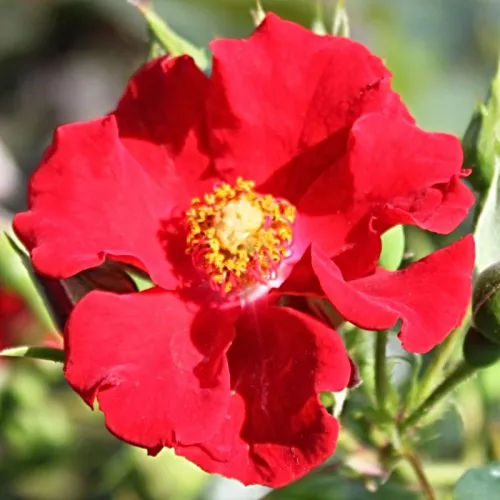
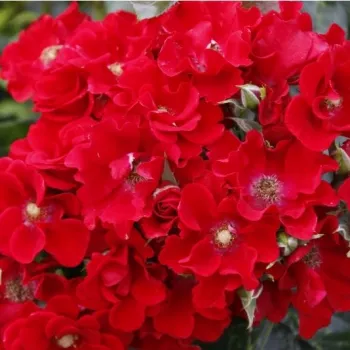
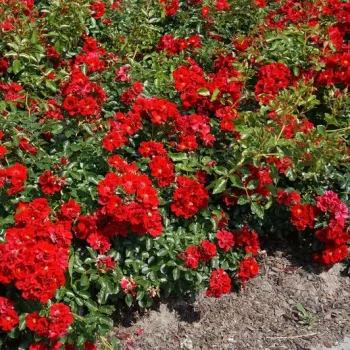
Step onto your front path after rain and ENCELADUS greets you with scarlet carpets of single blooms, their golden centres humming with bees and a lemony yet honeyed fragrance that lingers in the cooler evening air. This compact groundcover rose settles happily into typical UK conditions, coping reliably even where heavy clay needs careful drainage and steady structure. Once planted in peat‑free compost and watered in with harvested rain, its own-root strength builds quietly below ground, giving you a rose that matures steadily rather than needing constant coddling. From the first year’s root-building to fuller shoots in the second and a rounded, flower-rich shape by the third, you gain lasting balance between colour, scent and low effort. Naturally resilient to common fungal problems and hardy across most British winters, it offers relaxed, sustainable maintenance for busy households. Its bushy, mid‑green foliage knits together to form a neat, weed‑suppressing groundcover, ideal for transforming small London front gardens, shared entrances or balcony planters into quietly uplifting, year-round green space.
Usage options
| Target area | Reasoning |
|---|
| Urban front garden groundcover |
Low, bushy growth and a spreading habit quickly knit bare soil into a tidy red-and-green carpet, reducing weeding and watering while keeping entrances smart in tight city spaces, especially for busy owners. |
| Pollinator-friendly strip by pavement |
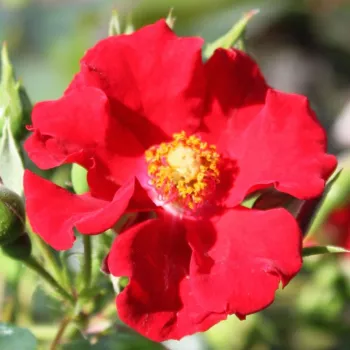
Single, open flowers with prominent golden stamens draw in bees and hoverflies from early repeats through summer, creating a living corridor of nectar right beside the street, appealing to wildlife-minded residents. |
| Low-maintenance family border edge |
Reliable repeat flowering and glossy foliage provide colour and structure without fussy pruning, so borders stay presentable around play areas and paths with minimal effort from time-poor gardeners. |
| Rainwater-focused planting on heavy clay |
The shallow, spreading root system suits amended clay beds where rainfall is channelled from roofs, helping stabilise the surface and work with improved drainage for sustainability-conscious households. |
| Long-lived, own-root groundcover drift |
Grown on its own roots, the plant regenerates well after harsh winters or accidental damage, maintaining an even, flower-rich mat over many years, reassuring cautious beginners. |
| Compact rose for large containers |
Its modest height and spreading form adapt well to 40–50 litre pots, where stable own-root growth and good hardiness keep terrace and balcony plantings dependable for flat-dwellers. |
| Coastal or exposed sites |
Firm, bushy structure and healthy foliage help it withstand wind and driving rain in more open situations, retaining ornamental value where other roses may struggle for coastal gardeners. |
| Child-friendly, sensory planting corner |
Frequent flowers, colour shifts from vivid to softer reds, and strong, enduring lemon-honey fragrance create an engaging, low, tactile planting for supervised children and reflective families. |
Styling ideas
- Terrace-Ribbon – Run a narrow band of ENCELADUS along a London terrace front, underplanted with Carex flacca ‘Blue Zinger’ for texture – ideal for design-aware city homeowners.
- Bee-Carpet – Combine ENCELADUS with Liatris spicata 'Alba' for vertical spires above the red carpet – perfect for wildlife-focused urban gardeners.
- Clay-Corner – On improved heavy clay, mix ENCELADUS with drought-tolerant nepeta and sage to create a resilient, fragrant triangle by the front gate – suited to low-maintenance planners.
- Balcony-Bowl – Plant a single ENCELADUS in a 50 litre container with trailing thyme at the rim for scent and softness – attractive for balcony and roof-terrace residents.
- Storybook-Path – Edge a winding garden path with repeated ENCELADUS plants and intersperse with lavender for a fairy-tale, sensory route – appealing to families with young children.
Technical cultivar profile
| Parameter | Data |
|---|
| Name and registration |
ENCELADUS – red groundcover rose, marketed as Enceladus Mulch pharmaROSA®; a groundcover–miniature garden rose from the pharmaROSA® ORIGINAL 2-litre own-root collection. |
| Origin and breeding |
Discovered in Germany in 2003 and later introduced by PharmaRosa® Ltd. (Hungary); exact parentage and original breeder details remain unknown or undocumented. |
| Growth and structural characteristics |
Bushy, low-growing groundcover rose reaching about 50–85 cm in height and 50–90 cm spread, forming a moderately dense, mid-green, glossy canopy with moderate prickles along the stems. |
| Flower morphology |
Small, flat, single blooms (around 5–12 petals) borne in clusters, repeating well through the season with a notably abundant second flush, offering a light, airy floral effect rather than heavy fullness. |
| Colour data and phenology |
Deep scarlet to bright red flowers with warm orange bases and golden-yellow stamens, later softening towards raspberry or brick-red hues as blooms age, maintaining an overall warm, glowing appearance. |
| Fragrance and aroma |
Distinct, strong and long-lasting perfume combining clear lemony top notes with softer honeyed sweetness, noticeable on warm still days and particularly evocative in the evening after rainfall. |
| Hip characteristics |
Produces decorative hips in moderate quantities, roughly 8–16 mm across, adding a subtle seasonal accent and potential wildlife interest in late season once the main flowering has eased. |
| Resistance and winter hardiness |
Rated H7, hardy to approximately −26 to −23 °C, and assessed as resistant to black spot, powdery mildew and rust, supporting consistent foliage quality in humid or disease-prone gardens. |
| Horticultural recommendations |
Prefers well-drained soil with some organic matter; space 85–155 cm depending on use, plant 1.1–1.3 per m² for groundcover, and keep watering and feeding moderate to encourage steady, resilient growth. |
ENCELADUS offers compact groundcover habit, bee-attracting single blooms and enduring lemon-honey fragrance on a resilient own-root framework, making it a thoughtful choice for long-lived, low-effort planting.