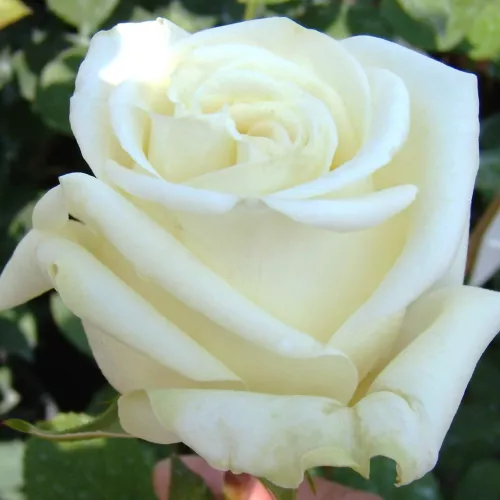
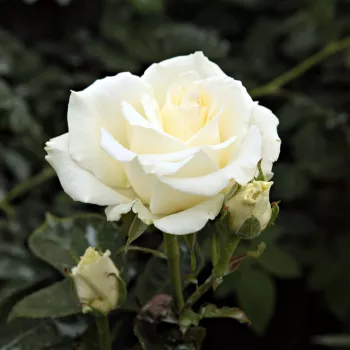
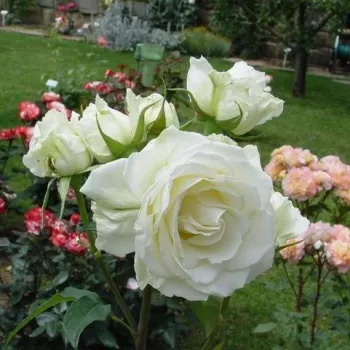
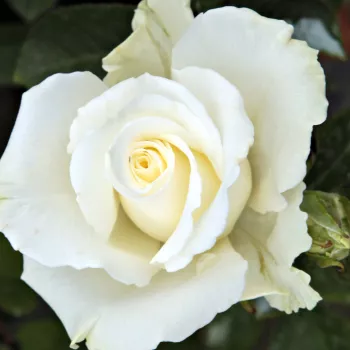
Pure, snow-white petals with a subtle pearlescent sheen. - hybrid tea rose - mild, subtly scented rose - refreshing character
– Pure snow‑white, high‑centred exhibition blooms.
– Mild, refreshing classic rose fragrance.
– Reliable remontant flowering with good second flush.
– Upright, compact habit for beds and cutting.
– Strong resistance to black spot and mildew.
– Special feature: Historic RNS Gold Medal winner (1949), combining elegant form with enduring garden value.
Long lifespan – Responsible plant selection
eleanorROSE® ORIGINAL 2-litre own-root potted rose
19,30 £
Unfortunately, we are currently unable to ship to the United Kingdom; we only deliver to countries within the European Union. For more information, please contact us!
5(10890)
VIRGO™ – white hybrid tea rose – Mallerin
Step onto your front path after rain and meet Virgo, a refined hybrid tea rose whose clear snow‑white blooms bring a sense of calm to compact, rainwater‑wise London gardens. Bred in France in 1947, it offers enduring elegance on a naturally upright framework, with medium‑sized, high‑centred flowers ideal for cutting and displaying indoors. Its reliable disease resistance helps it cope with damp, changeable weather and heavier soils, making it well suited to areas where wet spells and wind challenge less robust roses. As an own‑root plant, it builds a strong, stable framework over time, supporting a long garden lifespan with steady renewal and minimal intervention. Given a sunny spot, regular watering and sensible drainage on clay or chalk, Virgo settles in gradually and rewards you with repeat flushes of flowers through the season. In a large 40–50 litre container or in the ground, you can expect roots to establish in the first year, stronger shoots and shape in the second, and full, dependable ornament by the third, for a quietly sustainable, low‑fuss presence in your family garden.
Virgo™ in potted sales condition
Usage options
Target area
Reasoning
Small London front garden feature
The upright habit and compact spread let Virgo hold its own in the tight beds typical of terraced‑house fronts, giving a single, clear focal point without overwhelming the space, ideal for the busy urban garden owner seeking balance.
Cut‑flower row or micro cutting bed
High‑centred, exhibition‑type blooms and long, straight stems make this variety particularly rewarding for home cutting, so you can enjoy its snow‑white flowers indoors with minimal effort, suiting home florists who value elegance.
Low‑maintenance family flower bed
Good resistance to black spot and powdery mildew means less spraying and fewer worries during humid spells, supporting a relaxed approach to care for families and beginners who prioritise ease.
Long‑term specimen in a mixed border
As an own‑root rose it forms a durable framework that ages gracefully, regenerating from its base rather than relying on a graft, appealing to gardeners who think ahead and appreciate plant longevity.
Large container on a paved front garden
Performs well in a substantial 40–50 litre pot with regular watering, bringing soft structure and bloom to rainwater‑friendly, largely paved spaces, attractive for urban households turning hardstanding into a modest retreat.
Clay or chalky suburban plot
With sensible drainage, its robust constitution and disease resistance help it cope where heavier or chalky soils and unsettled, wet weather can stress fussier roses, reassuring householders gardening on typical British ground.
Urban green space or communal planting
Low‑to‑medium maintenance needs and tidy, upright growth make Virgo suitable for shared beds where reliable structure and easy care are important, fitting caretakers and residents who prefer understated, enduring beauty.
Developing new gardens over 1–3 years
Ideal where you want to see clear progress: roots in year one, strong framework in year two, and full ornamental effect by year three, a reassuring choice for newer gardeners planning their first longer‑term investment.
Styling ideas
Front‑door calm – Plant Virgo as a single statement rose by the front step with low Nepeta and soft gravel mulch to echo a rain‑friendly London entrance – for urban homeowners wanting a composed welcome.
White‑on‑white – Combine with dwarf Gypsophila paniculata and pale paving for a serene, all‑white scheme that stays bright even on overcast days – for those who favour a restrained, classic palette.
Modern romance – Set Virgo against dark fencing with Penstemon ‘Husker Red’ and slate chippings to contrast its snow‑white flowers – for style‑conscious gardeners seeking a contemporary, “girly” edge.
Porch container – Grow one plant in a 40–50 litre pot with free‑draining peat‑free compost and underplant with trailing thyme – for balcony and small‑yard gardeners needing portable elegance.
Quiet showcase – Line a short path with widely spaced plants, infilling with lavender or sage for scent and foliage contrast – for hobby gardeners who enjoy simple structure with minimal upkeep.
Technical cultivar profile
Parameter
Data
Name and registration
Hybrid tea rose; registered cultivar name Virgo, current trade name Virgo™ hybrid tea rose Virgo; ARS approved exhibition name Virgo; part of the hybrid tea rose commercial group.
Origin and breeding
Bred by Charles Mallerin in France from ‘Blanche Mallerin’ × ‘Neige Parfum’; introduced by Meilland Richardier in 1947; unregistered cultivar name in formal registers.
Awards and recognition
Recognised with an RNS Gold Medal in 1949, reflecting its early success as a high‑quality white hybrid tea rose for both gardens and exhibition cutting displays.
Growth and structural characteristics
Upright hybrid tea with moderately dense, glossy dark green foliage; height about 75–105 cm, spread 70–95 cm; moderately thorny stems; spent blooms need deadheading as self‑cleaning is weak.
Flower morphology
Medium, double flowers with 26–39 petals; classic high‑centred, pointed hybrid tea form on mostly solitary stems; remontant, with a generous second flush, suitable for cutting and display.
Colour data and phenology
Pure snow‑white petals with subtle pearlescent sheen; buds greenish with creamy tips; opens creamy white, then bright white, finally taking a light ivory tone shortly before petals drop or are removed.
Fragrance and aroma
Mild, refreshing fragrance of classic rose character; noticeable at close range without being overpowering, making it suitable near paths, seating areas and for indoor arrangements from cut stems.
Hip characteristics
Hip set is generally poor due to its double blooms; where formed, hips are small, spherical, around 10–14 mm in diameter, coloured red‑orange and not a dominant ornamental feature.
Resistance and winter hardiness
Good resistance to black spot and powdery mildew, moderate for rust; hardy approximately to −21 to −18 °C (RHS H7, USDA 6b, Swedish Zone 3) with regular watering in summer and no prolonged drought.
Horticultural recommendations
Best in full sun with regular watering and free‑draining soil; plant 55 cm apart in beds, 50 cm for hedging, 90 cm as specimens; density about 3.2–3.7 plants/m² for mass, own‑root for long‑term stability.
VIRGO™ offers long‑lived, easy‑care white blooms on a compact, disease‑resistant framework, and in own‑root form it establishes steadily for years of reliable structure; a thoughtful choice if you prefer enduring simplicity.
Detailed product attributes
Product Identification Data
Product Name:
VIRGO™ – white hybrid tea rose - Mallerin
Product Type:
eleanorROSE® ORIGINAL - 2-litre own-root potted rose
Closed Bud:
Greenish in hue, with the tip marked by a creamy-white stripe.
Newly Opened Flower:
Soft creamy-white base colour, with a delicate ice‑white shading at the centre of the petals.
Full Bloom:
Uniform, bright snow-white with no change of shade.
Before Fading:
Pale ivory tone, with a slight yellowish tint on the outer petals.
Colour Fading Description:
During opening, the soft creamy white clears to pure white, and shortly before the bloom fades a slightly yellowish ivory tone appears.
Pollinator Attraction:
Double flowers with 26–39 petals have limited attractiveness to pollinators because the double flower form and reduced accessibility of the stamens restrict insect access to pollen and nectar.
Pollinator-Friendly Rating:
Double, 26–39-petalled flowers partially cover the stamens, so its pollinator-friendliness is limited; primarily an ornamental variety.
Maintenance Requirement:
Maintenance requirement low–medium; good disease resistance, generally requires little intervention, occasional treatment may be necessary.
Primary Uses:
flower bed, cut flower, specimen, urban green space
Comments
Strengths:
Long lifespan – Responsible plant selection
Our product is a rose grown with pharmaROSA®’s unique cultivation technology!
2-litre, own-root, potted rose.
With a shoot system appropriate to the season.
With a root system that thoroughly permeates the growing medium.
Quality compliant with the requirements of the E.N.A. (European Nurserystock Association).
Supplied in unique packaging that prevents damage.
Can be planted during frost-free periods.
True-to-variety rose bush with a unique identifier.
The pharmaROSA® own-root potted rose is a well-rooted plant that supports reliable establishment when planted and cared for properly, so it can be planted whenever the soil is not frozen.
Crop overview: several varieties and growth stages in a short crop section.Shoot system: intensive growth of fresh basal shoots on a young plant.Root system: demonstration of a vigorous root system permeating the growing medium, by removing the pot.Balance: mature plant with root system and shoots in harmony with each other.
Information about the videos
The video series is not a “seasonal showcase”; it illustrates the essence of pharmaROSA® own-root cultivation in a tangible way: how the plant is built up, what the root system is like and how the shoot system regenerates. The recordings were therefore made at different times and with plants at various stages of development, so mixed foliage levels and differing stages of growth may appear in the videos. They are not a ‘sample’ of the batch dispatched, but a visual explanation of how the technology works. The current condition of the rose available to order — typical for the given period and similar to what you can expect to receive in the parcel — is shown in the upper part of the product page.
Pages for private customers Garden roses for the family garden, with minimal care → ORIGINAL® Premium garden roses – instant impact, a truly showpiece garden → EXTRA® Pages for professionals and private customers Roses for public spaces – large areas, sustainable maintenance → NATURAL® Roses for projects – hedge and row planting, fast implementation → RAPID® For professional partners only Production – propagation material for garden roses, wholesale → NEONATAL®
Company details
PharmaRosa Ltd. Company registration number: 01-09-717479 VAT number: 13075314-2-43 Plant health registration no.: HU130721 Bank account (IBAN): HU85117631891388688400000000 BIC (SWIFT): OTPVHUHB Bank name: OTP Bank Nyrt.